- Solar Guides
5kW Solar System Guide 2026: Cost, Panels, Power & Savings
A 5kW solar system is a practical option for homeowners who want to reduce electricity bills without installing an oversized rooftop solar array. Depending on sunlight, roof conditions, and electricity use, a system this size can cover a substantial portion of a home’s annual energy needs.
But how much does a 5kW system actually cost in 2026? How many panels will you need, and how much electricity can they generate?
According to EnergySage’s July 2026 solar pricing data, a professionally installed 5kW residential system costs approximately $13,900 before incentives in the United States. EnergySage also estimates average annual production of around 7,260 kilowatt-hours (kWh), although actual output varies considerably by location.
This guide explains installation costs, panel requirements, roof space, electricity production, battery storage, and potential savings. It also covers an important change to federal solar tax credits for systems installed in 2026.
What Is a 5kW Solar System?
A 5kW solar system is a photovoltaic (PV) installation with a combined solar panel capacity of approximately 5 kilowatts, or 5,000 watts.
The system captures sunlight and converts it into electricity that can power household appliances, lighting, heating and cooling equipment, and other electrical devices.
A typical residential installation includes:
Solar panels: Generate direct-current (DC) electricity from sunlight.
Solar inverter: Converts DC electricity into alternating-current (AC) electricity used by most household appliances.
Mounting equipment: Secures the solar panels to the roof or a ground-mounted structure.
Electrical wiring and protection: Connects the equipment safely.
Monitoring system: Tracks electricity production and system performance.
Optional battery storage: Stores electricity for nighttime use or backup power.
The term 5 kilowatt solar system usually describes the total DC rating of the solar panels, not the amount of AC electricity continuously available to your home.
Does a 5kW System Produce 5kW All Day?
No. The 5kW rating represents the combined output of the panels under standardized test conditions.
Actual power changes throughout the day because of sunlight intensity, temperature, shading, panel orientation, and inverter limitations.
For example, a rooftop array rated at 5kW DC might deliver less than 5kW of AC power even during a sunny afternoon.
It also produces very little electricity before sunrise and after sunset.
This is why homeowners should consider both power, measured in kW, and energy production, measured in kWh, when selecting a solar system.
A kilowatt measures power at a particular moment. A kilowatt-hour measures how much energy is generated or consumed over time.
How Much Does a 5kW Solar System Cost in the US in 2026?
The average 5kW solar system price in the United States is approximately $13,900 before available incentives, based on EnergySage’s 2026 marketplace pricing data.
That equals approximately $2.78 per watt of installed solar capacity.
Cost calculation:
$13,900 ÷ 5,000 watts = $2.78 per watt
This figure is a market reference, not a guaranteed installation quote. Your actual price will depend on the location, equipment, installer, and complexity of the project.
2026 Solar Installation Prices by State
EnergySage publishes the following examples for professionally installed 5kW solar systems.
| State | Average 5kW System Price |
|---|---|
| Texas | $10,195 |
| Florida | $10,594 |
| Arizona | $11,412 |
| California | $12,257 |
| Colorado | $13,416 |
| New York | $13,822 |
| Massachusetts | $14,847 |
Source: EnergySage’s 2026 state-level solar pricing data.
These are reported marketplace averages. They do not mean every homeowner in a particular state will receive the same price.
What Affects the Installation Cost?
Several factors influence the final price of a residential solar installation.
Solar panel quality: Higher-efficiency panels may cost more, but they can be useful when roof space is limited.
Inverter selection: String inverters, microinverters, and hybrid inverters have different equipment and installation requirements.
Roof conditions: Steep roofs, multiple roof sections, limited accessibility, and structural modifications can increase installation labor.
Electrical upgrades: An older electrical panel or unsuitable existing wiring may require additional work.
Permits and inspections: Local building departments and utilities may require approvals before the system can operate.
Battery storage: A battery system adds equipment and installation costs that are not included in a basic solar-only quote.
Homeowners can use the Solar Cost Calculator to explore different system budgets.
For a more detailed estimate that considers installation-related factors, try the Solar Installation Cost Calculator.
Both tools provide planning estimates rather than binding contractor prices.
How Many Solar Panels Do You Need for a 5kW System?
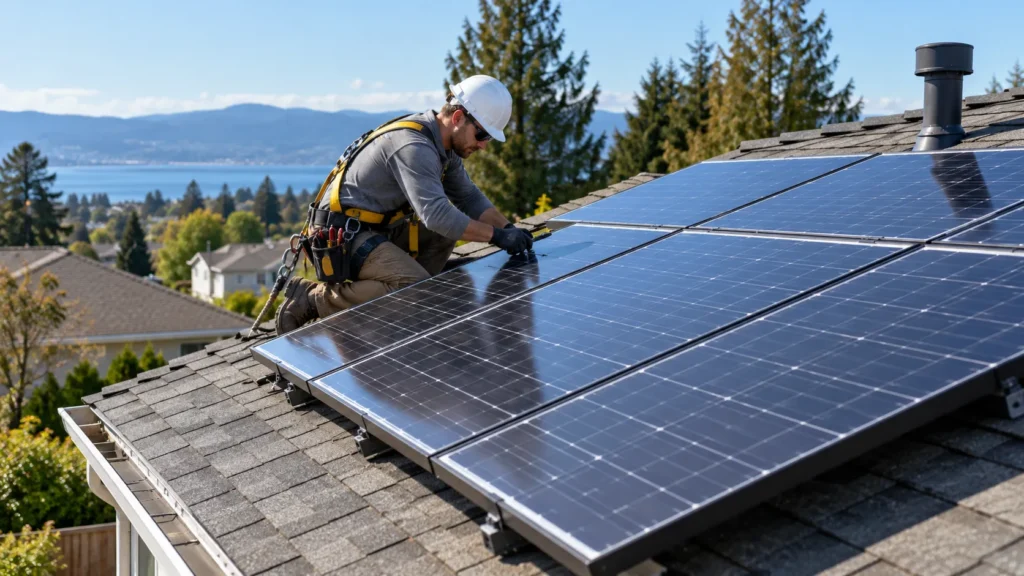
Most residential 5kW solar installations can be built using approximately 10 to 13 modern solar panels, depending on each panel’s rated wattage.
A higher-wattage panel produces more rated power, so fewer panels are needed to reach the target capacity.
The basic formula is:
Number of Solar Panels = Target System Wattage ÷ Individual Panel Wattage
Because panels must be installed in whole units, round up the result.
Solar Panels for a 5kW System
| Panel Wattage | Number of Panels | Actual DC Capacity |
|---|---|---|
| 400W | 13 | 5.20kW |
| 420W | 12 | 5.04kW |
| 450W | 12 | 5.40kW |
| 500W | 10 | 5.00kW |
These are mathematical configurations, not manufacturer-specific recommendations.
Example: Using 420W Solar Panels
Suppose you choose panels rated at 420 watts each.
5,000 ÷ 420 = 11.90 panels
Since you cannot install part of a panel, you would need 12 panels.
12 × 420W = 5,040W
Your finished solar array would have a rated capacity of 5.04kW DC.
In practice, the installer must also verify the inverter’s electrical limits, panel voltage, string configuration, and available mounting space.
Does More Panel Wattage Always Mean Better Performance?
Not necessarily.
Higher-wattage panels can reduce the number of modules needed, but their physical dimensions may also be larger.
A properly designed array using slightly lower-wattage panels can perform well if the roof has enough space and suitable sunlight.
The better choice depends on total installed cost, panel efficiency, warranty coverage, roof layout, and expected electricity production.
How Much Roof Space Does a 5kW Solar System Require?
A 5kW rooftop solar installation needs enough usable space for its panels, mounting equipment, and required clearances.
The exact area depends on the dimensions and arrangement of the selected solar panels.
Example Roof Space Calculation
Suppose you are installing 13 solar panels, each occupying approximately 21 square feet.
13 × 21 = 273 square feet
The solar panels alone would occupy approximately 273 square feet.
However, this is not the same as the total roof area required.
Your installer may need additional room for:
Fire-access pathways and required roof setbacks
Chimneys, vents, skylights, and other obstructions
Spacing between separate panel groups
Roof edges and unsuitable mounting areas
Shaded or structurally unsuitable sections
A roof with 300 square feet of total area may not provide 300 square feet of usable solar installation space.
Does Roof Direction Matter?
Yes. Panel direction and tilt influence how much sunlight the array receives throughout the year.
In the Northern Hemisphere, south-facing panels often provide favorable annual solar exposure. However, east- and west-facing installations can also work well.
The ideal arrangement depends on the location, roof geometry, shading, and household electricity demand.
The U.S. Department of Energy’s Homeowner’s Guide to Solar recommends evaluating roof age, tree cover, and other property conditions before installing solar panels.
If your roof will need replacement soon, compare the cost of completing roofing work before the solar installation.
How Much Electricity Does a 5kW Solar System Produce?
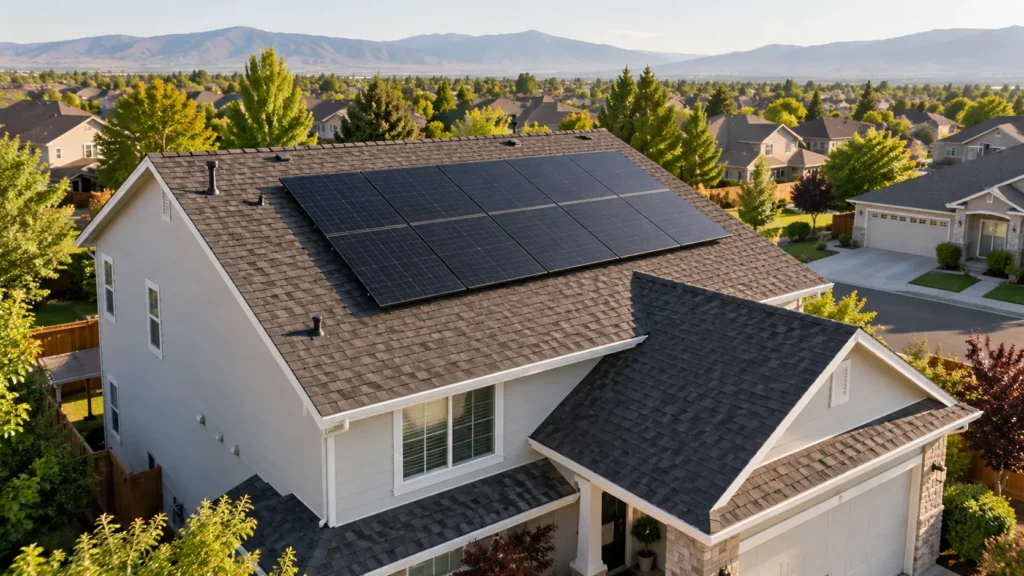
A 5kW solar power system can generate approximately 20 kWh per day, 600 kWh per month, or 7,300 kWh per year under a simplified example with five daily peak sun hours and an overall performance factor of 80%.
These figures are illustrative, not guaranteed production levels.
Actual generation depends heavily on geographic location, seasonal weather, shading, and system design.
Daily, Monthly, and Annual Solar Production
The following table uses three hypothetical sunlight scenarios.
| Average Daily Peak Sun Hours | Daily Production | Average Monthly Production | Annual Production |
|---|---|---|---|
| 4 hours | 16 kWh | 487 kWh | 5,840 kWh |
| 5 hours | 20 kWh | 608 kWh | 7,300 kWh |
| 6 hours | 24 kWh | 730 kWh | 8,760 kWh |
Calculation assumptions: 5kW DC array, 80% overall performance factor, 365 days per year, and no additional shading or orientation penalties beyond the simplified performance assumptions.
Monthly values are annual totals divided by 12. Actual calendar months will produce different amounts.
How to Calculate Solar Electricity Production
A simple planning formula is:
Daily Solar Production (kWh) = Solar Capacity (kW) × Peak Sun Hours × Performance Factor
For example:
5kW × 5 hours × 0.80 = 20 kWh per day
Annual generation:
20 × 365 = 7,300 kWh
Average monthly generation:
7,300 ÷ 12 = approximately 608 kWh
This calculation helps homeowners understand the relationship between system capacity, available sunlight, and energy losses.
What Are Peak Sun Hours?
Peak sun hours describe the daily amount of solar energy received, expressed as the equivalent number of hours at a sunlight intensity of 1,000 watts per square meter.
They are not the same as total daylight hours.
A location might experience 11 hours of daylight but receive the equivalent of only five peak sun hours of solar energy during that day.
Why Does Actual Solar Production Vary?
Solar output can change because of:
Clouds and seasonal weather
Panel temperature
Roof direction and tilt
Trees or nearby buildings
Dust, pollen, and other deposits
Inverter and wiring losses
Gradual equipment aging
For more accurate location-specific estimates, the National Renewable Energy Laboratory’s PVWatts Calculator models solar electricity production using location, equipment, and system parameters.
You can also use our Solar Production Calculator to compare different system sizes, sunlight conditions, shading assumptions, and expected annual output.
How Much Electricity Can a 5kW System Offset in an Average US Home?
A 5kW solar installation can offset a meaningful portion of household electricity purchases, but it will not necessarily eliminate the entire electric bill.
The U.S. Energy Information Administration reported that residential customers purchased an average of approximately 865 kWh of electricity per month in 2024.
That equals:
865 × 12 = 10,380 kWh annually
Source: U.S. Energy Information Administration — Residential Electricity Bills and Consumption.
EnergySage estimates average annual production of approximately 7,260 kWh for a 5kW system.
Comparing those figures:
7,260 ÷ 10,380 × 100 = approximately 70%
This means the modeled annual production of a 5kW system is equivalent to about 70% of the average US residential customer’s 2024 annual grid electricity purchases.
It does not mean every homeowner will reduce their utility bill by 70%.
Why Electricity Production and Bill Savings Are Different
A solar system may generate more electricity than your home needs during sunny afternoons but less than it needs at night.
If excess electricity is sent to the grid, the compensation depends on your utility’s export-credit or net-metering policy.
Some utilities credit exported solar energy differently from electricity purchased from the grid.
Minimum monthly charges, time-of-use rates, and other billing rules can also affect savings.
In addition, household electricity consumption varies widely. Homes with electric heating, swimming pools, electric vehicles, or high air-conditioning demand may require larger systems.
Before deciding on 5kW, review at least 12 months of electricity bills and estimate your actual annual consumption.
What Battery Size Is Suitable for a 5kW Solar System?
A 5kW solar system does not automatically require a particular battery size.
Solar capacity measures how much power the panels can generate under rated conditions. Battery capacity measures how much energy can be stored.
Your battery requirement depends on what you want to power, how long backup electricity is needed, and whether the system remains connected to the utility grid.
Example: Battery Backup for Essential Appliances
Suppose your essential appliances consume 8 kWh during a 24-hour outage.
Assume a battery with:
90% usable depth of discharge
90% battery-to-AC delivery efficiency
One day of backup without solar recharging
The minimum nominal battery capacity would be:
Battery Capacity = Required Energy ÷ (Usable Depth of Discharge × Delivery Efficiency)
8 ÷ (0.90 × 0.90) = 9.88 kWh
A battery with approximately 10 kWh of nominal capacity could meet this modeled energy requirement, subject to its actual specifications and additional design margins.
However, the battery must also supply enough instantaneous power to operate your chosen appliances. A battery with sufficient stored energy may still be unable to start a large air conditioner or other motor-driven equipment.
What About Whole-Home Backup?
Whole-home backup generally requires more storage than powering a few essential circuits.
For example, a home needing 20 kWh of delivered electricity over one day would require:
20 ÷ (0.90 × 0.90) = approximately 24.7 kWh of nominal storage
This is only an energy-capacity estimate. It does not establish the appropriate inverter rating, startup surge capability, or charging capacity.
Battery requirements may increase further if you want multiple days of backup during poor weather.
The U.S. Department of Energy’s Homeowner’s Guide to Solar explains how solar-plus-storage systems can store daytime electricity for later use and provide backup energy during outages.
Use our Solar Battery Calculator to estimate storage capacity based on daily electricity demand, backup duration, and battery chemistry.
5kW Grid-Tied vs Hybrid vs Off-Grid Solar Systems
Before purchasing equipment, decide how you want your solar installation to operate.
A 5kW array can be used with different system configurations, but each has different equipment, cost, and backup requirements.
| System Type | Grid Connection | Battery Requirement | Main Benefit |
|---|---|---|---|
| Grid-tied | Yes | Usually optional | Reduces grid electricity purchases |
| Hybrid | Yes | Optional, depending on configuration; needed for most stored-energy backup designs | Combines solar, grid electricity, and storage options |
| Off-grid | No | Generally required for nighttime and low-sunlight use | Supports independent electricity supply |
Grid-Tied Solar System
A grid-tied system connects your solar panels to the utility network.
During sunny periods, your home can use solar electricity directly. When production is insufficient, the utility supplies the difference.
Excess generation may be exported under the utility’s applicable rules.
A conventional grid-tied solar system normally shuts down during a utility outage for safety, unless it has specifically designed and approved backup capabilities.
This is often the simplest option for homeowners mainly interested in electricity-bill savings.
Hybrid Solar System
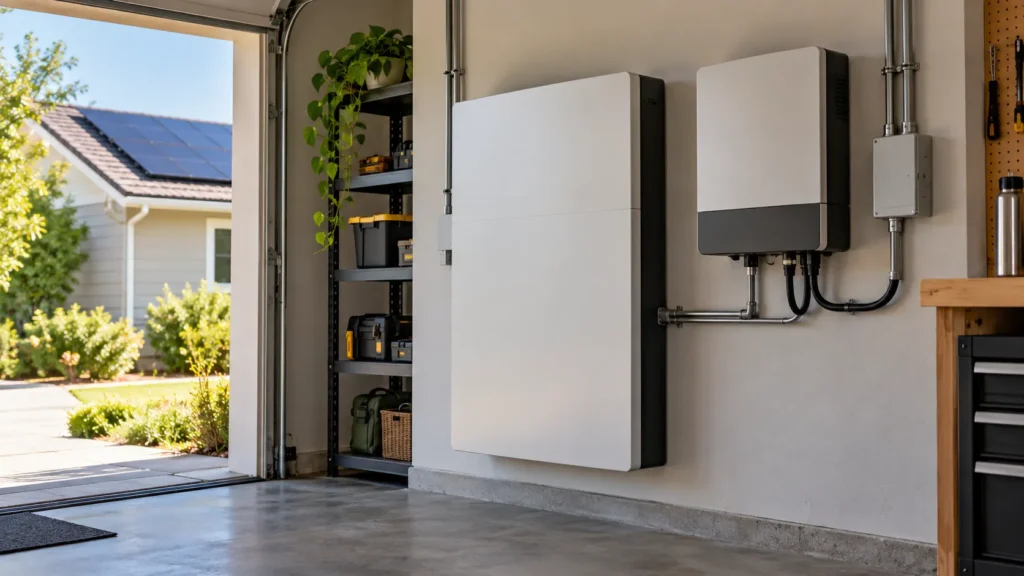
A hybrid system can combine rooftop solar, a utility connection, and compatible battery storage.
Depending on its design, it may store excess daytime electricity for use after sunset or during utility outages.
Not every hybrid inverter provides backup automatically. The installation may need a compatible battery, transfer or isolation equipment, and designated backup circuits.
Hybrid equipment generally adds complexity and may increase the total installation cost.
Off-Grid Solar System
An off-grid installation operates independently of the utility.
It must provide sufficient solar production, storage, and inverter capacity to meet electricity demand without relying on grid power.
A 5kW off-grid array may be enough for an energy-efficient cabin or a carefully managed household.
However, it may be undersized for a home with high winter electricity demand, electric heating, or several large appliances.
Off-grid design should use realistic low-sunlight-season conditions rather than annual average production alone.
Our Off-Grid Solar Calculator can help estimate solar array capacity, battery requirements, and inverter power for an independent system.
5kW Solar System Savings, Payback Period, and ROI
A 5kW solar installation may provide long-term financial benefits, but the results depend on installation cost, electricity prices, energy production, utility billing policies, and ongoing expenses.
A homeowner receiving full retail value for nearly all solar electricity will have different savings from someone receiving lower compensation for exported power.
How Electricity Rates Affect Savings
The U.S. Energy Information Administration’s electricity price data shows that the average US residential retail electricity price was approximately 18.16 cents per kWh during January–June 2026.
That is an average retail price, not a guaranteed financial value for each solar-generated kilowatt-hour.
To estimate realistic savings, homeowners should consider both electricity consumed directly and electricity exported to the grid.
Example: Annual Solar Savings
Consider a hypothetical homeowner with the following assumptions.
| Item | Example Value |
|---|---|
| Solar capacity | 5kW |
| Installation cost | $13,900 |
| Annual electricity production | 7,300 kWh |
| Effective blended electricity value | $0.15/kWh |
| Annual maintenance allowance | $100 |
| Assumed upfront incentives | $0 |
The effective blended value is an example that accounts conceptually for the possibility that some exported electricity receives less than the retail purchase rate. It is not a nationwide average.
Step 1: Calculate annual electricity value
7,300 × $0.15 = $1,095
Step 2: Subtract the maintenance allowance
$1,095 − $100 = $995
Under these assumptions, estimated first-year net savings would be approximately $995.
How Long Would the System Take to Pay for Itself?
Simple payback estimates how long it takes for annual net savings to equal the original installation cost.
Simple Payback = Installation Cost ÷ Annual Net Savings
$13,900 ÷ $995 = approximately 14 years
This illustrative system would have a simple payback period of approximately 14 years.
The estimate assumes a constant first-year annual savings amount. It does not model changing electricity prices, declining panel output, financing costs, or irregular repair expenses.
What About 25-Year Return on Investment?
For a more detailed illustration, keep the same $13,900 installation cost and $0.15 effective electricity value.
Now assume:
First-year production of 7,300 kWh
A hypothetical 0.5% annual decline in electricity output
A fixed electricity value of $0.15/kWh
A $100 yearly maintenance allowance
No incentives or financing expenses
Over 25 years, this simplified model produces approximately 171,958 kWh.
Estimated electricity value:
171,958 × $0.15 = approximately $25,794
Subtract 25 years of assumed maintenance:
$25,794 − $2,500 = $23,294
Subtract the initial investment:
$23,294 − $13,900 = approximately $9,394
Under these assumptions, the project produces approximately $9,394 in cumulative undiscounted net benefit over 25 years, equivalent to about 68% of the original upfront investment.
This is a scenario calculation, not a forecast of guaranteed returns. It excludes financing, inflation, the time value of money, possible inverter replacement, insurance changes, additional repairs, and other expenses. Actual results may be considerably different.
To compare your own installation price, electricity rates, production, maintenance assumptions, and potential incentives, use the Solar ROI Calculator.
US Solar Incentives and Tax Considerations in 2026
Solar incentives can affect installation affordability, but homeowners must use the rules that apply to their actual installation date and location.
Is the 30% Federal Solar Tax Credit Available in 2026?
No. The former federal Residential Clean Energy Credit under Internal Revenue Code Section 25D is not available for new residential solar installations completed after December 31, 2025.
The IRS confirms that the 30% credit applied to eligible residential clean energy property installed from 2022 through December 31, 2025.
Under the law enacted in July 2025, the credit ended for expenditures treated as made after December 31, 2025.
The IRS also clarifies that paying for solar equipment in 2025 does not preserve eligibility when the original installation is completed in 2026.
Sources: IRS Residential Clean Energy Credit guidance and IRS FAQs on changes to residential energy credits.
Homeowners should not subtract a 30% federal residential tax credit from the quoted price of a new system completed in 2026.
Are State and Local Solar Incentives Still Available?
Some state, local, and utility programs may still provide financial benefits.
Depending on the location and program, these can include:
State or local solar rebates
Certain state tax incentives
Property tax exemptions
Solar renewable energy certificate programs
Utility-specific solar programs
Compensation for electricity exported to the grid
Availability, eligibility, and financial value vary by jurisdiction. Programs can also change or close.
The Database of State Incentives for Renewables & Efficiency (DSIRE) is a useful resource for researching renewable energy incentives and policies across the United States.
Before signing a contract, verify applicable programs with your state energy office, utility, or qualified tax professional.
Do not assume that an incentive mentioned in an older solar article remains available in 2026.

5 Practical Tips for Planning a 5kW Solar System
A carefully planned system can perform better financially than a larger installation selected without considering the household’s actual needs.
1. Review Your Electricity Bills Before Choosing System Size
Start with your electricity consumption, not the number of panels a contractor recommends.
Add the kWh figures from your last 12 monthly electricity bills.
For example, if your home uses 7,800 kWh annually and a 5kW array is expected to generate approximately 7,300 kWh, the proposed system may be reasonably close to your annual energy demand.
However, the timing of consumption and your utility’s export rules still matter.
If you expect to purchase an electric vehicle or switch to electric heating, consider how those changes could affect future electricity needs.
2. Evaluate Roof Condition and Shading
Even a high-efficiency panel cannot produce its expected energy when sunlight is consistently blocked.
Ask your installer to evaluate shade from trees, chimneys, dormers, and nearby buildings.
The installer should also inspect roof condition and confirm whether the structure can accommodate the additional equipment.
If roofing work is likely within the next few years, consider the potential cost of removing and reinstalling the solar panels.
3. Compare Multiple Detailed Installer Quotes
Request estimates from more than one qualified solar installer.
Compare more than the final dollar amount.
A useful quotation should identify panel models, installed DC capacity, inverter type, expected annual production, warranties, installation labor, and relevant electrical work.
Ask whether the price includes permits, interconnection, monitoring equipment, and any required upgrades.
Also compare the cash price with the total cost of financing. A low advertised monthly payment does not necessarily mean the project is inexpensive.
4. Match Battery Storage to Your Actual Backup Needs
Do not buy a large battery simply because you are installing a 5kW solar array.
Identify which appliances you need during an outage and how long they must operate.
Refrigeration, internet equipment, lighting, medical equipment, and other essential loads may require much less energy than the entire home.
Check both usable battery capacity and continuous power output before choosing equipment.
5. Plan for Long-Term Performance and Ownership Costs
Solar ownership continues after installation.
Monitor electricity generation, review warranties, and allow for possible repairs or equipment replacement over the system’s useful life.
The U.S. Department of Energy reports that solar panels can remain operational for decades, although their output generally declines gradually over time.
For more information, read our guide on how long solar panels last on a roof.
You can also review our solar panel maintenance cost guide to understand common service expenses and maintenance planning.
Good planning should account for long-term performance, not just the initial installation price.
Frequently Asked Questions About 5kW Solar Systems
How much does a 5kW solar system cost in 2026?
EnergySage’s July 2026 marketplace data places the approximate average US installation price at $13,900 before incentives. Actual costs vary by state, equipment, roof conditions, labor, and installer. Battery storage and significant electrical upgrades can increase the total project price.
How many solar panels are needed for a 5kW system?
A system with approximately 5kW of DC capacity may need 13 panels rated at 400W, 12 panels rated at 420W, or 10 panels rated at 500W. The final number depends on the selected equipment and design.
How much power does a 5kW solar system produce per day?
Under an illustrative scenario with five peak sun hours and an 80% performance factor, a 5kW system generates about 20 kWh of electricity per day. Actual output varies by location, weather, equipment, and season.
Can a 5kW Solar System Run an Entire House?
It can supply a substantial portion of electricity for some homes, particularly smaller or energy-efficient households.
However, a 5kW system does not guarantee that every appliance can run simultaneously or that the home will have electricity overnight without grid power or storage.
Household electricity consumption, inverter capacity, and system configuration determine what the installation can support.
Is a 5kW Solar System Enough for Air Conditioning?
It may help power an air conditioner during sunny periods, but suitability depends on the air conditioner’s electrical demand and the other appliances operating at the same time.
Large central air-conditioning systems can consume considerable electricity and may require substantial startup power.
For reliable backup operation, the inverter and battery must also be capable of supporting the required load.
How Much Roof Space Do I Need for 5kW of Solar Panels?
There is no universal measurement because panel sizes and roof layouts differ.
As an example, 13 panels measuring 21 square feet each occupy approximately 273 square feet before additional roof clearances and layout restrictions.
A professional roof assessment is needed to confirm available installation space.
Can a 5kW Solar System Work During Winter?
Yes. Solar panels can generate electricity during winter whenever sufficient sunlight reaches them.
However, shorter days, snow coverage, and seasonal weather can reduce production.
In some conditions, cooler temperatures can improve photovoltaic efficiency, but that does not necessarily compensate for reduced sunlight.
For more accurate winter expectations, compare monthly solar production estimates for your location instead of relying on an annual average.
Do I Need a Battery With a 5kW Solar System?
Not necessarily.
A standard grid-connected installation can operate without batteries by using solar electricity when available and drawing additional energy from the utility.
A battery becomes useful when you want stored electricity for nighttime use, backup power, or specific electricity-rate management strategies.
How Long Does a 5kW Solar System Last?
Solar panels can operate for several decades, with output generally declining gradually over time.
The inverter, battery, and other supporting components may have different service lives and warranty periods.
Long-term performance depends on equipment quality, installation, environment, and maintenance.
Is a 5kW Solar System Worth It in 2026?
It can be worthwhile when installation costs are reasonable, the property receives sufficient sunlight, and solar electricity has meaningful value under the local utility’s billing rules.
However, the end of the federal residential solar tax credit makes accurate financial planning especially important for new installations completed in 2026.
Compare actual quotes, expected production, potential incentives, and long-term ownership costs before deciding.
Final Thoughts: Is a 5kW Solar System Right for Your Home?
A 5kW solar system can be a sensible choice for US homeowners who want to reduce grid electricity purchases without installing a much larger array.
With modern solar panels, the system typically requires around 10–13 modules. Under favorable planning assumptions, it may produce approximately 7,300 kWh annually, although the real output depends on the property and local sunlight conditions.
Installation prices also vary. EnergySage’s 2026 marketplace data provides a reference of approximately $13,900 before incentives, but homeowners should compare actual local quotes.
The most important step is to match the system to your electricity consumption, usable roof space, and financial goals.
Before committing, estimate your expected output, check local utility policies, compare installation offers, and calculate your likely payback period.
A good solar investment is not simply the one with the most panels. It is the one that fits your home, your energy needs, and your budget.
Disclaimer: Cost figures and external policy information reflect published sources reviewed in October 2026. Calculations are illustrative planning examples, not guaranteed production, savings, tax outcomes, or professional engineering advice. Solar equipment selection and electrical installation should be reviewed by qualified professionals.