- Solar Guides
Solar Panel Maintenance Cost in 2026: 5 Smart Ways to Save
Solar panel maintenance cost is an important part of owning a home solar system, but it is often much lower than homeowners expect. Most residential solar panels need little routine attention. The biggest expenses tend to come from optional professional cleaning, system inspections, or occasional equipment repairs.
In the United States, professional solar maintenance services can cost around $390 to $720 per year, according to Angi’s 2026 pricing guide. However, that does not mean every homeowner needs to spend that amount annually. Some households spend very little in a normal year, especially when rainfall keeps the panels reasonably clean and the system continues operating normally.
This guide explains current US maintenance prices, when different services are necessary, how to budget for future repairs, and what those costs mean for your long-term solar savings.

How Much Does Solar Panel Maintenance Cost Per Year?
The cost depends on your solar system, location, roof accessibility, and whether you purchase a service plan or pay only when work is needed.
Here are published US pricing estimates for common services.
| Service | Estimated US Cost | When You Might Need It |
|---|---|---|
| Professional maintenance plan | $390–$720 per year | Optional ongoing service coverage |
| Professional solar panel cleaning | $150–$500 per visit | When dirt or debris affects performance |
| Solar system inspection | $150–$350 per visit | Scheduled or issue-based evaluation |
| Solar inverter replacement | $800–$5,000 | Occasional equipment replacement |
Sources: Angi maintenance pricing, HomeGuide cleaning costs, Angi inspection costs, and Angi inverter pricing.
These are broad pricing ranges rather than guaranteed local quotes. Service packages can already include cleaning or inspection, so avoid adding every row together when estimating your budget.
Does Every Homeowner Need an Annual Maintenance Plan?
No. Many residential solar systems operate for years without regular professional servicing.
The most useful routine task is monitoring electricity generation to identify unexpected drops. Some homeowners also arrange occasional inspections, particularly after severe weather or when an inverter reports a fault.
A paid maintenance plan may be worthwhile for a complex system, a difficult-to-access roof, or a homeowner who prefers professional support. But you should first check whether your installer already provides monitoring, inspection, or service visits under the existing agreement.
Solar Panel Cleaning Cost in 2026
Professional solar panel cleaning generally costs $150 to $500 per visit, with HomeGuide also reporting approximately $10 to $20 per panel.
For example, a contractor charging $15 per panel would quote $300 for a 20-panel system, before any minimum callout fee or access-related charges.
Cleaning prices are influenced by:
Number and arrangement of panels
Roof height, slope, and accessibility
Local labor rates
Dust, pollen, bird droppings, and other deposits
Whether specialized access equipment is required

How Often Should Solar Panels Be Cleaned?
There is no universal cleaning schedule that applies to every home.
In areas with regular rainfall, tilted panels may remain reasonably clean without scheduled washing. Dry, dusty environments can require closer attention.
Homeowners in Arizona, Nevada, and similar climates may experience dust accumulation, while homes near agricultural land or heavy tree pollen can encounter different cleaning problems.
The National Renewable Energy Laboratory found that rainfall did not completely remove pollen deposits at certain solar installations in North Carolina. That research concerned utility-scale sites, so its measured production losses should not be assumed for every residential roof.
Read the NREL research on rainfall, pollen, and solar panel performance.
The best approach is to monitor output, inspect from a safe location, and arrange professional cleaning when conditions justify it.
Solar Panel Inspection Cost
A professional solar system inspection typically costs approximately $150 to $350, according to Angi’s 2026 estimates.
Depending on the service, an inspection may include checking:
Visible panel damage and mounting components
Inverter operation and fault notifications
Electrical connections and protective equipment
System monitoring records
Signs of moisture intrusion, corrosion, or physical damage
Detailed thermal imaging, electrical diagnostics, or difficult roof access may cost extra.
A regular inspection schedule can be helpful, but its frequency should reflect the system’s age, service history, warranty conditions, and installer recommendations.
If your system shows an unexplained decline in output, obtain a professional assessment rather than assuming that cleaning will solve the problem.
Solar Inverter Repair and Replacement Costs
Solar panels are designed for long service lives, but their supporting equipment may need attention sooner.
The inverter is especially important because it converts the direct-current electricity produced by solar panels into usable alternating-current electricity.
According to Angi, inverter replacement costs can range from about $800 to $5,000, depending on inverter type, size, installation requirements, and other factors.
A system using a central string inverter may have different repair costs and warranty terms from one using microinverters.
Before paying for replacement, check:
Whether the product warranty is still active
Whether labor is covered
Whether the original installer provides service
Whether the problem can be repaired
Whether a compatible replacement is available
A warranty covering replacement hardware does not necessarily cover all labor, shipping, or access costs.
Important: Inverter replacement is a possible long-term ownership expense, not an annual maintenance charge.
What Affects Solar Panel Maintenance Costs?
Several conditions explain why homeowners with similar solar systems may face different bills.
1. System Size and Panel Count
A larger array can require more cleaning time and additional inspection work. Contractors may charge by the panel, by the visit, or by the complexity of the installation.
2. Roof Height and Accessibility
A ground-mounted system or an easily accessible single-story roof may cost less to service than panels installed on a steep, multi-story roof.
3. Climate and Local Conditions
Dust storms, pollen, nearby construction, bird activity, and coastal deposits can increase the need for cleaning. Regular rainfall may reduce the need in some locations but cannot guarantee that all deposits disappear.
4. Equipment Age and Warranty Coverage
Older systems may face a greater likelihood of component servicing. An active manufacturer’s warranty can reduce some repair expenses, depending on its terms.
5. Maintenance Contract Terms
An annual plan may combine monitoring, inspection, and cleaning. Compare the services actually included rather than selecting a package solely on its advertised yearly price.

Solar Panel Maintenance Cost Over 25 Years
An annual maintenance estimate does not tell the whole story.
A solar system may have low expenses for several years and then require a more expensive repair. For long-term financial planning, it is useful to estimate both recurring services and occasional replacements.
Example: A 6 kW Home Solar System
Consider a hypothetical homeowner who chooses the following 25-year maintenance schedule.
| Expense | Assumption | 25-Year Cost |
|---|---|---|
| Professional cleaning | 12 visits at $250 | $3,000 |
| Professional inspection | 8 visits at $200 | $1,600 |
| Inverter replacement | One event at $2,000 | $2,000 |
| Total estimated cost | $6,600 |
Average annualized maintenance and replacement allowance:
$6,600 ÷ 25 = $264 per year
This example is a planning scenario, not a prediction that these exact services will be needed. Actual frequency and replacement costs can differ. It also excludes inflation, insurance changes, financing, roof repairs, and unexpected major failures.
A homeowner with minimal service needs may spend less. One requiring repeated cleaning or additional repairs may spend more.
What About National Solar Maintenance Benchmarks?
The National Renewable Energy Laboratory’s residential PV modeling has used operation-and-maintenance assumptions measured in dollars per installed kilowatt per year.
For example, its published model reports a 2023 base-year fixed O&M benchmark of $30 per kW per year.
For a 6 kW installation:
6 kW × $30 = $180 per year
This is an analytical cost-model input that can include several expense categories. It is not a current 2026 contractor quote or a guaranteed bill for a homeowner.
See the NREL residential PV cost benchmark.
Is Professional Solar Panel Cleaning Worth the Cost?
Cleaning can improve output when dirt or other deposits are blocking sunlight. However, paying for cleaning does not always generate enough extra electricity to recover the cleaning fee quickly.
Consider this hypothetical example:
Annual clean-panel generation: 9,000 kWh
Electricity value: $0.18 per kWh
Energy production affected by dirt: 3%
Professional cleaning cost: $250
Potential annual electricity value affected by dirt:
9,000 × 3% × $0.18 = $48.60
If cleaning recovers only that amount of annual production, the $250 service would not pay for itself through one year’s added generation.
This does not mean cleaning should never be performed. Deposits can create longer-term performance concerns, and the actual loss may be larger or smaller.
Instead, compare the expected improvement, local electricity value, system condition, and contractor price before committing to frequent cleaning.
A qualified installer can help determine whether a low-output problem is caused by dirt, shading, weather, equipment faults, or another issue.
How Maintenance Expenses Affect Solar ROI
Maintenance costs reduce the net financial benefits of a solar investment.
A simple calculation is:
Net Annual Solar Savings = Annual Electricity Bill Savings − Annual Maintenance Allowance
Suppose your solar system saves $1,650 on electricity each year and your long-term average maintenance and replacement allowance is $264.
$1,650 − $264 = $1,386 in estimated annual net savings
This illustration excludes financing, taxes, depreciation, changes in electricity prices, and the timing of individual repair bills.
You can use our Solar ROI Calculator to estimate potential electricity savings and payback. Remember that the current calculator does not automatically subtract maintenance expenses, so account for those separately.
If you are still budgeting for a new installation, try the Solar Cost Calculator to estimate upfront system costs before adding a realistic long-term maintenance allowance.
For roof-related installation expenses, the Solar Installation Cost Calculator can provide another starting estimate.
How to Reduce Solar Panel Maintenance Expenses
A sensible maintenance routine focuses on detecting problems early without paying for unnecessary services.
Monitor Solar Production
Check the manufacturer’s monitoring app and compare electricity generation with similar seasons in previous years.
Short-term changes can occur because of weather. A persistent, unexplained decline deserves further investigation.
Review Your Warranty Documents
Keep records of panel, inverter, installation-workmanship, and monitoring warranties. Check which services and labor costs are covered.
Avoid Unnecessary Cleaning
Do not automatically book multiple cleaning visits every year. Base decisions on local conditions, system performance, and installer guidance.
Hire Qualified Professionals
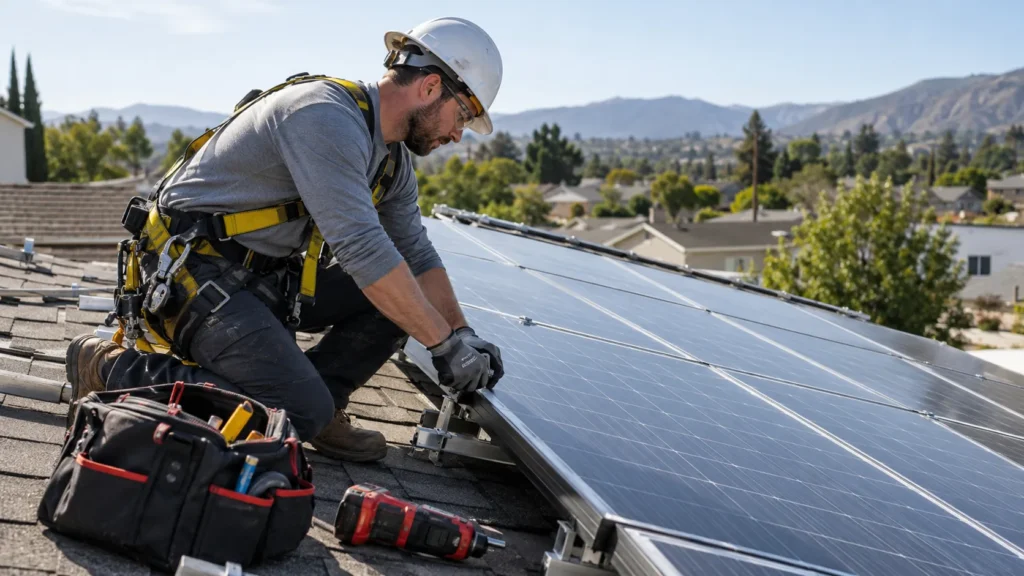
Roof access and solar electrical equipment create serious safety hazards. Do not walk on panels, open electrical enclosures, or attempt inverter or wiring repairs without appropriate professional qualifications.
Follow the manufacturer’s cleaning instructions and ask a professional about safe access methods.
Compare Service Quotes
Request written quotes describing the work, travel charges, inspection scope, repair parts, and warranty coverage.
For more background on maintenance procedures, see the US Department of Energy’s solar operations and maintenance guidance.
Frequently Asked Questions
How much does solar panel maintenance cost per year?
Professional maintenance plans commonly cost several hundred dollars annually, with Angi reporting $390–$720 in its 2026 pricing guide. Actual homeowner spending may be much lower when paid service is not needed every year.
Do solar panels need maintenance every year?
Solar systems benefit from ongoing performance monitoring, but not every residential installation requires annual professional cleaning or an annual paid service visit. Follow manufacturer guidance and investigate unusual performance changes.
How much does it cost to clean 20 solar panels?
At an illustrative rate of $10–$20 per panel, cleaning 20 panels would cost approximately $200–$400. Local labor rates, roof accessibility, and minimum service fees can affect the final quote.
How often should rooftop solar panels be inspected?
There is no single schedule for every installation. Consider the manufacturer’s recommendations, warranty requirements, system age, weather exposure, and any fault notifications when deciding how often to arrange professional inspections.
Do solar panel warranties cover maintenance?
Not always. Product warranties generally have specific terms for defects or equipment failures. Routine cleaning, labor, shipping, and other service expenses may be excluded. Review the actual warranty agreement.
Can rain clean solar panels?
Rain can remove some loose dust, but it may not remove sticky pollen, bird droppings, or accumulated mineral deposits. Cleaning needs vary by location and contamination type.
How much should I budget for solar maintenance over 25 years?
There is no universal amount. Consider occasional cleaning, inspections, potential inverter replacement, and an allowance for unexpected repairs. The hypothetical example in this guide totals $6,600 over 25 years, but real ownership expenses can be substantially different.
Final Thoughts: Budget for Maintenance Without Overpaying
Solar panel maintenance cost is generally manageable, and many residential systems require relatively little hands-on attention during normal operation.
The key is to distinguish routine monitoring from paid maintenance, optional cleaning, and major equipment replacement.
Before buying a service plan, review your installation warranty, monitor electricity generation, consider local weather conditions, and compare professional quotes.
For a realistic financial forecast, include a maintenance allowance alongside your installation cost and expected electricity savings.
Disclaimer: Prices are published US market estimates as of 2026 and vary by location and provider. Examples are illustrative calculations, not individualized engineering, electrical, or financial advice. Always consult qualified professionals for electrical maintenance and repairs.