- Solar Battery Calculator
Solar Battery Calculator
Use our free solar battery calculator to estimate the battery storage needed for your home, solar setup, or backup power system. Enter your daily electricity use, backup duration, and battery type to get a practical battery bank estimate.
- Free to use
- Lithium & Lead-Acid
- Instant estimate
Battery Bank Calculator
Estimate battery storage for your daily energy needs and backup duration.
Your Battery System
Preliminary sizing estimate
Planning estimate only. Lead-acid examples use 12 V / 100 Ah (1.20 kWh) modules; LiFePO4 examples use 12.8 V / 100 Ah (1.28 kWh) modules. Confirm nominal voltage, series/parallel limits, inverter losses, BMS compatibility and equipment specifications before purchase. Cost estimates are illustrative, not live prices.
How to Use the Calculator
Estimate your solar battery storage in three simple steps using your energy needs and preferred battery settings.
STEP 01
Enter Your Daily Energy Use
Enter the electricity your batteries need to supply each day in kilowatt-hours (kWh). Focus on the appliances you want to keep running during an outage. If you are unsure, estimate their power use and daily operating hours first.
STEP 02
Choose Your Battery Settings
Select how many days you need backup power without recharging. Then choose LiFePO4 or lead-acid batteries and your preferred voltage class. The calculator applies different efficiency and depth-of-discharge assumptions based on the selected battery chemistry.
STEP 03
Review Your Battery Estimate
Check the recommended nominal storage, amp-hour capacity, example battery count, and installed capacity. You will also see an illustrative module cost range. Compare these estimates with actual battery specifications before selecting equipment for your solar or backup system.
Understanding Your Results
Learn what each result means so you can choose battery storage that suits your electricity needs and backup goals.
Minimum Battery Capacity (kWh)
Shows the minimum nominal energy capacity required for your selected backup period. The estimate accounts for battery efficiency and usable depth of discharge. This is the battery’s rated storage requirement, not the amount of electricity available after all operating losses.
Battery Bank Capacity (Ah)
Converts the required battery energy into amp-hours using the selected battery bank voltage class. This helps compare battery configurations, but amp-hours alone do not describe total storage. Always check both the battery’s actual nominal voltage and its rated energy capacity.
Example Battery Module Count
Estimates the number of 100 Ah batteries needed to meet your storage requirement. The calculator rounds the count to complete series groups for the selected voltage class. Actual battery configurations depend on manufacturer-approved series and parallel connections.
Rounded Installed Capacity
Shows the total nominal storage of the example battery modules after rounding up to a valid series-group count. This can be higher than the minimum calculated requirement. Confirm usable energy, discharge limits, and installation compatibility before choosing a physical battery bank.
Illustrative Battery Cost (USD)
Estimates a battery-module cost range using example per-module prices for the selected battery chemistry and required storage capacity. This is a preliminary budget estimate, not a live market quote or complete installation cost. Actual prices depend on battery quality, capacity, brand, location, wiring, electrical protection, installation labor, and supplier pricing. Additional equipment and local requirements may increase the total project cost.
How Solar Battery Sizing Works
A solar battery calculator helps estimate the energy your battery bank must store to power selected appliances when solar charging or grid electricity is unavailable.
Battery sizing starts with daily energy consumption and the number of backup days. Then it accounts for the usable portion of the battery and the modeled delivery efficiency.
Battery Bank Sizing Formula
Minimum Nominal Battery Capacity (kWh) = Daily Energy Use × Backup Days ÷ (Battery Efficiency × Usable Depth of Discharge)
To estimate amp-hours:
Battery Capacity (Ah) = Nominal Battery Energy (Wh) ÷ Actual Nominal Bank Voltage (V)
Practical Battery Sizing Example
Suppose your home needs 10 kWh per day and you want 2 days of backup.
For the calculator’s LiFePO4 assumptions:
Daily energy requirement: 10 kWh
Backup duration: 2 days
Battery efficiency: 95%
Usable depth of discharge: 90%
10 × 2 ÷ (0.95 × 0.90) = 23.39 kWh
You need approximately 23.39 kWh of nominal battery capacity before rounding to example battery modules.
Using 12.8 V, 100 Ah LiFePO4 modules, a 48 V-class configuration in this model requires 20 modules, providing 25.60 kWh of nominal installed storage.
These figures use the calculator’s example assumptions. Real batteries may have different voltage, capacity, efficiency, and approved wiring limits.
Daily Electricity Consumption: Your daily energy demand determines how much electricity the batteries must deliver. Include essential appliances, nighttime use, and standby consumption. A more accurate load estimate reduces the risk of choosing a battery bank that cannot cover your needs.
Backup Duration: Backup duration is the length of time your system must operate without recharging. One day requires less stored energy than three days at the same electricity demand. Longer autonomy increases battery capacity requirements and often raises system costs.
Depth of Discharge: Depth of discharge describes how much of a battery’s rated capacity you plan to use. The calculator assumes different usable limits for LiFePO4 and lead-acid batteries. Actual recommended limits depend on the manufacturer, battery condition, and operating requirements.
Battery Efficiency: Not all stored electrical energy can be delivered without losses. The calculator uses a battery-efficiency assumption for each chemistry. Inverter losses, cold temperatures, battery aging, and other operating conditions may require additional capacity beyond the displayed estimate.
LiFePO4 vs Lead-Acid Batteries
LiFePO4 Battery Storage
LiFePO4 batteries generally support a higher usable depth of discharge and often provide longer cycle life than conventional lead-acid batteries. They commonly require compatible battery management systems and charging equipment. The purchase cost may be higher, depending on product quality and capacity.
Lead-Acid Battery Storage
Lead-acid batteries can have a lower initial purchase price, but typically offer less usable capacity at the same nominal storage rating. Battery life and performance depend on discharge depth, temperature, charging quality, and maintenance. Installation requirements vary by battery construction.
How a Solar Battery System Works
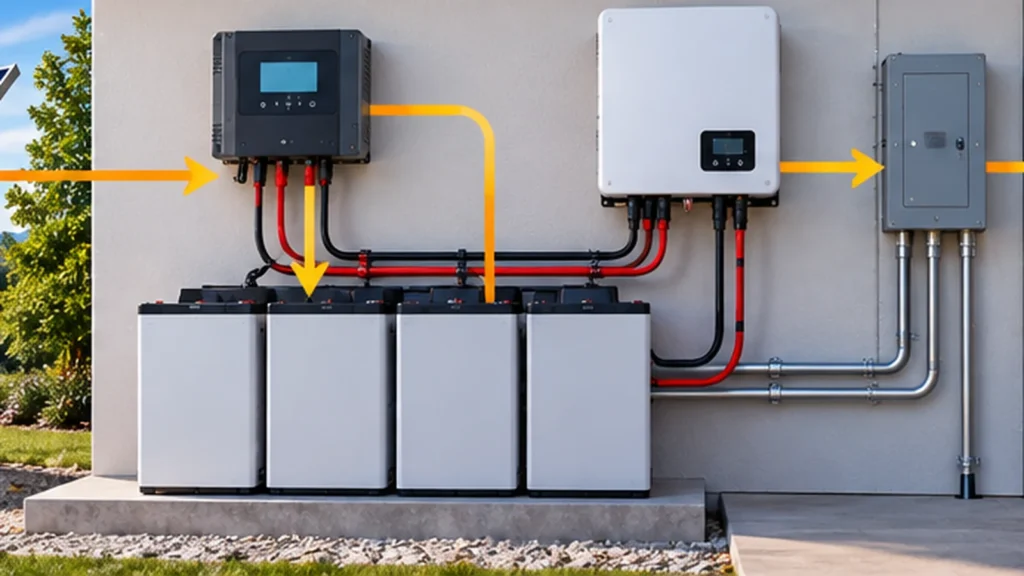
Solar panels generate electricity during daylight hours. A compatible charge controller or hybrid inverter manages battery charging, while the battery stores energy for later use.
1. Solar Panels
Capture sunlight and generate DC electricity.
2. Charge Controller
Regulates solar charging to protect the battery.
3. Battery Bank
Stores electrical energy for later use.
4. Solar Inverter
Converts DC electricity into usable AC power.
5. Household Loads
Use electricity to operate household appliances.
The exact system arrangement depends on the inverter architecture, battery type, and whether the installation is off-grid, hybrid, or grid-connected.
Useful resource: Learn how battery storage works with solar panels in the U.S. Department of Energy’s Solar Energy and Storage Guide.
Frequently Asked Questions
How do I calculate solar battery capacity?
Start with the electricity your battery must supply each day in kWh. Multiply it by the required backup days. Then divide by the assumed battery efficiency and usable depth of discharge. The result estimates the minimum nominal storage capacity before rounding up to available battery modules.
How many solar batteries do I need for my home?
The number depends on daily electricity use, desired backup duration, battery capacity, and system voltage. For example, a 48 V-class battery bank may use several modules connected in approved series and parallel groups. Always verify the actual battery specifications and connection limits.
Is LiFePO4 better than lead-acid for solar storage?
LiFePO4 often offers a larger usable capacity and longer cycle life, while lead-acid batteries may have a lower upfront cost. The better choice depends on budget, climate, maintenance needs, charging equipment, expected cycling, and whether the manufacturer permits your intended configuration.
What is the difference between kWh and Ah?
Kilowatt-hours measure stored energy, while amp-hours measure electrical charge. A battery’s energy capacity depends on both amp-hours and nominal voltage. For example, a nominal 48 V, 100 Ah battery bank stores approximately 4.8 kWh before considering discharge limits and energy losses.
How much battery storage is needed for two days?
Multiply the electricity your batteries must supply each day by two to find the required delivered energy. Then account for battery efficiency and usable depth of discharge. A home needing 10 kWh daily requires approximately 23.39 kWh nominal under the calculator’s LiFePO4 assumptions.
Does this calculator include inverter and installation costs?
No. The displayed cost range covers illustrative battery-module prices only. It does not include the inverter, installation labor, cabling, protective equipment, permits, or other system components. Actual battery performance also depends on inverter losses and equipment conditions not separately modeled here.
Related Solar Calculators
Explore these free tools to plan your solar energy system with more detailed estimates.
Estimate the solar panels, battery storage, and inverter capacity required for an independent solar power system. Use this tool to plan overall system size alongside your battery storage requirements.
Find typical appliance wattages and estimate daily electricity consumption before sizing an off-grid solar or battery system.
Estimate how much electricity your solar array may produce using system size, sunlight conditions, and performance assumptions.
Important: This calculator provides preliminary battery-sizing estimates, not a final electrical design. Confirm battery capacity, voltage compatibility, BMS requirements, discharge current, electrical protection, and manufacturer-approved connections with a qualified professional.