- Solar Guides
Solar Roof Tiles in 2026: Cost, Benefits & Are They Worth It?
Solar roof tiles offer a way to generate electricity without installing conventional solar panels above your roof. Instead of using large rack-mounted panels, these products incorporate photovoltaic technology into roofing materials, creating a cleaner and more integrated appearance.
They’re an appealing option for homeowners who want solar power without changing the architectural look of their house. However, solar roof tiles generally cost more than traditional solar panels, and the available products, installation requirements, and warranties can vary significantly.
For many homeowners, the biggest question is whether the premium appearance justifies the higher investment.
This 2026 guide explains how solar roofing works, what solar roof tiles cost in the United States, how they compare with standard solar panels, and what to consider before choosing a system.
What Are Solar Roof Tiles?
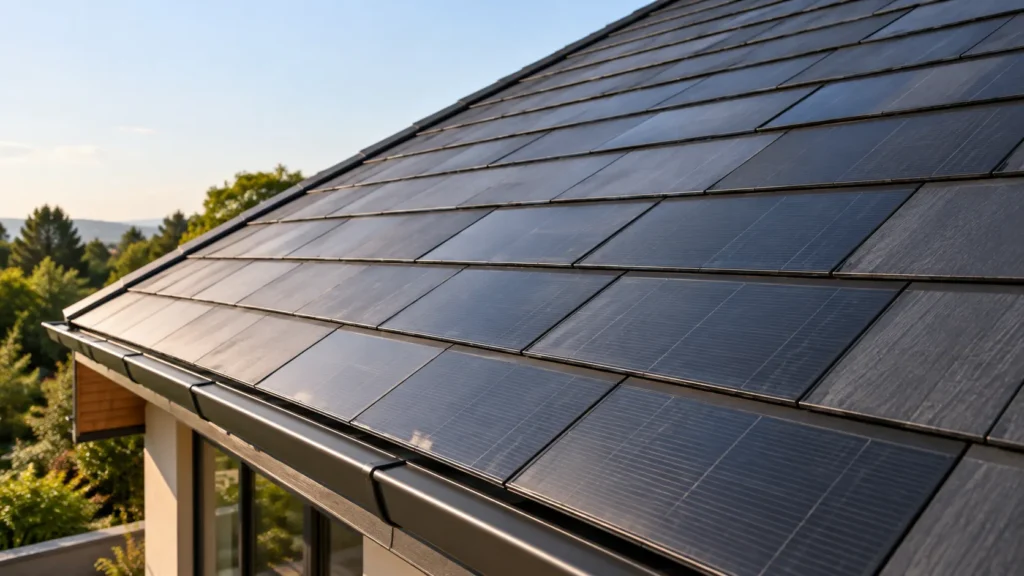
Solar roof tiles are roofing components designed to generate electricity from sunlight while forming part of a building’s roof covering.
They’re often called solar shingles, solar roofing tiles, or building-integrated photovoltaics (BIPV).
Unlike conventional solar panels mounted on rails above an existing roof, solar roof products are integrated into the roofing system itself.
Some products resemble regular asphalt shingles, while others use glass or tile-like materials to create a uniform roof appearance.
How Do Solar Roof Tiles Work?
The basic process is similar to conventional solar power generation.
Photovoltaic cells inside the solar tiles absorb sunlight.
The cells produce direct-current (DC) electricity.
Electrical connections carry the generated power to the inverter system.
The inverter converts DC electricity into alternating-current (AC) electricity.
The electricity can power household appliances, reduce grid purchases, or be exported under applicable utility rules.
A compatible home battery may also be added for energy storage, depending on the system design.
The main difference is how the electricity-generating components are incorporated into the roof—not the basic physics of solar power.
Solar Roof Tiles vs Solar Panels: What's the Difference?
Both technologies convert sunlight into electricity, but their installation approach and project economics differ.
| Feature | Solar Roof Tiles | Traditional Solar Panels |
|---|---|---|
| Appearance | Integrated into roof design | Mounted above roof covering |
| Roofing function | Can form part of the weatherproof roofing system | Require an existing roof beneath them |
| Upfront cost | Generally higher | Usually lower |
| Installation | Specialized roofing and electrical work | More widely available solar installation process |
| Roof replacement | Often installed with new roofing | Usually installed on a serviceable existing roof |
| Power density | Depends on product; often lower | Often higher for comparable usable roof area |
| Product selection | More limited | Broad selection |
| Maintenance | Roofing and solar considerations | Solar equipment plus separate roof maintenance |
| Best fit | New roof projects and appearance-focused homeowners | Cost-focused homeowners with suitable existing roofs |
Which Option Produces More Electricity?
Neither technology produces a fixed amount of electricity simply because it is called a solar tile or a solar panel.
Actual generation depends on installed capacity, sunlight, orientation, shade, inverter performance, and system losses.
However, conventional rack-mounted panels often offer greater power capacity per square foot of usable roof area.
This can make regular solar panels a better choice when roof space is limited or the household has high electricity demand.
Solar tiles can still provide substantial electricity, but the roof layout and number of active energy-generating tiles are important.
Which Option Looks Better?
Appearance is subjective.
Solar roof tiles create a more uniform look because their active components blend into the roofing materials.
Traditional rooftop solar panels remain visible above the roof surface, although modern all-black panels and low-profile mounting systems can reduce their visual impact.
If aesthetics are your highest priority, integrated solar roofing deserves consideration. If initial price and maximum power output matter most, regular panels are often more practical.
How Much Do Solar Roof Tiles Cost in 2026?
The cost of solar roof tiles depends on the roofing system, installed solar capacity, roof area, project complexity, and manufacturer.
There is no universal nationwide price because many solar roofing companies provide custom quotes rather than publishing standard installed rates.
The financial comparison is also different from a normal solar installation: a solar roof may include a major roofing replacement that would otherwise be a separate project.
Traditional Solar Panel Cost Benchmark
According to EnergySage’s 2026 US marketplace data, conventional residential solar installations average approximately $2.60 per watt before incentives.
At that rate, the following prices provide useful solar-only benchmarks.
| Solar System Size | Illustrative Traditional Panel Cost |
|---|---|
| 5 kW | $13,000 |
| 6 kW | $15,600 |
| 8 kW | $20,800 |
| 10 kW | $26,000 |
| 12 kW | $31,200 |
Formula: Solar Capacity (kW) × 1,000 × $2.60/W
These estimates do not include a full roof replacement or optional battery storage.
Source: EnergySage — US Solar Panel Cost Data.
How Much More Expensive Are Solar Shingles?
Solar shingles frequently carry a substantial price premium over traditional rooftop panels.
In an earlier published comparison, EnergySage reported an approximate $45,000 price for a 10 kW CertainTeed solar shingle installation, compared with lower prices for conventional panels.
That figure is a published historical reference, not a verified October 2026 quote. Actual prices must be obtained from qualified installers.
See EnergySage’s Solar Shingles Guide.
Example: Comparing Two Solar Roofing Projects
Suppose a homeowner needs both a new roof and an 10 kW solar energy system.
Consider these illustrative estimates:
| Expense | Standard Roof + Solar Panels | Integrated Solar Roof |
|---|---|---|
| Roof replacement | $15,000 | Included in quoted project |
| 10 kW solar installation | $26,000 | Included in quoted project |
| Total project cost | $41,000 | $50,000 |
| Difference | $9,000 higher |
The $15,000 replacement roof and $50,000 integrated solar roof are hypothetical contractor quotes used to demonstrate the comparison method. They are not verified national average prices.
If both options deliver the same annual solar electricity value, the $9,000 difference is an architectural and roofing premium rather than an additional energy-saving investment.
That is why homeowners should compare the complete project—not a solar roof quote against a panel-only quote that excludes new roofing.
What Influences Solar Roof Tile Pricing?
The most important factors include:
Total roof area and complexity
Number of electricity-generating solar tiles
Roof slope, dormers, valleys, and penetrations
Existing roofing removal and structural work
Local labor and permitting expenses
Inverter and electrical upgrades
Battery storage and backup equipment
Warranty coverage and installer availability
Before accepting a quote, ask the installer to separate solar electrical equipment, ordinary roofing materials, labor, structural work, and optional storage wherever possible.
For preliminary budgeting, use our Solar Cost Calculator. Its installed cost assumptions are designed for conventional solar systems, so they should not be treated as automatic solar roof tile quotes.
Tesla Solar Roof vs GAF Timberline Solar
Two well-known approaches to integrated solar roofing are Tesla’s Solar Roof and GAF Energy’s Timberline Solar.
Both aim to reduce the visual difference between roofing and solar equipment, but their construction and installation approaches are different.
Tesla Solar Roof
Tesla Solar Roof uses roof-integrated glass tiles designed to combine weather protection and electricity production in a single roofing system.
Tesla’s US Solar Roof limited warranty effective March 4, 2026, specifies:
A 25-year product warranty, subject to terms
A 25-year weatherization warranty
A module output warranty that guarantees specified performance over time
However, warranty documentation does not by itself establish current product availability or installation pricing in every US location.
Homeowners should confirm whether Tesla Solar Roof installations are currently offered for their address and request an actual written proposal.
For detailed coverage, refer to the Tesla Solar Roof Limited Warranty.
GAF Timberline Solar ES 2
GAF Energy’s Timberline Solar ES 2 takes a different approach.
Its energy shingles are designed to be installed directly alongside compatible GAF roofing shingles, integrating solar generation with a familiar asphalt roofing system.
According to GAF’s published technical specifications, the ES 2 provides:
57 watts per energy shingle
A nominal shingle size of approximately 68.75 × 16.875 inches
A minimum specified roof pitch of 2:12
Integrated roof covering and solar functionality
The product is designed around specialized roofing installation rather than the separate mounting rails used by conventional solar panels.
Learn more from the official GAF Timberline Solar product page.
Tesla vs GAF: What Should You Compare?
| Consideration | Tesla Solar Roof | GAF Timberline Solar ES 2 |
|---|---|---|
| Solar design | Roof-integrated glass tile system | Nailable photovoltaic shingles |
| Roofing appearance | Glass-tile style | Integrated asphalt-shingle style |
| Published product details | Refer to current product and warranty documentation | 57 W per ES 2 energy shingle |
| Installation | Specialized system requirements | GAF-certified roofing approach |
| Pricing | Custom quote | Custom quote |
| Availability | Confirm locally | Confirm locally |
| Warranty | Product, weatherization and solar output provisions | Roofing, solar output and optional enhanced coverage |
Important: Neither product should be selected solely because of an advertised warranty duration. Compare the exact contract, roof protection, electronics, installation workmanship, and claim procedures.
How Many Solar Roof Tiles Do You Need?
The number of tiles depends on your desired solar system capacity and the rated output of each active tile.
It also depends on how much usable roof area is available.
Solar Roof Tile Sizing Formula
Number of Solar Tiles = Desired Solar Capacity in Watts ÷ Rated Watts per Tile
Round up to the next whole tile for a preliminary mathematical estimate.
Example: 8 kW Solar Roof
Using the GAF Timberline Solar ES 2’s published 57 W rating:
8,000 W ÷ 57 W = 140.35
Rounding up gives approximately 141 energy shingles.
At their rated power, 141 shingles would provide:
141 × 57 W = 8,037 W, or approximately 8.04 kW
This is a simplified rating calculation, not a complete roofing layout or electrical design.
Actual tile count and system capacity must account for roof measurements, solar exposure, permissible electrical configurations, transitions to non-solar shingles, and manufacturer specifications.
How Much Electricity Could an 8 kW Solar Roof Generate?
As a hypothetical planning example, assume:
System capacity: 8 kW
Average peak sun hours: 4.5 per day
Combined performance factor: 80%
Days per year: 365
Annual Energy = 8 × 4.5 × 365 × 0.80
Estimated annual production = 10,512 kWh
This model is useful for understanding the calculation, but it is not a local solar production forecast.
The 80% performance factor represents combined system losses and should not automatically be assumed for every solar shingle product.
Use our Solar Production Calculator for an initial energy estimate.
For a location-specific photovoltaic simulation, consult the official PVWatts Calculator, noting that its simplified modeling does not fully represent every solar roofing product’s thermal and installation characteristics.
5 Best Benefits of Solar Roof Tiles
Solar roofing offers several advantages, particularly for homeowners planning a roof replacement.
1. A Clean, Integrated Appearance
Solar tiles blend more closely with roof materials than conventional rack-mounted solar panels.
This can be particularly appealing for contemporary homes where the roof is a prominent architectural feature.
2. Roofing and Solar in One Project
Instead of installing a new roof and returning later to add rooftop solar panels, homeowners can plan both functions together.
This may simplify project coordination, although integrated installations still require careful roofing and electrical planning.
3. Potential Electricity Bill Savings
Solar roof tiles generate electricity that may reduce purchases from the grid.
The value of that energy depends on the homeowner’s consumption, local utility prices, export compensation, and the amount of solar electricity consumed directly.
4. Long-Term Roofing Design
Integrated solar roofing products are designed with both weather protection and energy generation in mind.
Depending on the manufacturer, the system may come with warranties covering roofing materials, water intrusion, and solar output.
However, the covered conditions and exclusions are just as important as the warranty period.
5. A Distinctive Home Upgrade
For owners already investing in premium roofing, solar tiles may provide a way to combine appearance, roof replacement, and electricity production.
The potential impact on property value depends on the local housing market, ownership arrangement, system performance, and buyer preferences. Increased resale value is not guaranteed.
Important Disadvantages of Solar Roof Tiles
The benefits are meaningful, but the trade-offs should be understood before purchase.
Higher Initial Investment
Integrated solar roofing usually costs more than adding standard panels to a roof that is already in good condition.
The total project can be especially expensive when the entire roof must be replaced.
Fewer Product and Installer Options
Conventional solar panels are widely available across the United States.
Solar shingle installation may be limited to particular products, qualified installers, and service regions.
Roof Layout Limitations
Dormers, skylights, chimneys, complex valleys, and heavily shaded roof sections can limit the area available for solar-generating tiles.
Possible Power-Density Disadvantages
Solar shingles can produce less electricity per usable square foot than high-efficiency conventional modules.
For homes with limited roof space, that may affect how much household electricity can be offset.
Specialized Repairs and Future Roof Work
If a roof-integrated component develops a fault, maintenance may involve coordinating roofing and electrical specialists.
Ask about future replacement-part availability and who will handle leaks, electrical repairs, and warranty claims.

Are Solar Roof Tiles Worth It in 2026?
Solar roof tiles can be worth considering, but the decision depends on your priorities.
They may be more attractive when:
You already need a complete roof replacement.
The integrated appearance is important to you.
Your roof design is compatible with the available products.
You can obtain qualified local installation and service.
The added price fits your long-term budget.
Traditional solar panels may be the better option when:
Your existing roof is in good condition.
You want to minimize upfront spending.
Your available roof area is limited.
You prioritize electricity production per dollar.
You want access to a wider choice of installers and equipment.
How to Estimate Solar Roof Savings
Start with the value of electricity that the installation can replace.
Annual Solar Electricity Value = Self-Consumed Energy × Avoided Electricity Rate + Exported Energy × Export Credit Rate
For example, suppose an 8 kW system produces 10,512 kWh annually, and the homeowner:
Uses 70% of solar production directly.
Exports the remaining 30%.
Avoids electricity purchases valued at $0.18/kWh.
Receives $0.06/kWh for exported electricity.
Self-consumed energy:
10,512 × 70% = 7,358.4 kWh
Direct electricity value:
7,358.4 × $0.18 = $1,324.51
Exported electricity:
10,512 × 30% = 3,153.6 kWh
Export credit value:
3,153.6 × $0.06 = $189.22
Total illustrative first-year electricity value: $1,513.73
This example excludes maintenance, financing, equipment replacement, taxes, utility fixed charges, and performance degradation.
It also assumes these tariff and production conditions remain applicable throughout the first year.
The key point is that a more expensive solar roof does not automatically generate more valuable electricity than a less expensive conventional system of comparable output.
For long-term financial comparisons, use the Solar ROI Calculator. Its assumptions can be adjusted for actual project cost, electricity value, degradation, and maintenance.
When comparing options, remember that part of a solar roof’s cost may relate to replacing the roof itself. Evaluate the roofing investment separately from the incremental cost of generating electricity.
Solar Roof Tiles and Federal Tax Credits in 2026
An important federal tax change affects residential solar installations in the United States.
The former Section 25D Residential Clean Energy Credit is not available for qualifying expenditures made after December 31, 2025.
The IRS also explains that paying for qualifying equipment before that deadline does not preserve the credit if the installation is completed afterward.
Therefore, homeowners planning a new solar roof installation in 2026 should not automatically deduct the former 30% federal residential solar tax credit from their project estimates.
Other state, local, utility, or commercial ownership incentives may have different rules.
Refer to the IRS guidance on the Section 25D termination.
Some manufacturer or third-party websites may still contain older references to federal solar incentives. Always verify their current eligibility before making a financial decision.
Solar Roof Installation: What Should Homeowners Check?
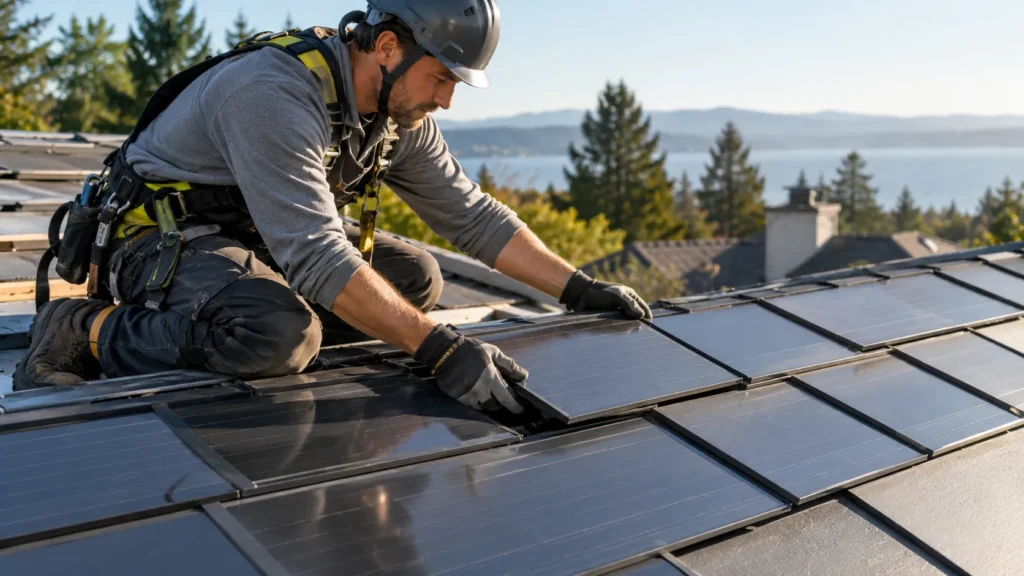
Solar roofing is both a building-envelope project and an electrical installation.
Before signing a contract, make sure your project has been evaluated for:
Roof Structure and Condition
A qualified professional should confirm that the proposed roofing system meets applicable structural requirements.
Roof slope, existing damage, framing, drainage, and local wind or snow loads may affect the installation.
Electrical Design
The installer should specify system capacity, inverter compatibility, circuit protection, grounding, shutdown requirements, and grid interconnection arrangements.
Roofing and Waterproofing
Ask how the system manages water around roof penetrations, valleys, edges, flashing, and transitions between solar and non-solar roofing materials.
Permits and Inspections
Confirm which contractor is responsible for obtaining permits, coordinating inspections, and receiving permission to operate from the utility.
Warranty Responsibilities
Understand whether roofing and solar warranties are handled by the same company or by separate providers.
For general guidance, see the US Department of Energy’s Homeowner’s Guide to Solar.
How Long Do Solar Roof Tiles Last?
Solar roof tile systems are typically designed for long-term outdoor use, and many products have warranties extending to approximately 25 years.
However, warranty coverage depends on the specific brand and product.
For example, Tesla’s March 2026 Solar Roof warranty includes separate provisions for product defects, weatherization, and module power capacity.
GAF provides distinct base warranty coverage and optional enhanced solar-related warranty packages.
Solar tiles may continue generating electricity after their warranty period ends, but that is not a guaranteed service life.
The roof’s condition, electrical equipment, weather exposure, and maintenance history all affect long-term performance.
For a deeper explanation of solar equipment lifespan, read our guide: How Long Do Solar Panels Last on a Roof?.
Frequently Asked Questions About Solar Roof Tiles
Are solar roof tiles better than solar panels?
Solar roof tiles offer a more integrated appearance and can be attractive during roof replacement. Conventional solar panels are generally less expensive and may provide greater output from limited roof space. The better option depends on your roof, budget, and priorities.
How much do solar roof tiles cost in 2026?
Costs vary widely depending on roof size, product, installed solar capacity, and labor. Many manufacturers use custom quotes rather than publishing fixed nationwide prices. Compare the full solar roof project with the cost of a new conventional roof plus separately mounted solar panels.
Do solar roof tiles replace normal roof tiles?
Many integrated products are designed to form part of the weatherproof roofing system. A completed roof may combine electricity-generating solar tiles with matching non-solar roofing materials.
Can solar shingles power an entire house?
Potentially, if the system has sufficient usable roof area, sunlight, and generating capacity. The required size depends on annual household electricity consumption, not simply the number of rooms or the home’s floor area.
Are solar shingles waterproof?
Solar roofing systems are engineered to provide weather protection when installed according to manufacturer requirements. Waterproofing depends on the complete approved roofing assembly, correct flashing, installation quality, and ongoing condition.
How long do solar roof shingles last?
Many solar shingle products are supported by warranties lasting around 25 years, although the individual product and coverage terms differ. Actual service life may be shorter or longer depending on environmental conditions and equipment performance.
Can you walk on solar roof tiles?
Do not assume solar tiles are safe to walk on. Walking on photovoltaic roofing can damage components or create serious fall and electrical hazards. Follow manufacturer instructions and leave inspection and repair work to qualified professionals.
Do solar roof tiles work during a power outage?
A typical grid-connected solar system may shut down during a utility outage for safety. Backup electricity generally requires a compatible inverter and appropriately designed storage or other approved backup equipment.
Are Tesla Solar Roof and GAF Timberline Solar the same?
No. They use different roofing designs, components, installation methods, and warranty structures. Compare current product specifications and local availability rather than assuming all integrated solar roofs perform the same way.
Can solar roof tiles be installed on an existing roof?
Many products are intended for new roofing or roof replacement rather than being mounted directly over an existing finished roof. Installation possibilities depend on the specific product and the condition of your current roof.
Is the 30% federal solar tax credit available in 2026?
The former Section 25D homeowner credit is not available for qualifying expenditures made after December 31, 2025. Other incentives may apply under different programs, so confirm eligibility with official sources.

Final Thoughts: Should You Choose Solar Roof Tiles?
Solar roof tiles offer a compelling combination of renewable electricity and integrated roof design, particularly for homeowners replacing an aging roof or building a new house.
Their biggest advantage is the ability to combine solar generation with roofing materials in a more seamless appearance.
Their biggest drawbacks are generally higher upfront costs, fewer installer options, and product-specific roof compatibility requirements.
For homeowners mainly interested in lower electricity bills and a shorter payback period, traditional solar panels will often remain the more economical choice.
Before making your decision, compare multiple written proposals, estimate your household’s electricity needs, review warranties, and evaluate total ownership costs.
Use these free SolarSizeCalc tools to begin planning:
Solar Cost Calculator — Estimate conventional solar installation expenses.
Solar Production Calculator — Explore solar electricity generation.
Solar ROI Calculator — Compare financial assumptions and payback.
Solar Installation Cost Calculator — Examine installation and roof-complexity costs.
Editorial disclaimer: This guide is for educational purposes. Published prices, product specifications, warranties, and incentives can change. The numerical examples are illustrative, not installer quotations or guaranteed financial outcomes. Consult qualified roofing, electrical, solar, and tax professionals before making project decisions.