- Solar Guides
Solar Panels for 1000 Sq Ft Home: Best Proven Tips (2026)
Solar panels for 1000 sq ft home installations are best sized using actual electricity consumption, not just the size of the house. For example, a home using 600 kWh per month may need approximately 14 solar panels rated at 400 watts each, creating a 5.6 kW solar system. This estimate assumes 4.5 peak sun hours per day and 80% overall system performance.
However, your home could need fewer or more panels depending on where you live, how much electricity you use, and how much sunlight reaches your roof.
If you’re considering solar for a smaller house, you probably have three questions: How many panels do I need? Will they fit on my roof? And how much will the installation cost?
This guide answers all three with realistic examples, straightforward calculations, and practical advice. You’ll also learn how to estimate your own requirements before speaking with a solar installer.
Solar Panels for 1000 Sq Ft Home: How Many Are Needed?
A 1,000-square-foot house might need anywhere from a small 3 kW system to an 8 kW or larger array, depending on its energy consumption. Rather than treating that range as a universal recommendation, the table below shows what different monthly electricity bills mean for solar sizing.
The estimates assume 400W solar panels, 4.5 daily peak sun hours, a 30-day month, and an 80% overall performance factor.
| Monthly Electricity Use | Required Solar Capacity | Number of 400W Panels |
|---|---|---|
| 300 kWh | 2.78 kW | 7 |
| 450 kWh | 4.17 kW | 11 |
| 600 kWh | 5.56 kW | 14 |
| 900 kWh | 8.33 kW | 21 |
These numbers are planning estimates rather than guarantees. A roof with significant shade or a location with fewer sunny hours could require more capacity to generate the same amount of electricity.
The most useful number in this table is your monthly electricity usage in kilowatt-hours (kWh).
You can find it on your utility bill. If you have the past 12 months of bills, calculate the average instead of relying on a single month.
For a quicker estimate, try our free Solar Size Calculator. You can enter your monthly kWh consumption, location, and panel preferences to explore different system sizes.
Why House Size Alone Cannot Determine Solar Requirements
Two households can occupy identical 1,000 sq ft homes and still have completely different electricity bills.
Imagine a house occupied by two adults who use efficient appliances, LED lighting, and a small air-conditioning unit. Their electricity consumption may be relatively modest.
Now consider another house of the same size. Four people live there, the air conditioner runs frequently, and the household uses an electric water heater, clothes dryer, and several computers.
The second household may consume considerably more electricity despite having the same floor area.
Solar requirements are influenced by:
Heating and cooling: Air conditioners, electric heating, and heat pumps can account for substantial electricity consumption.
Appliance efficiency: Older refrigerators and other appliances may use more energy than efficient replacements.
Occupancy: More people often means greater demand for hot water, lighting, and electrical equipment.
Daily routines: Working from home and using equipment during the day can change consumption patterns.
Future additions: Electric vehicles, heat pumps, and other planned upgrades may increase electricity demand.
Before choosing solar panels, look at the bigger picture. A home that consumes 350 kWh per month needs a different approach from one consuming 800 kWh.

How to Calculate Solar Panels for a 1000 Sq Ft Home
You can estimate the solar capacity your home requires using four simple steps.
Let’s work through an example using a household that consumes 600 kWh of electricity each month.
Step 1: Calculate Daily Electricity Consumption
Find the number of kilowatt-hours shown on your electricity bill.
For our example:
Monthly electricity consumption = 600 kWh
Divide by 30 days:
600 ÷ 30 = 20 kWh per day
This means the household consumes approximately 20 kilowatt-hours of electricity during an average day.
If your energy use changes significantly between summer and winter, calculate your daily average from a full year of electricity bills.
That will provide a more useful starting point for sizing your system.
Step 2: Estimate Peak Sun Hours
Peak sun hours describe the daily solar energy available at a location, expressed as an equivalent number of hours at standard peak sunlight intensity.
They are not the same as ordinary daylight hours.
For example, a location may experience more than 12 hours of daylight, but its daily solar energy could be equivalent to only 4.5 peak sun hours.
For this calculation, we’ll use:
Average peak sun hours = 4.5 per day
Your actual figure depends on local weather, seasons, and panel orientation.
A useful independent resource is the PVWatts Calculator, which estimates solar energy production using location and system information.
Step 3: Account for System Losses
Solar panels rarely deliver their full rated output throughout the day.
Real-world system performance is influenced by:
Solar panel temperature
Wiring and electrical losses
Inverter conversion efficiency
Dust and dirt accumulation
Shading and installation conditions
For our simplified calculation, we’ll use an 80% overall system performance factor.
This is a planning assumption, not a guaranteed efficiency rating for every installation.
The formula is:
Solar System Size (kW) = Daily Electricity Use (kWh) ÷ (Peak Sun Hours × Performance Factor)
Insert our example numbers:
20 ÷ (4.5 × 0.80)
20 ÷ 3.6 = 5.56 kW
Our estimated solar capacity is approximately 5.56 kilowatts.
Step 4: Convert System Size Into Panel Count
Once you know the required capacity, divide it by the wattage of your chosen panels.
For 400W panels:
5.56 kW = approximately 5,560 watts
5,560 ÷ 400 = 13.9 panels
Since you cannot install part of a panel, round up to the next whole number.
Final estimate: 14 solar panels rated at 400W each.
Their combined rated capacity would be:
14 × 400W = 5,600W = 5.6 kW
Using the same assumptions, estimated production over a 30-day month would be:
5.6 × 4.5 × 0.80 × 30 = 604.8 kWh
That is close to the household’s assumed monthly consumption of 600 kWh.
Actual output will vary by location and season.
Choosing Between 400W, 450W, and 550W Solar Panels
Not every solar panel produces the same amount of rated power.
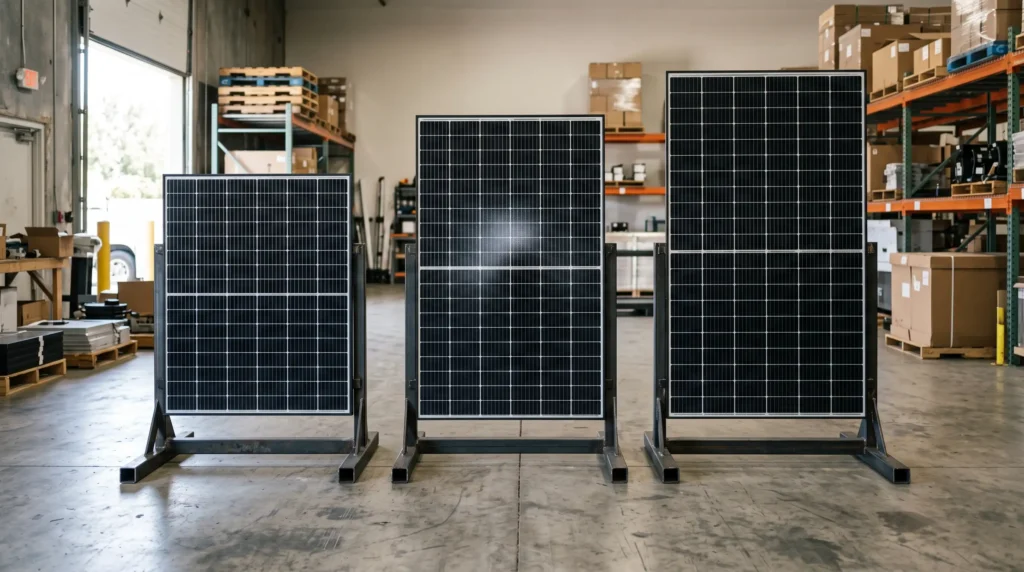
Modern residential solar systems can use modules with different wattage ratings, dimensions, and performance characteristics.
For our approximate 5.56 kW requirement, here’s how the panel count changes.
| Panel Wattage | Panels Needed | Total DC Capacity |
|---|---|---|
| 400W | 14 | 5.60 kW |
| 450W | 13 | 5.85 kW |
| 550W | 11 | 6.05 kW |
Higher-wattage panels can reduce the number of individual modules needed. However, they may also be physically larger.
For a compact residential roof, panel dimensions can matter just as much as the advertised wattage.
A smaller module might fit more efficiently around roof vents or skylights, while a larger module may be a better choice for an unobstructed roof.
Instead of choosing panels based only on wattage, compare:
Actual panel dimensions
Product and performance warranties
Installed cost per watt
Expected electricity production
Roof compatibility
Inverter specifications
A well-designed system using 400W panels can be just as practical as one using larger modules.
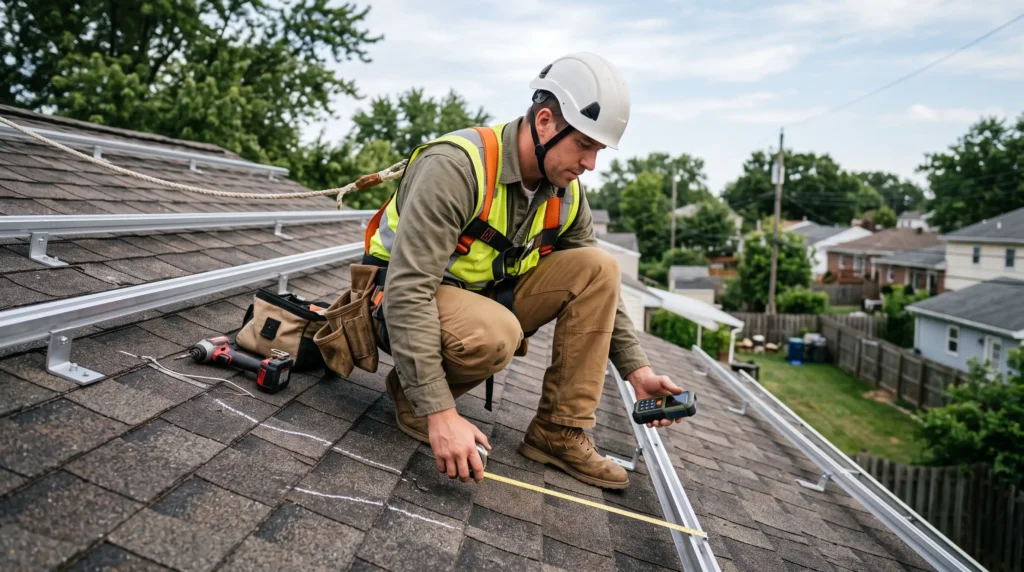
How Much Roof Space Do You Need?
Before purchasing solar equipment, confirm that your roof has enough suitable space.
A residential solar module around the 400W range may occupy approximately 20–25 square feet, depending on its design.
For 14 modules:
14 × 20 = 280 sq ft
14 × 25 = 350 sq ft
This gives a rough combined panel surface area of 280–350 square feet.
However, you may need additional usable rooftop space because of safety setbacks, roof access requirements, and obstructions.
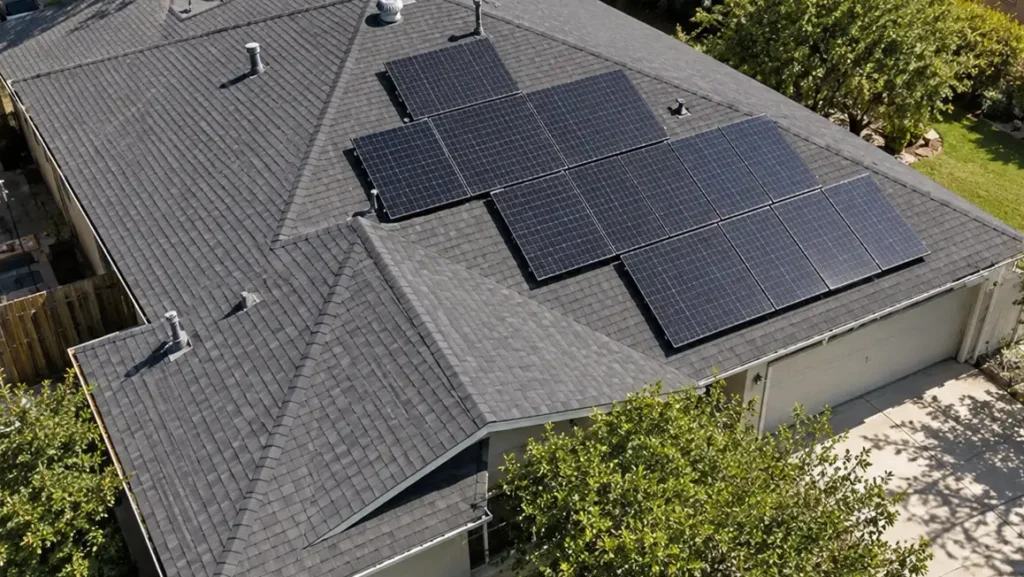
A house with 1,000 square feet of living space does not necessarily have 1,000 square feet of usable roof.
For example, a two-story home can have a smaller roof footprint than a single-story house with the same total living area.
What About Roof Direction and Shading?
In many Northern Hemisphere locations, south-facing solar panels can provide favorable annual electricity generation.
East- and west-facing arrays may also work well, especially when their production aligns with household electricity usage.
Nearby trees, chimneys, buildings, and roof features can cast shadows that reduce output.
Roof condition matters too. If the roof needs major repairs soon, coordinating those repairs with the solar installation can avoid unnecessary removal and reinstallation expenses.
The U.S. Department of Energy’s Homeowner’s Guide to Solar recommends considering roof condition, suitability, and shading when evaluating a residential solar project.
How Much Electricity Will Your Solar System Generate?
Solar system capacity is measured in kilowatts (kW), while electricity generation is measured in kilowatt-hours (kWh).
These units describe different things.
A 5.6 kW array has a rated DC generation capacity of 5.6 kilowatts under standard test conditions.
It will not continuously produce 5.6 kW throughout the day.
Electricity production changes with sunlight, temperature, clouds, shading, and equipment performance.
Using our simplified assumptions:
Daily production = 5.6 × 4.5 × 0.80 = 20.16 kWh
Approximate annual production:
20.16 × 365 = 7,358.4 kWh
This annual estimate assumes the same average conditions throughout the year. It is not a weather-based forecast.
Real installations often generate more electricity during favorable seasons and less during cloudy or shorter winter days.
If you want to explore these differences, use our Solar Energy Production Calculator.
It lets you compare different system sizes, sunlight assumptions, panel directions, and shading conditions.
Solar Panels for 1000 Sq Ft Home: Installation Cost in 2026
The cost of installing solar panels depends primarily on the capacity of the system, equipment selection, local labor rates, roof conditions, and permitting requirements.
For U.S. homeowners, EnergySage reported a median quoted solar-only installation price of approximately $2.62 per watt for the first half of 2026.
Using that benchmark, our example 5.6 kW system would cost approximately:
5,600 watts × $2.62 = $14,672 before incentives
This is a general marketplace benchmark, not a guaranteed price for a particular home.
Some installations may cost more because of electrical upgrades, complex roof work, permitting, or regional labor rates. Others may receive more competitive quotes.
A useful installation proposal should clearly identify the equipment, expected annual production, warranties, installation work, and final contract price.
Are Federal Solar Tax Credits Available in 2026?
For new installations completed in 2026, homeowners should not assume that the former 30% federal Residential Clean Energy Credit is available.
The IRS states that the Section 25D credit is unavailable for expenditures treated as made after December 31, 2025. For this purpose, the expenditure generally occurs when the original installation is completed.
State, local, and utility incentives may have different rules. Check eligibility before including incentives in your financial calculations.
To explore installation expenses for different system sizes, use our Solar Installation Cost Calculator.

How Much Money Could You Save With Solar?
Installing solar panels can reduce the amount of electricity purchased from your utility.
However, actual savings depend on local electricity prices, how much solar electricity you use directly, and how your utility compensates you for exported energy.
Consider a hypothetical month in which a solar array produces approximately 605 kWh.
Suppose the homeowner:
Uses 350 kWh of solar electricity directly
Exports 255 kWh to the grid
Pays $0.18 per kWh for grid electricity
Receives $0.06 per kWh for eligible exported electricity
The avoided cost of grid electricity would be:
350 × $0.18 = $63.00
The value of exported energy would be:
255 × $0.06 = $15.30
Total illustrative benefit:
$78.30 for the month
These electricity rates are hypothetical, not national averages.
The calculation excludes financing costs, fixed utility charges, maintenance, and other tariff-specific rules.
Matching your solar generation to your electricity consumption also does not guarantee a zero-dollar electricity bill.
For a longer-term financial estimate, try our Solar ROI Calculator.
Do You Need a Solar Battery for a Small Home?
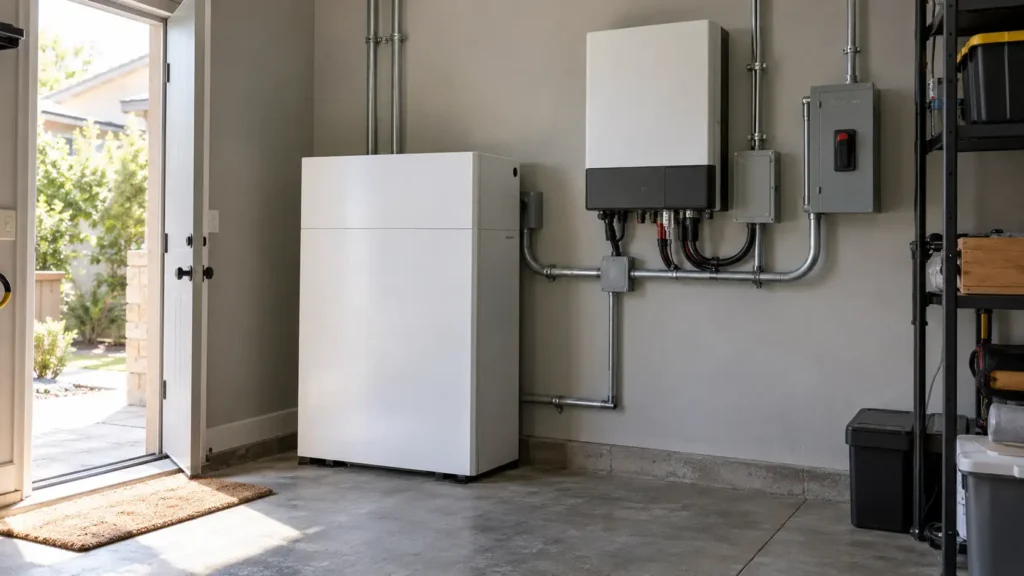
A battery is not necessary for every residential solar system.
If your main goal is to reduce electricity purchases and your grid connection is reliable, a grid-tied system without storage may be worth considering.
Battery storage becomes more relevant when you want backup electricity during outages or when your electricity rates make storing energy financially attractive.
Battery capacity is measured in kilowatt-hours and should be based on essential appliances and the number of hours you want them to operate.
For example, running essential loads that consume a combined 5 kWh during an outage requires at least that much delivered energy, with additional capacity potentially needed to account for equipment losses and usable battery limits.
Importantly, ordinary grid-connected solar panels do not automatically provide electricity during a blackout. Backup operation requires compatible equipment and an appropriate system design.
Use our Solar Battery Bank Calculator to estimate storage requirements based on your energy needs.
Common Mistakes to Avoid When Sizing a Small Solar System
A solar installation is a long-term investment, so it’s worth taking time to avoid common planning mistakes.
Estimating From Square Footage Alone
Your roof area tells you something about installation space, but your electricity bills tell you how much energy you need.
Always begin with energy consumption.
Using Only One Month of Electricity Data
A single monthly bill may not represent your annual consumption.
Compare seasonal usage, especially if your home uses electric heating or air conditioning.
Ignoring Shading and Roof Conditions
A partly shaded roof may produce significantly less electricity than an unobstructed roof.
Ask installers for realistic production estimates rather than relying only on nameplate capacity.
Selecting Panels Based Only on Price
Low upfront pricing is attractive, but equipment compatibility, warranties, expected production, and installation quality also matter.
Compare complete system proposals.
Assuming More Panels Always Mean Better Savings
An oversized system may not be financially worthwhile if your utility provides limited compensation for exported electricity.
The goal is to choose a suitable system, not necessarily the largest one.
Frequently Asked Questions
How Many Solar Panels Does a 1000 Sq Ft House Need?
The answer depends on electricity consumption. Under the assumptions used in this guide, a home consuming 600 kWh monthly may need about 14 panels rated at 400W each. A household using less electricity could require fewer panels.
Is a 3 kW Solar System Enough for a 1000 Sq Ft Home?
It might be sufficient for a low-consumption household. With 4.5 peak sun hours and an 80% system performance factor, a 3 kW array could produce approximately 324 kWh in a 30-day month.
Compare that amount with your actual electricity usage before making a decision.
Can a 5 kW Solar System Run a Small House?
A 5 kW system may offset a substantial portion of the electricity consumption of a smaller home.
Under the same example assumptions, it would generate approximately 540 kWh during a 30-day month.
Whether that covers your needs depends on your energy consumption, location, and seasonal production.
Do Solar Panels Work During Cloudy Weather?
Yes. Solar panels can generate electricity under cloudy conditions, although output generally decreases when less sunlight reaches the modules.
Cloud cover, seasonal weather, and shading are reasons to use annual production estimates rather than relying on ideal sunny-day conditions.
Are 550W Solar Panels Better Than 400W Panels?
Not automatically. Higher-wattage modules provide more rated power per panel, but their physical dimensions, cost, warranties, and compatibility with your roof and electrical equipment should also be considered.
Can Solar Panels Eliminate My Electricity Bill?
Solar panels may substantially reduce electricity costs, but utility connection fees, nighttime electricity purchases, and export-credit arrangements can prevent a bill from reaching zero.
Should I Install Extra Panels for Future Electricity Needs?
Additional capacity may make sense if you’re planning an electric vehicle, heat pump, or other major electrical upgrade.
However, the decision should account for projected usage, budget, roof space, and local utility interconnection rules.
Final Thoughts
Choosing solar panels for 1000 sq ft home projects becomes much easier when you focus on electricity consumption instead of floor area.
For a household using approximately 600 kWh per month, a 5.6 kW system with 14 panels rated at 400W provides a reasonable starting estimate under the assumptions used here.
Your actual requirements may differ because of local sunlight, roof orientation, seasonal electricity use, and equipment performance.
Before purchasing equipment, review your utility bills, assess your available roof space, and compare several professional installation quotes.
Ready to estimate your own system? Visit the free Solar Size Calculator and enter your electricity consumption to explore the solar capacity your home may need.
Sources and Further Reading
Disclaimer: Solar system sizes, costs, electricity production, and savings in this article are illustrative estimates. Actual results depend on site conditions, equipment, electricity rates, and applicable regulations. Consult a qualified installer before purchasing a solar system.