- Solar Guides
Solar Panels for 2000 Sq Ft Home: How Many Do You Need and What Will It Cost?
Solar panel for 2000 sq ft home sizing depends on how much electricity your household uses, how much sunlight your roof receives, and the wattage of the panels you choose. A 2,000-square-foot U.S. house might need approximately 12–25 solar panels, but there is no universal panel count based on floor area alone.
For example, a home using 900 kilowatt-hours (kWh) of electricity per month could need approximately 19 panels rated at 400 watts, assuming five peak sun hours per day and an 80% overall solar performance factor. With 450W panels, the same example would require approximately 17 panels.
A household using more electricity, or living in a location with less available sunlight, may need a larger system.
The key is to calculate your solar requirements from your electricity bills—not simply the size of your house.
In this guide, you’ll learn how to estimate solar system capacity, compare 400W and 450W panels, calculate roof space, understand 2026 installation costs, and estimate potential electricity savings using practical U.S. examples.
Solar Panel for 2000 Sq Ft Home: Quick Sizing Guide
For homeowners looking for a quick answer, the table below shows how panel requirements change with monthly electricity consumption.
| Monthly electricity use | Estimated solar system size | 400W panels | 450W panels |
|---|---|---|---|
| 500 kWh | 4.2 kW | 11 | 10 |
| 600 kWh | 5.0 kW | 13 | 12 |
| 750 kWh | 6.25 kW | 16 | 14 |
| 900 kWh | 7.5 kW | 19 | 17 |
| 1,050 kWh | 8.75 kW | 22 | 20 |
| 1,200 kWh | 10.0 kW | 25 | 23 |
Calculation assumptions: Five peak sun hours per day, a 30-day month, and an overall performance factor of 0.80. Panel counts are rounded up to the next whole panel.
These are illustrative sizing estimates, not measured production values or guarantees of a particular electricity-bill reduction.
A 2,000 sq ft house with efficient appliances and relatively low electricity consumption may need fewer panels than a home with electric heating, multiple air conditioners, or an electric vehicle.
To estimate your own requirements, start with our free Solar System Size Calculator.
Why House Size Is Only a Starting Point
Square footage can provide general context about a home’s potential energy needs, but it does not directly measure electricity consumption.
Consider two houses with identical 2,000 sq ft floor plans.
One has efficient insulation, a gas furnace, and two occupants. The other has electric heating, several occupants, a swimming-pool pump, and an EV charger.
The second household may use considerably more electricity despite having the same living area.
Other important factors include:
Heating and cooling systems
Insulation and building efficiency
Household occupancy
Appliance efficiency and operating hours
Electric vehicle charging
Local weather and climate
Electricity consumption habits
The U.S. Department of Energy’s consumer solar guide recommends reviewing previous electricity bills to understand annual and seasonal energy requirements.
What Size Solar System Does a 2000 Sq Ft House Need?
A solar system between approximately 5 kW and 10 kW may be suitable for many 2,000-square-foot homes, depending on electricity consumption and local sunlight.
However, this is a broad planning range rather than a measured national average.
A home with unusually low energy consumption could need a smaller array, while a home with substantial electric heating or EV charging may need more than 10 kW.
Understanding kW and kWh
These two measurements serve different purposes.
Kilowatt (kW) measures power. Solar system capacity is usually expressed in kW.
Kilowatt-hour (kWh) measures energy. Your electricity bill shows how many kWh your household consumed over a billing period.
For example, 20 solar panels rated at 400W provide:
20 × 400W = 8,000W
8,000W ÷ 1,000 = 8 kW DC
That 8 kW system does not continuously generate 8 kW throughout the day.
Actual output changes with sunlight, temperature, shading, inverter performance, and other operating conditions.
Estimated Solar System Size by Electricity Usage
| Monthly consumption | Daily consumption | Estimated DC capacity |
|---|---|---|
| 600 kWh | 20 kWh | 5.0 kW |
| 750 kWh | 25 kWh | 6.25 kW |
| 900 kWh | 30 kWh | 7.5 kW |
| 1,050 kWh | 35 kWh | 8.75 kW |
| 1,200 kWh | 40 kWh | 10.0 kW |
These examples assume five peak sun hours per day and an 80% overall performance factor.
Your actual system should be designed using local solar resource data, electricity consumption, roof characteristics, and the utility’s compensation rules.
Our Solar Production Calculator can help you explore expected generation from different system capacities.
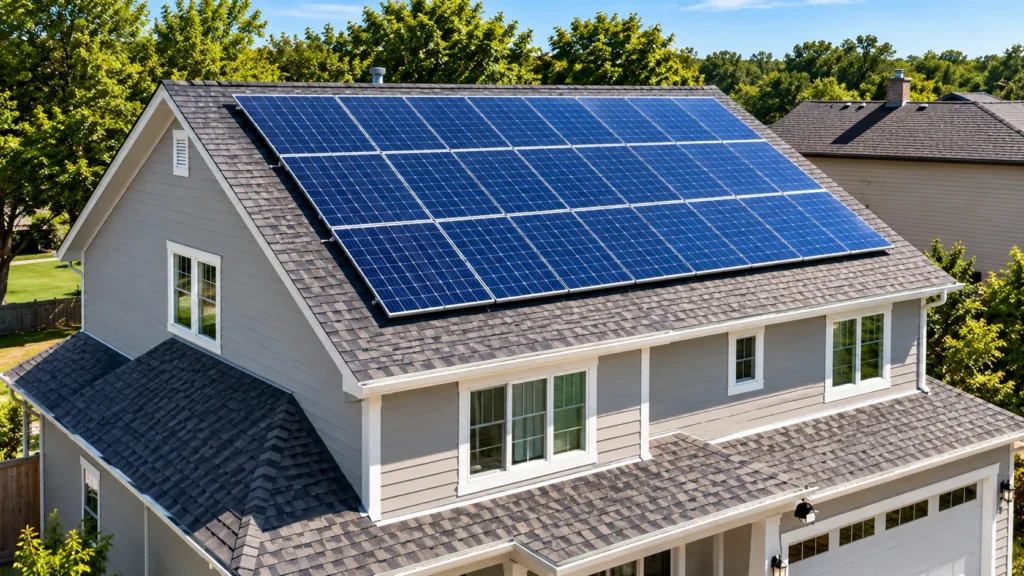
How to Calculate Solar Panels for a 2000 Sq Ft Home
You can calculate a preliminary solar system size in four steps.
We’ll use a hypothetical U.S. household that consumes 900 kWh per month.
Step 1: Check Your Monthly Electricity Usage
Look at your utility bill and find the total electricity consumption in kWh.
For the most reliable estimate, review 12 months of bills.
Using our example:
Monthly electricity use = 900 kWh
Average daily electricity consumption:
900 ÷ 30 = 30 kWh per day
This is the amount of electricity the solar system would need to generate on an average day to match the example household’s consumption.
It does not mean all electricity would be consumed directly when generated.
Step 2: Determine Peak Sun Hours
Peak sun hours describe the equivalent duration of solar irradiance at 1,000 watts per square meter.
They are different from the total number of daylight hours.
For this example, assume five peak sun hours per day.
Your actual location may receive more or fewer equivalent peak sun hours, and production will change seasonally.
For a location-specific estimate, use the PVWatts Calculator, a solar production modeling resource referenced by the U.S. Department of Energy.
Step 3: Include System Performance Losses
Solar systems lose some energy because of factors such as:
Module temperature
Shading and soiling
Wiring losses
Inverter conversion
Equipment performance differences
For a simplified calculation, assume an overall performance factor of 0.80.
Required solar capacity (kW) = Daily electricity consumption (kWh) ÷ (Peak sun hours × Performance factor)
Using our example:
30 ÷ (5 × 0.80)
= 30 ÷ 4
= 7.5 kW DC
The household would therefore need approximately 7.5 kW of installed solar capacity under these assumptions.
The 80% performance factor is a planning assumption, not a universal equipment efficiency. Detailed solar modeling may use different loss assumptions, so avoid applying the same losses twice.
Step 4: Calculate the Number of Panels
Convert the required solar capacity to watts:
7.5 kW × 1,000 = 7,500W
For 400W panels:
7,500 ÷ 400 = 18.75
Round up to 19 panels.
For 450W panels:
7,500 ÷ 450 = 16.67
Round up to 17 panels.
The final array capacities would be:
19 × 400W = 7.6 kW
17 × 450W = 7.65 kW
Both are slightly larger than the calculated 7.5 kW target because panels are installed in whole units.
A qualified solar installer must also verify inverter sizing, electrical design, mounting configuration, and local code requirements.
400W vs. 450W Solar Panels for a 2000 Square Foot Home
One of the most common questions homeowners ask is whether 400W or 450W panels are better.
The answer depends on available roof space, panel dimensions, efficiency, pricing, and the required system capacity.
For an approximately 8 kW system:
| Panel wattage | Panels needed | Installed DC capacity |
|---|---|---|
| 350W | 23 | 8.05 kW |
| 400W | 20 | 8.00 kW |
| 450W | 18 | 8.10 kW |
| 500W | 16 | 8.00 kW |
Higher-wattage panels generally reduce the number of modules needed to reach a target capacity.
However, a higher-wattage panel may also be physically larger.
Therefore, fewer panels do not automatically mean less total roof area.
Which Panel Size Should You Choose?
A 400W panel may be appropriate when its dimensions fit the available roof layout and its cost is competitive.
A 450W panel may be attractive when fewer modules simplify the array layout or provide a better fit for the roof.
The best choice should consider:
Cost per installed watt
Module efficiency
Panel dimensions
Temperature performance
Manufacturer warranty
Installer compatibility
Available unshaded roof area
Rather than selecting a panel solely because it has a higher wattage rating, compare the total expected electricity generation and installed cost of the complete system.
How Much Roof Space Is Needed for Solar Panels on a 2000 Sq Ft House?
A 2,000-square-foot home does not necessarily have 2,000 square feet of usable roof space.
For example, a two-story house with 2,000 square feet of total living area may have a roof footprint closer to the area of one floor, adjusted for roof geometry.
An attached garage, roof pitch, dormers, chimneys, skylights, and setbacks also influence usable installation space.
Estimated Panel Surface Area
Assume each solar panel occupies approximately 21 square feet.
| Number of panels | Combined module area |
|---|---|
| 12 | 252 sq ft |
| 16 | 336 sq ft |
| 18 | 378 sq ft |
| 20 | 420 sq ft |
| 24 | 504 sq ft |
| 25 | 525 sq ft |
These values describe the combined surface area of the panels themselves.
They do not represent the final roof area required for installation.
Actual panel dimensions vary by model, and the usable roof area must also account for layout constraints, fire-access pathways, roof obstacles, and local requirements.
Does Roof Direction Matter?
Yes. Roof orientation and pitch affect solar production.
In the Northern Hemisphere, south-facing roof sections often provide favorable annual solar exposure, although east- and west-facing installations can also be practical.
The U.S. Department of Energy’s Homeowner’s Guide to Solar explains how roof orientation, slope, shading, and roof condition affect solar suitability.
What If Your Roof Cannot Fit Enough Panels?
You may still have options.
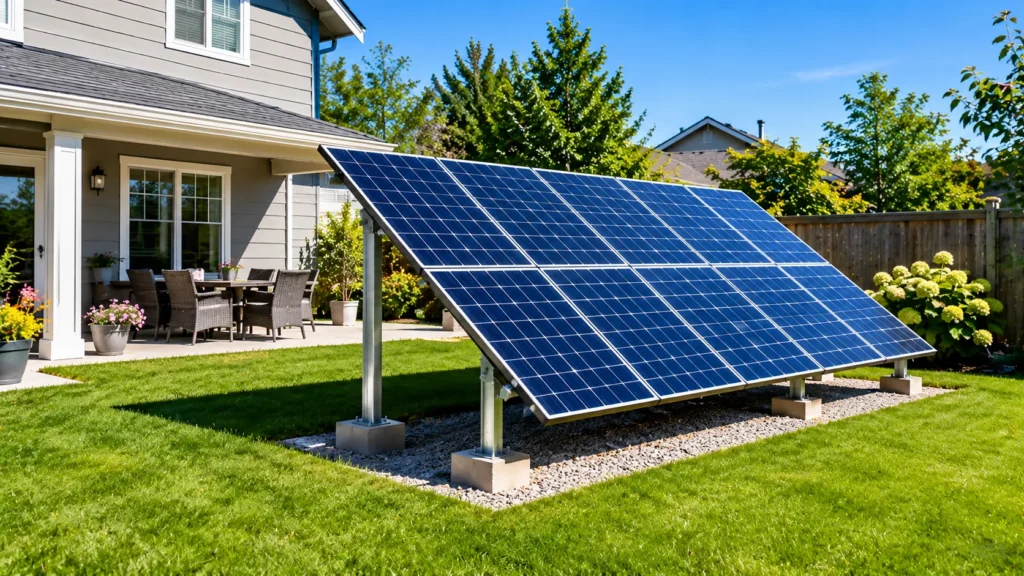
Higher-efficiency modules, alternative roof sections, or a ground-mounted system may help where suitable.
Reducing household electricity consumption can also lower the required solar capacity.
Before purchasing solar equipment, review major household loads using our Appliance Wattage Chart.
An energy-efficient home may need a smaller and less expensive solar array to achieve the same energy offset.
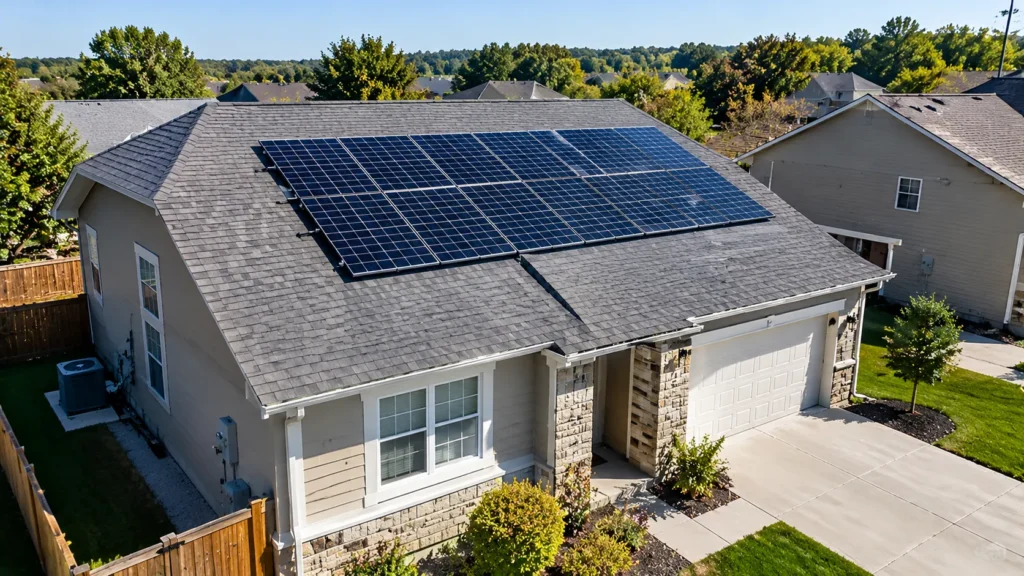
How Much Electricity Will a Solar System Generate?
Solar generation depends on system capacity, sunlight, orientation, temperature, and losses.
For a simplified estimate:
Daily solar output (kWh) = System size (kW) × Peak sun hours × Performance factor
Assume five peak sun hours and an overall performance factor of 0.80.
| System capacity | Daily output | 30-day output | Annualized output |
|---|---|---|---|
| 5 kW | 20 kWh | 600 kWh | 7,300 kWh |
| 6 kW | 24 kWh | 720 kWh | 8,760 kWh |
| 7.5 kW | 30 kWh | 900 kWh | 10,950 kWh |
| 8 kW | 32 kWh | 960 kWh | 11,680 kWh |
| 10 kW | 40 kWh | 1,200 kWh | 14,600 kWh |
These are mathematical examples using the same assumptions throughout.
They are not actual production measurements for a particular U.S. city.
Why Monthly Solar Output Changes
Solar generation is not identical every month.
Seasonal changes in sunlight, snow cover, shading, temperature, and weather affect production.
A system that generates 1,000 kWh in one month may generate significantly less in another.
That’s why annual production estimates are often more useful than multiplying one unusually sunny month’s output by 12.
Use our Solar Production Calculator to explore daily, monthly, and annual electricity generation.
How Location Changes Solar Panel Requirements
The same house can require different solar capacities in different locations.
A home with strong solar exposure may need fewer panels to produce a given amount of electricity than a comparable home with lower available sunlight.
Consider a household consuming 900 kWh per 30-day month.
Using an 80% performance factor:
| Peak sun hours/day | Required system capacity | 400W panels |
|---|---|---|
| 3.5 | 10.71 kW | 27 |
| 4.0 | 9.38 kW | 24 |
| 4.5 | 8.33 kW | 21 |
| 5.0 | 7.50 kW | 19 |
| 5.5 | 6.82 kW | 18 |
| 6.0 | 6.25 kW | 16 |
These are illustrative sunlight scenarios, not measured averages for specific states.
Why a Texas Home May Need a Different System Than a Washington Home
Location affects both solar electricity production and household energy demand.
A Texas household may have strong solar resources but substantial air-conditioning use.
A Washington household may receive less solar energy during parts of the year, but its cooling demand may be lower.
Actual results depend on the specific property, electricity usage, and local weather.
For that reason, solar sizing should use the home’s utility bills and location-specific solar modeling rather than relying on a single nationwide panel-count estimate.
Solar Panel Cost for a 2000 Sq Ft House in 2026
The cost of a residential solar installation depends more on the required system capacity than the square footage of the home.
Important pricing factors include panel selection, inverter equipment, mounting hardware, labor, permitting, roof complexity, and electrical upgrades.
EnergySage’s June 2026 U.S. solar pricing guide reports a typical residential system of approximately 12 kW costing around $31,135 before incentives. That implies approximately $2.59 per installed watt for that reported benchmark.
For easy planning calculations, we’ll use a rounded illustrative rate of $2.60 per watt.
Source: EnergySage — Solar Panel Cost in 2026.
Estimated Installation Cost by System Size
| Solar system size | Illustrative cost before incentives |
|---|---|
| 5 kW | $13,000 |
| 6 kW | $15,600 |
| 7 kW | $18,200 |
| 7.5 kW | $19,500 |
| 8 kW | $20,800 |
| 9 kW | $23,400 |
| 10 kW | $26,000 |
These are calculated examples using a constant $2.60/W rate, not actual installer quotations. Smaller and larger systems may have different per-watt prices.
For example:
7,500W × $2.60 = $19,500
An estimated 7.5 kW installation would therefore cost $19,500 under this illustrative pricing assumption.
Your actual price may be higher or lower.
Use our Solar Cost Calculator to explore installation expenses for different solar capacities.
What Increases Solar Installation Costs?
Roof complexity: Steep or difficult roof sections can increase labor requirements.
Electrical upgrades: Some homes require electrical panel or service modifications.
Premium equipment: Higher-priced panels, inverters, and monitoring systems affect the total cost.
Battery storage: Adding storage increases project costs.
Permits and local requirements: Installation rules and fees vary by jurisdiction.
Installer pricing: Labor, overhead, equipment sourcing, and warranty coverage differ among companies.
Compare multiple written quotes with similar system specifications before making a decision.
Are Federal Solar Tax Credits Available in 2026?
An important change affects U.S. homeowners planning solar installations in 2026.
The federal Residential Clean Energy Credit under Section 25D is not available for qualifying expenditures made after December 31, 2025, following the 2025 federal legislative changes.
The IRS confirms the termination in its Residential Clean Energy Credit guidance.
Do not automatically deduct 30% from the price of a new 2026 residential solar installation.
State, local, and utility incentives may still be available, depending on your location and eligibility.
Check the current program rules before including incentives in a solar payback calculation.
How Much Can Solar Panels Save on a 2000 Sq Ft Home?
Solar savings depend on how much electricity your panels produce, how much your household consumes directly, and how your utility compensates exported electricity.
A solar system that produces enough energy to match annual household consumption does not necessarily eliminate your electricity bill.
Let’s examine a realistic billing structure using hypothetical rates.
Example: A Household Using 900 kWh per Month
Assume the following:
| Factor | Monthly amount |
|---|---|
| Household electricity consumption | 900 kWh |
| Solar generation | 900 kWh |
| Solar electricity used directly | 500 kWh |
| Electricity exported | 400 kWh |
| Electricity imported | 400 kWh |
| Retail electricity rate | $0.18/kWh |
| Solar export credit rate | $0.07/kWh |
These rates are illustrative, not nationwide averages.
Before Solar
Without solar, the household purchases 900 kWh from the utility.
900 × $0.18 = $162
This represents the variable electricity charge before fixed fees and taxes.
After Solar
The household consumes 500 kWh of solar electricity directly.
It purchases the remaining 400 kWh from the grid.
Grid electricity cost:
400 × $0.18 = $72
Export credit:
400 × $0.07 = $28
Net variable electricity charge:
$72 − $28 = $44
Estimated Electricity Savings
Before solar: $162
After solar: $44
Monthly variable-charge savings:
$162 − $44 = $118
Annualized savings under identical monthly conditions:
$118 × 12 = $1,416
This example excludes fixed utility charges, taxes, financing payments, and seasonal variation.
Actual savings depend on your utility’s net-metering or net-billing arrangements.
The U.S. Department of Energy explains that compensation for electricity exported to the grid depends on state and utility policies.
Does a 100% Solar Energy Offset Mean a $0 Electric Bill?
Not necessarily.
Even if your solar system generates the same amount of electricity your household consumes over a year, you may still purchase electricity at night.
Export credits may be worth less than the retail rate paid for imported electricity.
Fixed utility charges can also remain.
For a complete financial comparison, use our Solar ROI Calculator.
Is a Solar Battery Worth It for a 2000 Sq Ft Home?
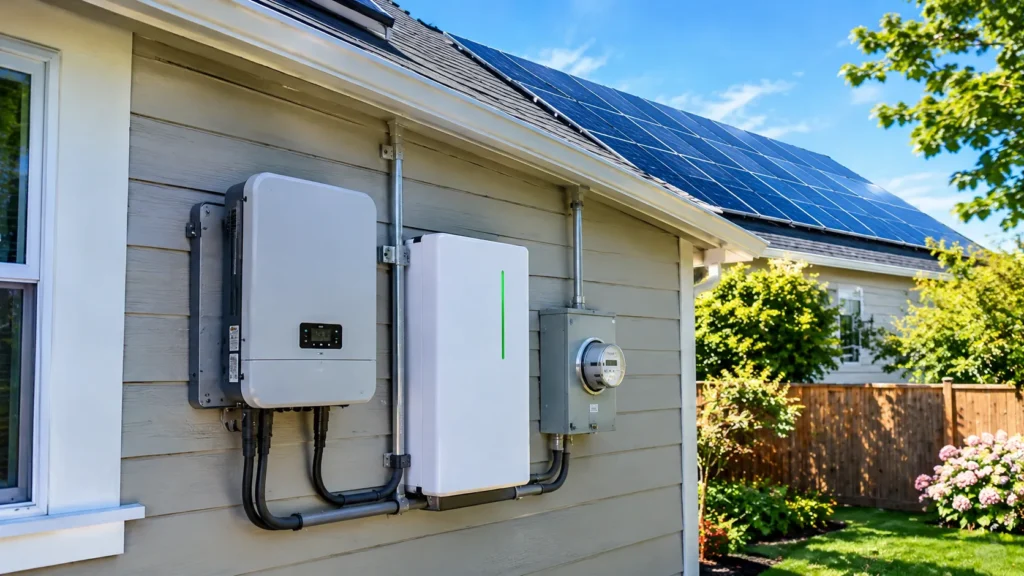
Solar battery storage can help homeowners use more of their solar electricity after sunset.
A battery stores some excess daytime generation for later consumption.
It may also provide backup electricity during outages when paired with suitable equipment.
However, battery storage is not automatically necessary for every grid-connected solar installation.
When a Battery May Be Useful
A battery can be worth considering when:
Your utility provides relatively low compensation for solar exports.
Electricity prices are higher during evening hours.
You want backup power for essential household appliances.
You want to increase solar self-consumption.
Battery economics depend on storage costs, usable capacity, round-trip efficiency, utility rates, and operating patterns.
Example Battery Capacity Calculation
Suppose you want 10 kWh of AC electricity available for essential loads during an outage.
Assume:
Desired delivered energy: 10 kWh
Usable depth of discharge: 90%
Conversion efficiency: 90%
Approximate nominal battery capacity:
10 ÷ (0.90 × 0.90)
= 12.35 kWh
This is a simplified energy-capacity estimate. A complete battery design must also account for maximum power demand, surge loads, equipment compatibility, and backup duration.
Use our Solar Battery Calculator to estimate your storage requirements.
Can a 2000 Sq Ft Home Run Completely on Solar Power?
Yes, a 2,000-square-foot home can potentially meet its electricity requirements with solar energy, but the meaning of “completely on solar” matters.
There is a difference between a grid-connected home that offsets its annual electricity consumption and an off-grid home that must supply electricity continuously without utility support.
Grid-Connected Solar
A grid-connected system can generate electricity during daylight and draw power from the utility when solar production is insufficient.
Excess generation may earn utility credits.
This arrangement generally does not require enough battery storage to power the entire home overnight.
Off-Grid Solar
An off-grid system must supply electricity without relying on a utility connection.
That typically requires a combination of solar panels, battery storage, appropriate inverter equipment, and sometimes backup generation.
Off-grid sizing must account for low-sunlight periods and the desired reliability of the system.
Use our Off-Grid Solar Calculator to explore off-grid system requirements.
Common Mistakes When Choosing Solar Panels for a 2000 Sq Ft Home
A solar installation is a long-term investment, so sizing errors can affect both performance and financial returns.
1. Choosing Panel Count Based Only on Square Footage
Two homes with identical floor areas may have very different electricity needs.
Use actual kWh consumption as the foundation of your estimate.
2. Ignoring Seasonal Electricity Demand
Summer air conditioning and winter electric heating can create significant changes in electricity usage.
Review a full year of utility bills whenever possible.
3. Assuming Panel Wattage Equals Continuous Output
A 450W panel does not continuously generate 450 watts.
Its output changes with sunlight and operating conditions.
4. Ignoring Shading and Roof Obstacles
Trees, chimneys, roof vents, and neighboring buildings can reduce the amount of usable installation space or affect electricity production.
5. Overestimating Solar Savings
Do not calculate savings by multiplying all solar production by the retail electricity rate unless the utility’s actual billing arrangement supports that valuation.
Electricity consumed directly and electricity exported may have different financial values.
6. Assuming Expired Incentives Still Apply
Federal tax credit rules have changed for 2026.
Verify current incentives instead of relying on older solar articles or installation quotes that assume a 30% federal residential credit.
7. Forgetting Future Electricity Consumption
Adding an electric vehicle, heat pump, or electric water heater can increase electricity demand.
If these upgrades are planned, discuss them with your installer before finalizing system capacity.
How to Choose the Best Solar System for Your 2000 Sq Ft Home
The best solar system is not necessarily the largest one or the one with the highest-wattage panels.
It is the system that appropriately balances your household’s electricity needs, available roof area, expected production, installation cost, and financial goals.
Before requesting quotes, complete these steps:
Review 12 months of electricity consumption in kWh.
Estimate the solar capacity needed for your desired annual energy offset.
Evaluate available sunlight, shading, and roof orientation.
Compare panel wattage, dimensions, and equipment warranties.
Estimate installation costs using realistic local pricing.
Review utility export compensation and applicable incentives.
Compare expected savings with the full cost of owning or financing the system.
Start with our Solar System Size Calculator to estimate your home’s required solar capacity.
Then use the Solar Production Calculator to explore expected electricity generation and the Solar Cost Calculator to estimate project expenses.
Frequently Asked Questions
How many solar panels does a 2000 sq ft home need?
A 2,000-square-foot home may need approximately 12–25 panels, although the actual requirement depends on electricity consumption, sunlight, panel wattage, and roof conditions. For example, a home using 900 kWh per month may need approximately 19 panels rated at 400W under the simplified assumptions used in this guide.
What is the best solar panel for 2000 sq ft home installations?
There is no single best panel for every 2,000-square-foot home. Compare panel efficiency, wattage, physical dimensions, price, warranties, and suitability for the available roof space. The complete system design matters more than one panel specification.
Is a 6kW solar system enough for a 2000 sq ft house?
It may be. Under an assumption of five peak sun hours per day and an 80% overall performance factor, a 6 kW system could generate approximately 720 kWh over 30 days. Whether that is sufficient depends on the home’s electricity usage.
How many 400W solar panels do I need for a 2000 sq ft house?
For a target system of 7.5 kW, you would need 19 panels rated at 400W, providing 7.6 kW of installed DC capacity.
How many 450W solar panels are needed for a 2000 sq ft home?
For a target system of 7.5 kW, you would need 17 panels rated at 450W, providing 7.65 kW of installed DC capacity.
How much does solar cost for a 2000 sq ft house in 2026?
The cost depends on system capacity and installation conditions. At an illustrative $2.60 per installed watt, a 7.5 kW system would cost approximately $19,500 before applicable incentives and financing costs.
Can solar panels power a 2000 sq ft house with air conditioning?
Yes, solar panels can contribute electricity toward air-conditioning consumption. The required solar capacity depends on the air conditioner’s electricity usage, operating hours, climate, and the household’s other electrical loads.
How much roof space do 20 solar panels need?
If each panel occupies approximately 21 square feet, 20 panels have a combined module area of 420 square feet. The actual installation area may be larger because of roof layout, setbacks, and access requirements.
Does a two-story 2000 sq ft house need fewer solar panels?
Not necessarily. A two-story home may have a smaller roof footprint, but the number of panels required is determined primarily by electricity consumption and expected solar production.
Can I eliminate my electric bill with solar panels?
Solar panels may substantially reduce electricity charges, but a zero-dollar bill is not guaranteed. Fixed utility charges, nighttime electricity purchases, and export compensation rules can leave a remaining balance.
Are solar panels worth installing without the federal tax credit?
They may still be financially worthwhile, depending on installation cost, local electricity rates, available state or utility incentives, and expected solar production. Evaluate the complete investment using realistic assumptions rather than relying on a single incentive.
How can I calculate the exact number of solar panels my home needs?
Start with annual electricity consumption, location-specific solar production data, panel specifications, and usable roof space. An online calculator can provide an initial estimate, while a qualified installer can complete the site-specific design.
Final Thoughts
Choosing a solar panel for 2000 sq ft home installation starts with understanding your household’s actual electricity needs.
For a typical planning scenario, a 2,000-square-foot house might require a solar system between 5 kW and 10 kW, but there is no fixed capacity based on square footage alone.
A home consuming 900 kWh per month could need approximately 19 panels rated at 400W or 17 panels rated at 450W under the assumptions used in this guide.
Your final system size should account for electricity consumption, peak sun hours, roof orientation, shading, equipment performance, and local utility rules.
Before investing in solar, estimate your required capacity using our free Solar System Size Calculator. Then compare expected production with the Solar Production Calculator and evaluate costs and savings with our Solar ROI Calculator.
A well-designed solar system should meet your energy goals without relying on exaggerated savings claims or unnecessary equipment.