- Solar Guides
Solar Panel Dimensions: Standard Sizes, Weight & Roof Space (2026)
Solar panel dimensions vary by manufacturer, wattage, and cell design, but many modern residential solar panels measure approximately 68–74 inches long and 40–48 inches wide. Larger commercial and utility-scale panels can exceed 90 inches in length.
For example, a Qcells 430W residential panel measures 67.8 × 44.6 inches and weighs 46.7 pounds, while a Canadian Solar 600W-class module measures approximately 93.8 × 44.6 inches and weighs 73.6 pounds.
Knowing the physical size of a solar panel helps you determine how many modules may fit on your roof, how much space a solar installation requires, and whether larger panels are suitable for your property.
However, physical dimensions are only part of the equation. Panel efficiency, wattage, weight, roof orientation, shading, and local installation requirements also matter.
This guide compares standard solar panel sizes, real manufacturer specifications, residential and commercial panels, and practical roof-space calculations.
What Are the Standard Solar Panel Dimensions?
There is no universal standard solar panel size.
Manufacturers produce photovoltaic modules in different physical formats to meet residential, commercial, off-grid, and utility-scale requirements.
Traditional residential panels often measured approximately 65–67 inches long and 39–40 inches wide. Many newer residential models are wider, and larger commercial panels can be considerably longer.
The following table provides a general comparison.
| Panel Category | Approximate Length | Approximate Width | Common Application |
|---|---|---|---|
| Compact and off-grid panels | Varies widely | Varies widely | RVs, cabins, portable systems |
| Traditional residential panels | 65–67 inches | 39–40 inches | Home rooftops |
| Modern residential panels | 68–74 inches | 40–48 inches | Home rooftops |
| Large commercial panels | 78–94+ inches | 40–51 inches | Commercial and ground-mounted systems |
These are approximate categories rather than official dimensional standards. Some residential modules fall outside these ranges, and the physical formats used for commercial projects may also be installed on suitable residential properties.
The exact manufacturer’s datasheet should always determine the dimensions used in a solar installation plan.
Solar Panel Dimensions by Wattage
solar panel’s wattage and physical size are related, but they are not interchangeable.
Wattage measures rated electrical power under specified test conditions. Physical dimensions describe the length, width, and thickness of the module.
A higher-wattage panel may be larger, more efficient, or both.
For example, two solar panels with similar dimensions may have different wattage ratings because they use different solar cells or technologies.
Real Solar Panel Size and Weight Examples
The table below uses published manufacturer specifications rather than estimated dimensions based solely on wattage.
| Solar Panel Model | Rated Power | Dimensions (inches) | Weight |
|---|---|---|---|
| Renogy ShadowFlux rigid | 200W | 49.69 × 30.08 × 1.18 | 23.83 lb |
| Qcells Q.TRON BLK M-G2+ | 430W | 67.8 × 44.6 × 1.18 | 46.7 lb |
| REC Alpha Pure-RX | 470W | 68.0 × 47.4 × 1.2 | 50.0 lb |
| Canadian Solar TOPBiHiKu6 | 600W-class | 93.8 × 44.6 × 1.57 | 73.6 lb |
These examples represent specific published product configurations, not guaranteed dimensions for every panel with the same wattage. Product availability and specifications may vary by market and model revision.
Manufacturer references:
Why Do Solar Panels With Similar Wattage Have Different Dimensions?
The main reasons include:
Solar cell efficiency: More efficient cells can generate more rated power from a given surface area.
Cell size and arrangement: Manufacturers use different cell formats and layouts.
Module design: Frame dimensions, cell spacing, and electrical design influence overall size.
Panel technology: Monocrystalline, TOPCon, heterojunction, and other photovoltaic technologies can have different power-density characteristics.
Bifacial construction: Some modules generate additional energy from light reaching the rear surface, although their front-side rated power and physical dimensions still depend on the specific design.
This is why comparing only the wattage printed on a solar panel is not enough.
Residential vs Commercial Solar Panel Dimensions
Residential solar panels are generally selected to balance electricity output, installation flexibility, appearance, and roof space.
Commercial and utility-scale modules may prioritize high power per module, installation economics, and compatibility with large mounting systems.
Residential Solar Panels
Residential panels often have a relatively compact footprint that works with pitched roofs.
A modern example is the Qcells Q.TRON BLK M-G2+ 430W panel.
Its published dimensions are:
Length: 67.8 inches
Width: 44.6 inches
Thickness: 1.18 inches
Weight: 46.7 pounds
This corresponds to a front-face area of approximately 21 square feet.
A residential roof can accommodate multiple panels in portrait or landscape orientation, subject to the actual roof geometry and installation requirements.
Commercial Solar Panels
Larger commercial modules may offer higher wattage per panel but require more physical space and careful handling.
For example, the Canadian Solar TOPBiHiKu6 600W-class module measures:
Length: 93.8 inches
Width: 44.6 inches
Thickness: 1.57 inches
Weight: 73.6 pounds
Its front-face area is approximately 29.1 square feet.
Although it produces more rated power per module than the 430W Qcells example, it also occupies substantially more surface area.
Therefore, a larger solar panel does not automatically deliver higher power per square foot.
Solar Panel Dimensions in Inches, Feet, and Millimeters
Solar panel datasheets often list dimensions in millimeters, while homeowners in the United States commonly measure roof space in feet and inches.
Understanding these units makes comparisons easier.
Useful conversions include:
1 foot = 12 inches
1 inch = 25.4 millimeters
1 meter = 1,000 millimeters
1 square foot = 144 square inches
Example: Converting Solar Panel Dimensions
Consider a panel measuring 67.8 × 44.6 inches.
Convert the length to feet:
67.8 ÷ 12 = 5.65 feet
Convert the width:
44.6 ÷ 12 = 3.72 feet
The panel is approximately:
5.65 × 3.72 feet
Its area is:
(67.8 × 44.6) ÷ 144 = 21.0 square feet
This represents the physical face area of one module, excluding installation clearances.
How Much Roof Space Do Solar Panels Need?
Roof space requirements depend on the number of panels, the dimensions of each panel, and the layout of the solar array.
A basic calculation starts with the physical area of the panels.
Total panel face area (sq ft) = Number of panels × Length (in) × Width (in) ÷ 144
For example, consider 20 Qcells panels measuring 67.8 × 44.6 inches.
Area per panel:
67.8 × 44.6 ÷ 144 = 21.0 sq ft
Total panel face area:
20 × 21.0 = 420 sq ft
Therefore, 20 panels cover approximately 420 square feet of panel surface.
However, that does not mean every roof with 420 square feet of total area can accommodate 20 modules.
The final layout must account for roof edges, ridges, obstructions, access requirements, mounting gaps, and applicable building and fire codes.
Roof Space Requirements by Number of Panels
Using the same 67.8 × 44.6-inch panel:
| Number of Panels | Total Rated Capacity at 430W | Panel Face Area |
|---|---|---|
| 10 | 4.3kW | 210 sq ft |
| 15 | 6.45kW | 315 sq ft |
| 20 | 8.6kW | 420 sq ft |
| 25 | 10.75kW | 525 sq ft |
| 30 | 12.9kW | 630 sq ft |
These figures describe the combined module face area, not the minimum total roof area required for a compliant installation.
Practical Roof Layout Example
Imagine a rectangular, unobstructed roof section measuring:
20 feet wide × 15 feet high
Its total area is:
20 × 15 = 300 square feet
A 67.8 × 44.6-inch panel measures approximately 5.65 × 3.72 feet.
With the panel’s longer dimension running vertically, a purely geometric layout could place five panels across and two rows vertically:
Width required:
5 × 3.72 = 18.6 feet
Height required:
2 × 5.65 = 11.3 feet
That creates a theoretical layout of 10 panels, with a combined rated capacity of:
10 × 430W = 4,300W, or 4.3kW
This is a geometry-only example. Actual panel spacing, roof setbacks, mounting constraints, and code requirements may reduce the number of modules that can be installed.
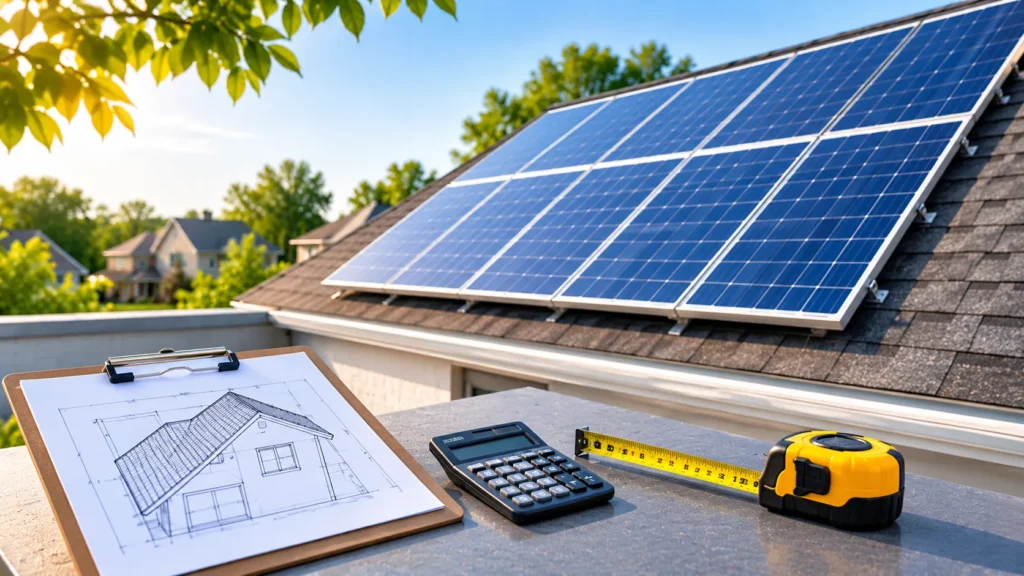
A qualified installer must verify the final layout.
How Many Solar Panels Can Fit on Your Roof?
The number of panels that fit depends on usable roof dimensions, not simply the home’s floor area.
For example, a 2,000-square-foot home does not necessarily have 2,000 square feet of suitable solar installation space.
A two-story house may have a smaller roof footprint than a single-story house with the same living area.
Roof shape, dormers, skylights, chimneys, vents, and shading also affect the available area.
Calculate Your Required Solar Panel Count
To estimate the number of panels needed for a target system capacity, use:
Number of panels = Target system wattage ÷ Individual panel wattage
Always round up to a whole panel when estimating the minimum count needed to meet or exceed a target DC capacity.
For example, an 8kW system using 430W panels requires:
8,000 ÷ 430 = 18.60
Round up:
19 panels
The resulting system capacity is:
19 × 430W = 8,170W, or 8.17kW
The combined panel face area is:
19 × 21.0 = 399 sq ft
The table below shows other examples using the same panel.
| Target Capacity | 430W Panels Needed | Actual DC Capacity | Panel Face Area |
|---|---|---|---|
| 6kW | 14 | 6.02kW | 294 sq ft |
| 8kW | 19 | 8.17kW | 399 sq ft |
| 10kW | 24 | 10.32kW | 504 sq ft |
| 12kW | 28 | 12.04kW | 588 sq ft |
These are capacity and area calculations. They do not predict how much electricity the system will generate.
For electricity-based sizing, use our Solar System Size Calculator or read How Many Solar Panels Do I Need?.
How Much Do Solar Panels Weigh?
Modern residential solar panels commonly weigh around 40–55 pounds, although actual weight depends on the model.
Large commercial and utility-scale panels may weigh considerably more.
For example:
| Panel | Weight |
|---|---|
| Renogy 200W ShadowFlux rigid | 23.83 lb |
| Qcells 430W Q.TRON BLK M-G2+ | 46.7 lb |
| REC 470W Alpha Pure-RX | 50.0 lb |
| Canadian Solar 600W-class TOPBiHiKu6 | 73.6 lb |
How Much Weight Does a Solar System Add to a Roof?
Consider an installation with 20 Qcells panels weighing 46.7 pounds each.
Total module weight:
20 × 46.7 = 934 pounds
This is the combined weight of the solar modules alone.
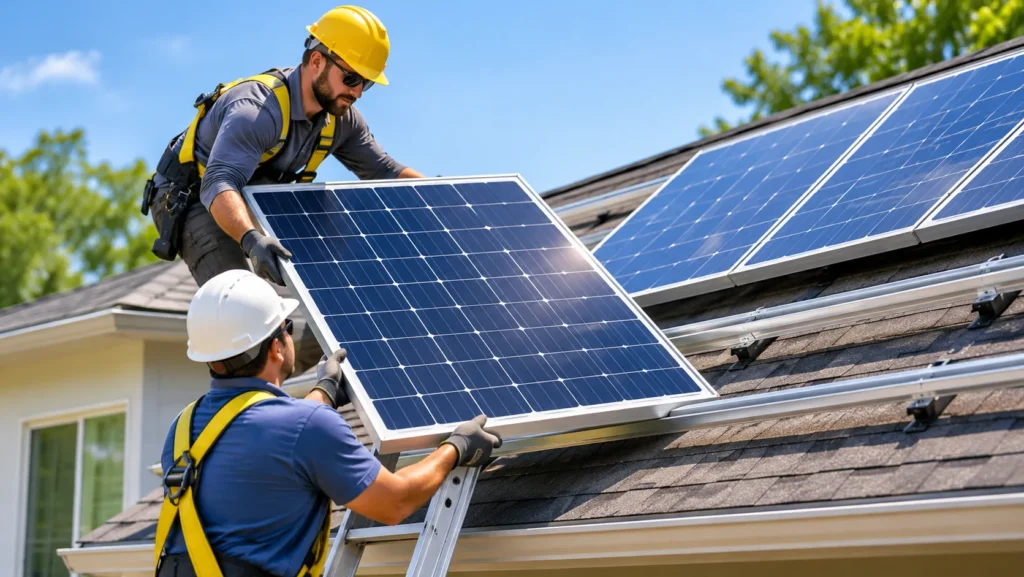
Mounting rails, attachments, electrical components, and other installation hardware add additional weight.
Roof structures must also withstand applicable wind, snow, and other design loads.
Therefore, module weight divided by panel area is not sufficient to determine whether a roof can safely support a solar system.
The U.S. Department of Energy’s solar guidance for homebuilders emphasizes roof structural capacity and installation conditions.
A qualified solar installer or structural professional should evaluate roof suitability before installation.
Solar Panel Thickness: How Thick Are Solar Panels?
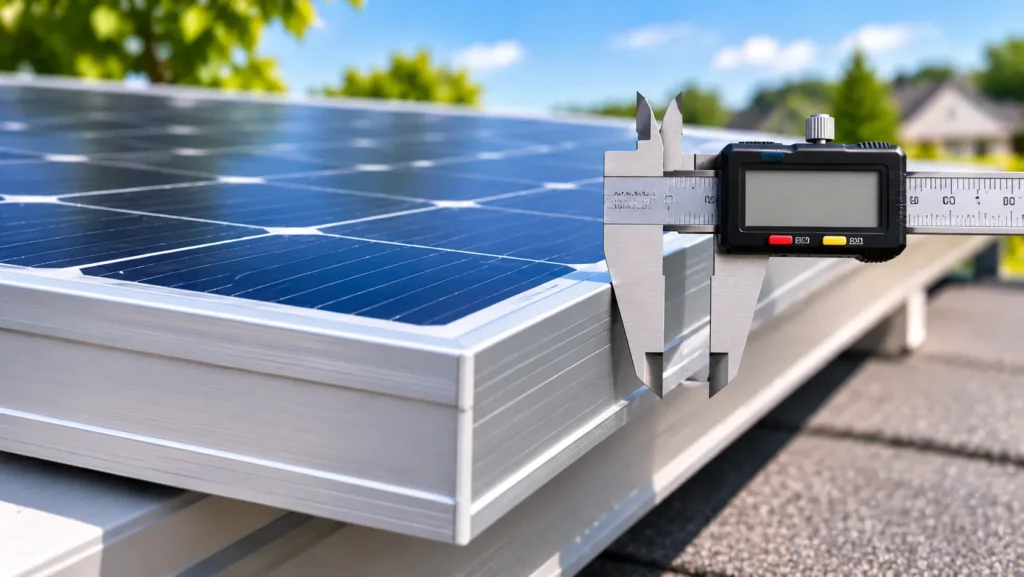
The thickness listed on a manufacturer’s datasheet usually refers to the module’s overall frame depth.
For example:
Qcells Q.TRON BLK M-G2+: 1.18 inches
REC Alpha Pure-RX: 1.2 inches
Canadian Solar TOPBiHiKu6: 1.57 inches
Panel thickness is different from the total height of an installed solar array above the roof.
Mounting equipment creates space between the roof surface and the modules, and the required clearance depends on the approved mounting design.
Some flexible solar panels have much thinner profiles than conventional framed glass modules, but they have different installation and durability considerations.
60-Cell vs 72-Cell vs Half-Cut Solar Panels
Solar panels are often described using their number of photovoltaic cells.
Historically, two widely used module formats were 60-cell and 72-cell panels.
A traditional 60-cell panel typically had a smaller physical footprint than a 72-cell panel.
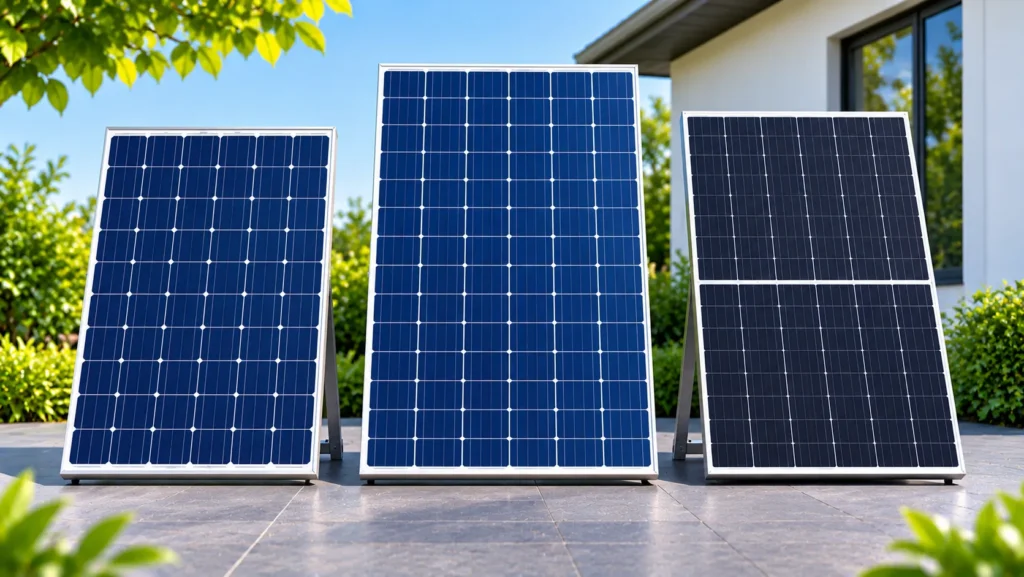
However, modern solar panel manufacturing includes different cell sizes, half-cut cells, and other layouts.
Traditional 60-Cell Solar Panels
A conventional 60-cell module contains 60 full solar cells, often arranged in six columns and ten rows.
These modules have historically been popular for residential installations.
Traditional 72-Cell Solar Panels
A conventional 72-cell module contains 72 full cells, often arranged in six columns and twelve rows.
The additional cells typically create a longer module compared with a traditional 60-cell design using similarly sized cells.
Modern Half-Cut Solar Panels
Half-cut technology divides solar cells into smaller sections.
For example, a panel with 120 half-cut cells can have a layout broadly comparable to a traditional 60-full-cell module.
However, modern manufacturers also use configurations such as 108, 132, and other half-cell counts.
The number of cells alone no longer provides a reliable universal method for determining a solar panel’s physical dimensions.
For accurate roof planning, use the module’s published length, width, and mounting specifications.
Solar Panel Size vs Wattage vs Efficiency
These three measurements describe different characteristics.
Physical size refers to the panel’s dimensions and surface area.
Wattage is the panel’s rated electrical power under defined test conditions.
Efficiency describes the percentage of incoming solar energy converted into electrical power under specified conditions.
A simplified module efficiency formula is:
Efficiency (%) = Rated power (W) ÷ [Panel area (m²) × 1,000 W/m²] × 100
The 1,000 W/m² value represents standard test irradiance.
Example: A 430W Solar Panel
The Qcells panel measures:
1.722 × 1.134 meters
Panel area:
1.722 × 1.134 = 1.953 square meters
Using its 430W rating:
430 ÷ (1.953 × 1,000) × 100 ≈ 22.0%
This is consistent with the manufacturer’s published efficiency for that power class.
Solar Panel Watts per Square Foot
Another useful comparison is rated power density.
Power density (W/sq ft) = Panel wattage ÷ Panel face area
For the Qcells 430W panel:
430 ÷ 21.0 ≈ 20.5 W/sq ft
For the REC 470W Alpha Pure-RX panel:
470 ÷ 22.38 ≈ 21.0 W/sq ft
These are rated power densities under standard test conditions, not average real-world electricity generation.
Actual solar energy production depends on local sunlight, shading, temperature, panel orientation, and system losses.
Use our Solar Production Calculator to estimate daily, monthly, and annual electricity generation.
Are Larger Solar Panels Better?
Not always.
Larger solar panels may offer higher rated power per module, but they also require more physical space and can be heavier or harder to handle.
Smaller panels may be more suitable for roofs with multiple sections, complex geometry, or limited unobstructed space.
The right choice depends on the project.
Advantages of Larger Solar Panels
Larger modules may reduce the number of panels needed to reach a target system capacity.
Depending on the installation, fewer modules may simplify certain aspects of wiring, mounting, and installation.
They can also be practical for commercial rooftops and ground-mounted solar systems with substantial available space.
Advantages of Smaller Solar Panels
Smaller modules may fit more easily around roof obstructions.
They can provide additional flexibility when arranging panels on irregular roof sections.
Compact panels are also useful for RVs, cabins, and certain off-grid applications.
The best approach is to compare complete system layouts rather than assuming that the highest-wattage panel is always the best option.
Portrait vs Landscape Solar Panel Installation
Solar panels can often be installed in portrait or landscape orientation, provided the module manufacturer and mounting system permit the arrangement.
Portrait orientation places the longer side vertically.
Landscape orientation places the longer side horizontally.
Both arrangements can be useful depending on roof geometry.
A roof section that cannot accommodate a certain number of portrait panels might support a different layout in landscape orientation.
However, the mounting configuration must comply with the manufacturer’s approved clamping zones, structural requirements, and installation instructions.
Panel orientation on the roof should not be confused with compass direction, which affects solar energy production.
What Affects the Number of Panels You Can Install?
Several factors determine the final layout.
Roof Shape and Available Area
Rectangular, unobstructed roof sections are generally easier to plan than roofs with numerous valleys, dormers, or separate surfaces.
Roof Setbacks and Access
Local fire and building requirements can restrict where solar panels may be installed.
The exact requirements vary by jurisdiction and roof configuration.
The U.S. Department of Energy’s rooftop solar permitting guidance explains the importance of local permitting and inspection.
Shading
Chimneys, trees, neighboring buildings, and roof features can cast shadows over solar panels.
A physically suitable location may still be a poor choice if shading significantly reduces production.
Roof Orientation and Tilt
Panel direction and roof slope influence sunlight exposure.
An installation with enough physical space may still require a different system design to achieve the desired annual electricity generation.
Roof Condition
Solar panels are long-term installations.
A roof approaching the end of its service life may need repair or replacement before solar installation.
Structural Capacity
The roof must safely support the complete solar installation under applicable structural and environmental loads.
This assessment should be completed by qualified professionals.
How to Choose the Right Solar Panel Dimensions for Your Home
Selecting the right solar panel involves more than choosing the smallest or largest module.
Start with these considerations.
1. Estimate Your Electricity Requirements
Review your annual electricity consumption and determine the approximate solar capacity needed.
A system designed to generate 5,000 kWh annually may require a different number of panels than one designed to generate 12,000 kWh.
2. Measure Usable Roof Sections
Identify roof dimensions, obstructions, and shaded areas.
Professional site measurements are necessary before final installation.
3. Compare Real Panel Specifications
For each shortlisted panel, review:
Rated wattage
Length and width
Thickness
Weight
Module efficiency
Power density
Approved mounting configuration
Manufacturer warranty
4. Calculate Panel Count and Surface Area
Determine the number of modules needed for the target system capacity.
Then calculate their combined physical area.
Remember that the module face area is not the same as the total roof space required.
5. Compare Estimated Electricity Production
A larger or higher-wattage panel does not automatically produce more annual electricity in every installation.
Shading, roof orientation, and local sunlight conditions influence system performance.
Use the Solar Production Calculator for preliminary energy estimates.
6. Get a Professional Roof Layout
Before installation, request a layout showing panel positions, roof clearances, electrical configuration, and structural considerations.
This is especially important for irregular roofs or properties with limited usable space.
Frequently Asked Questions About Solar Panel Dimensions
What is the standard size of a solar panel?
There is no single standard size. Many modern residential solar panels are approximately 68–74 inches long and 40–48 inches wide, but dimensions vary by manufacturer and model.
How big is a 400-watt solar panel?
A 400W solar panel does not have one fixed physical size. Dimensions depend on the manufacturer’s cell technology, efficiency, and module design. Always check the exact 400W model’s datasheet rather than assuming a standard measurement.
How big is a 200-watt solar panel?
The Renogy ShadowFlux 200W rigid solar panel measures approximately 49.69 × 30.08 × 1.18 inches. Other 200W modules can have different dimensions, especially flexible or portable models.
What are the dimensions of a 450W solar panel?
Dimensions vary by model. For example, the REC Alpha Pure-RX series includes a 450W power class with a module size of 68.0 × 47.4 × 1.2 inches.
What are the dimensions of a 550W solar panel?
There is no universal 550W panel size. Many panels in this power class are larger-format modules, but the exact length, width, and thickness must be obtained from the specific manufacturer’s datasheet.
How much does a residential solar panel weigh?
Many residential modules weigh approximately 40–55 pounds. For example, the Qcells 430W panel weighs 46.7 pounds, while the REC 470W panel weighs 50 pounds.
How many square feet is one solar panel?
A modern residential solar panel may occupy approximately 20–23 square feet of front-face area, depending on the model. Larger commercial panels can occupy substantially more.
How many solar panels fit on a 1,000 sq ft roof?
The answer depends on usable roof area, panel dimensions, obstructions, orientation, and code-required clearances. A 1,000 sq ft total roof area does not necessarily provide 1,000 sq ft of installable solar space.
For more context on residential sizing, read our Solar Panels for a 1,000 Sq Ft Home Guide.
Are all solar panels the same thickness?
No. Framed modules commonly have thicknesses around 1–1.6 inches, but individual models differ. Flexible solar panels can be much thinner.
Do higher-wattage solar panels take up more space?
Often, but not always. A higher-wattage panel may be physically larger, more efficient, or both. Compare watts per square foot to understand the relationship between rated power and module area.
Final Thoughts
Solar panel dimensions directly affect installation planning, roof-space requirements, and the number of modules needed to achieve a target system capacity.
While many modern residential panels measure approximately 68–74 inches long and 40–48 inches wide, there is no universal size that applies to every model.
The most reliable approach is to compare manufacturer datasheets, calculate panel face area, assess usable roof space, and estimate electricity requirements before choosing equipment.
A larger solar panel is not automatically better. The ideal module combines suitable physical dimensions, appropriate wattage, strong efficiency, and compatibility with your roof and mounting system.
Start with our Solar System Size Calculator to estimate system capacity, or explore our Solar Calculators for additional solar planning tools.