- Solar Guides
LiFePO4 Batteries for Solar Energy Storage: Complete 2026 Guide
LiFePO4 batteries for solar energy storage are rechargeable lithium iron phosphate batteries designed to store electricity generated by solar panels for later use. They are widely used in residential solar systems, off-grid installations, and backup power applications because of their long potential cycle life, high usable capacity, and relatively low maintenance requirements.
Compared with traditional lead-acid batteries, LiFePO4 batteries generally offer more usable energy from a similarly rated battery bank, better tolerance for repeated cycling, and lower maintenance needs.
However, not every LiFePO4 battery is suitable for every solar installation. Battery voltage, usable capacity, inverter compatibility, charging requirements, temperature limits, and safety certifications all matter.
This guide explains how LiFePO4 solar batteries work, their advantages and disadvantages, how to calculate the right battery size, and what to consider before choosing a system for your home.
What Are LiFePO4 Batteries for Solar Energy Storage?
LiFePO4 stands for lithium iron phosphate, a rechargeable battery chemistry commonly abbreviated as LFP.
LiFePO4 is one type of lithium-ion battery. Its cathode material uses lithium iron phosphate rather than the nickel- or cobalt-containing cathode materials found in some other lithium-ion chemistries.
These batteries store electrical energy through reversible chemical reactions.
When solar panels generate more electricity than a household immediately needs, a compatible energy storage system can direct some of that electricity into the battery.
Later, the battery releases stored energy to support household loads.
LiFePO4 batteries are available in several configurations, including:
Compact 12V-class batteries for small off-grid systems.
24V-class battery banks for medium-sized installations.
48V-class batteries for larger residential systems.
High-voltage battery systems designed for compatible hybrid inverters.
Modular battery cabinets that can expand storage capacity.
Important: A battery’s nominal voltage does not describe its energy storage capacity. Two batteries with the same voltage can store very different amounts of electricity.
For a preliminary storage estimate, try our Solar Battery Calculator.
How Do LiFePO4 Solar Batteries Work?
A solar-plus-storage system captures electricity from sunlight, uses it to power electrical loads, and stores surplus energy when system conditions allow.
The basic process involves four stages.
1. Solar Panels Generate Electricity
Solar photovoltaic panels convert sunlight into direct-current (DC) electricity.
The amount generated depends on panel capacity, sunlight, shading, orientation, and weather conditions.
Use our Solar Production Calculator to estimate potential generation for your system.
2. The System Manages Solar Electricity
A compatible solar inverter, charge controller, or hybrid inverter manages the movement of electricity between the solar array, household loads, battery, and utility grid.
The exact configuration depends on whether the system is grid-connected, hybrid, or off-grid.
3. The Battery Stores Excess Energy
When charging is permitted, electricity is stored through chemical reactions inside the LiFePO4 battery cells.
A battery management system monitors operating conditions and helps protect the battery from conditions outside its permitted limits.
4. Stored Electricity Powers Loads
When solar production falls or the system enters a supported backup mode, the battery can supply stored electricity.
An inverter converts DC electricity into alternating-current (AC) electricity for ordinary household appliances.
According to the U.S. Department of Energy’s explanation of solar energy and storage, storage allows electricity to be used at a different time from when it was generated.
Remember: A standard grid-tied solar installation does not automatically provide backup electricity during a power outage. Backup operation requires appropriately designed equipment and controls.
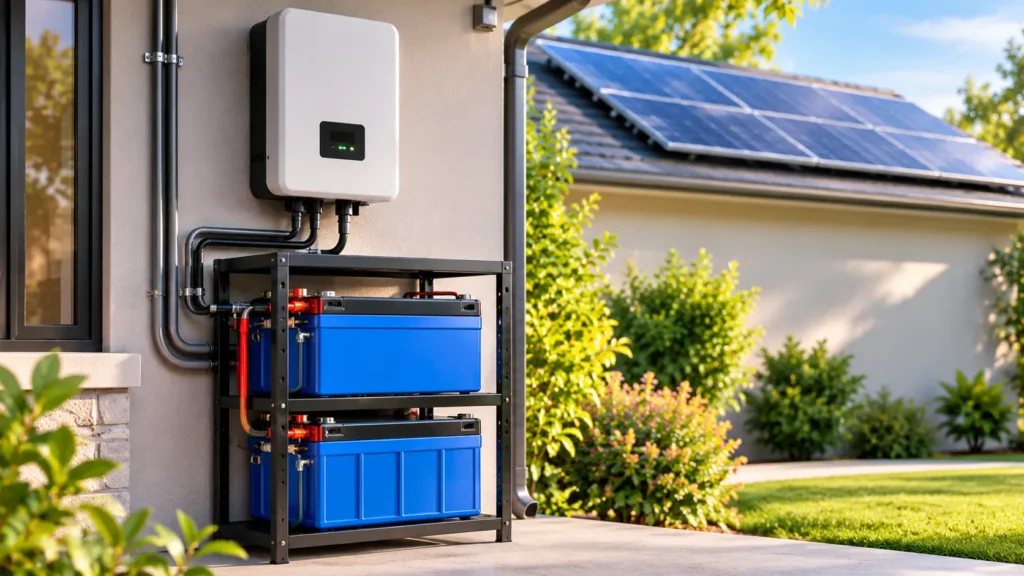
Advantages of LiFePO4 Batteries for Solar Energy Storage
LiFePO4 batteries have several characteristics that make them attractive for solar installations.
Long Potential Cycle Life
LiFePO4 batteries are designed for repeated charging and discharging.
Many quality products offer cycle-life specifications measured in thousands of cycles, although the actual number depends on the product and its testing conditions.
A battery’s cycle rating typically refers to the point at which its capacity declines to a specified percentage of its original value.
A high cycle-life rating does not mean the battery will operate indefinitely.
High Usable Battery Capacity
Usable capacity is the portion of stored energy that can be discharged under the manufacturer’s operating limits.
Many LiFePO4 systems permit relatively deep discharge compared with conventional lead-acid designs.
This can reduce the amount of nominal battery capacity needed for a particular daily energy requirement.
However, usable capacity must always be taken from the actual battery specifications.
Relatively Low Maintenance
Most sealed LiFePO4 batteries do not require routine electrolyte topping-up or the maintenance associated with flooded lead-acid batteries.
Homeowners still need to monitor system health, maintain suitable installation conditions, and follow manufacturer instructions.
Good Efficiency
Lithium-based storage systems can offer high charge and discharge efficiency.
However, total system efficiency depends on the battery, inverter, charge controller, operating conditions, and whether energy is converted between AC and DC.
Never assume that the efficiency of an individual battery is identical to the efficiency of the complete solar storage system.
Favorable Thermal Stability
LiFePO4 chemistry is generally considered more thermally stable than some other common lithium-ion chemistries.
That is an advantage, but it does not make LiFePO4 batteries fireproof or eliminate electrical hazards.
Safe operation still requires appropriate installation, compatible equipment, and functioning protective systems.
Flexible System Configurations
LiFePO4 batteries can be used in small and large storage installations.
Some products support parallel connections or modular expansion, but not all products can safely be connected in series or parallel.
Always follow the manufacturer’s approved configurations.
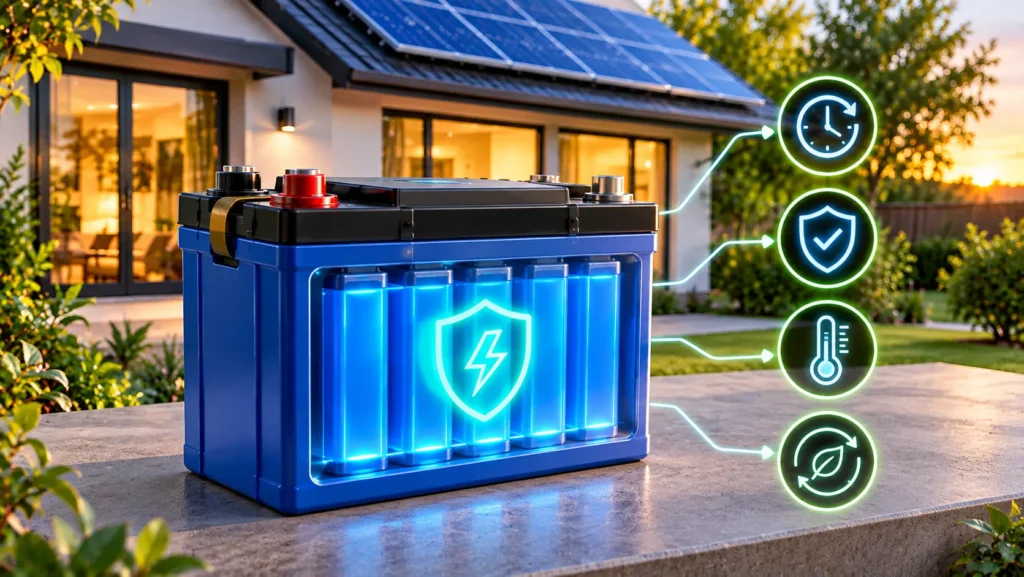
Disadvantages of LiFePO4 Solar Batteries
LiFePO4 technology also has limitations that homeowners should understand.
Higher Initial Purchase Cost
LiFePO4 batteries can cost more upfront than traditional lead-acid alternatives.
Their longer potential service life and usable capacity may improve long-term value, but the financial outcome depends on installation cost, actual usage, and replacement timing.
Cold-Temperature Charging Restrictions
Charging lithium batteries at low temperatures can cause permanent damage under certain conditions.
For example, Victron Energy’s Lithium Smart Battery operating guidance specifies a permitted charging temperature range of +5°C to +50°C for the particular models covered by that manual.
Other LiFePO4 products may have different limits or integrated heating systems.
The correct charging temperature range is always model-specific.
Compatibility Requirements
An existing solar inverter or charge controller may not support the charging profile, communications, or operating voltage of a new LiFePO4 battery.
Some systems require specific battery models, communication protocols, or firmware.
Battery Management Requirements
A properly designed BMS is essential for monitoring and protection.
Some batteries contain an integrated BMS, while other systems require a separate external BMS.
For example, Victron Energy’s Lithium Smart Battery manual describes batteries that require a compatible external BMS.
Capacity Declines Over Time
LiFePO4 batteries still experience calendar aging and cycling-related degradation.
The usable storage capacity gradually declines, even if the battery continues operating.
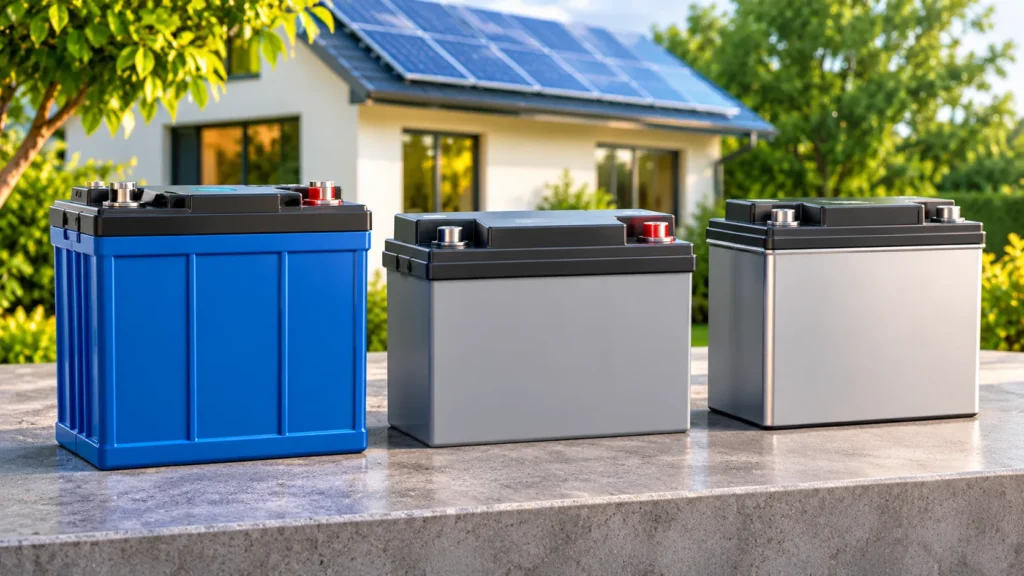
LiFePO4 vs Lead-Acid vs Other Lithium-Ion Batteries
Choosing the right battery chemistry affects installation requirements, operating costs, and long-term performance.
| Feature | LiFePO4 (LFP) | Lead-Acid | Other Lithium-Ion Chemistries |
|---|---|---|---|
| Battery chemistry | Lithium iron phosphate | Lead-acid | Varies, including NMC |
| Potential cycle life | Generally high | Generally lower | Depends on chemistry and design |
| Usable capacity | Often relatively high | Frequently more restricted | Product-dependent |
| Routine maintenance | Usually low | Can be higher | Usually low |
| Weight for equivalent energy | Relatively low | Typically higher | Often relatively low |
| Initial cost | Often higher than lead-acid | Often lower | Varies |
| Charging requirements | Lithium-specific | Lead-acid-specific | Chemistry-specific |
| Thermal behavior | Favorable relative to some lithium chemistries | Different hazard profile | Varies |
| Common solar application | Residential and off-grid storage | Budget and legacy systems | Residential and other storage systems |
These are general characteristics, not specifications for every battery sold.
Which Battery Type Is Better for Home Solar?
LiFePO4 is often a strong option for homeowners who expect frequent charging and discharging, want low routine maintenance, and plan to use storage for many years.
Lead-acid may still suit certain low-budget or occasional-use applications.
Other lithium-ion technologies can also be appropriate, particularly when supplied as part of a fully integrated, certified residential storage system.
The best choice depends on total installed cost, compatibility, warranty, usable energy, and operating conditions—not chemistry alone.
How to Size a LiFePO4 Battery for Your Home
Correct battery sizing starts with your electricity needs, not simply the number of solar panels installed.
A battery that is too small may provide insufficient backup time. An unnecessarily large system may increase installation costs without delivering proportional benefits.
Step 1: Calculate Daily Electricity Consumption
Start by estimating how much energy your appliances use.
The formula is:
Daily energy (Wh) = Appliance power (W) × Hours used per day
Suppose your essential appliances include:
| Appliance | Average Power | Daily Use | Daily Energy |
|---|---|---|---|
| Refrigerator | 100W | 10 equivalent running hours | 1,000Wh |
| LED lighting | 60W | 5 hours | 300Wh |
| Wi-Fi router | 15W | 24 hours | 360Wh |
| Television | 100W | 4 hours | 400Wh |
| Fans | 120W | 6 hours | 720Wh |
| Total | 2,780Wh |
Your estimated daily energy requirement is:
2,780Wh ÷ 1,000 = 2.78 kWh
These figures are illustrative. Actual refrigerator consumption and other appliance loads vary by model and usage.
Use our Appliance Wattage Chart to help estimate the wattage of household equipment.
Step 2: Account for Usable Capacity and Efficiency
A battery’s nameplate capacity is not always equal to the energy delivered to your appliances.
For a simplified estimate:
Required nominal battery capacity (kWh) = Daily energy requirement ÷ (Usable fraction × Discharge efficiency)
Assume:
Daily energy requirement: 2.78 kWh.
Usable battery fraction: 90%.
Discharge efficiency: 90%.
Calculation:
2.78 ÷ (0.90 × 0.90) = 3.43 kWh
Under these assumptions, approximately 3.43 kWh of nominal battery capacity would be required to supply one day’s estimated essential-load energy without recharging.
A practical battery selection should also consider reserve capacity, battery aging, surge loads, and future electricity needs.
If the manufacturer’s usable AC capacity already includes the relevant losses, do not deduct those losses a second time.
Step 3: Consider Backup Duration
A household requiring 3 kWh of delivered electricity per day would need approximately 6 kWh of delivered energy for two days without solar recharging.
This does not automatically mean a 6 kWh nameplate battery is sufficient.
Usable capacity, conversion losses, temperature, and battery state of charge still matter.
For preliminary planning, use the Solar Battery Calculator and our Off-Grid Solar Calculator.
Step 4: Check Power Output, Not Just Capacity
Battery capacity is measured in kilowatt-hours (kWh).
Battery or inverter power output is measured in kilowatts (kW).
A battery may store enough energy for several hours but still be unable to start or operate a large appliance if its discharge power or inverter surge capacity is insufficient.
For example, a battery system with 10 kWh of usable energy but a maximum continuous AC output of 3 kW cannot continuously supply a 5 kW household load.
Both energy capacity and power capacity must be considered.
12V vs 24V vs 48V LiFePO4 Solar Batteries
LiFePO4 batteries are commonly available in different nominal voltage classes.
A four-cell LiFePO4 battery pack is commonly rated at 12.8V, while eight-cell and sixteen-cell configurations are commonly rated at 25.6V and 51.2V.
These are often marketed as 12V, 24V, and 48V batteries.
12V LiFePO4 Batteries
12V-class batteries are often used for smaller off-grid installations, recreational vehicles, cabins, and modest DC loads.
They can be suitable where power requirements are relatively low.
24V LiFePO4 Batteries
24V-class systems may be appropriate for medium-sized off-grid installations.
For the same power level, a higher battery voltage generally means lower current than a 12V system.
48V LiFePO4 Batteries
48V-class systems are common in larger residential and off-grid battery installations.
Higher voltage can reduce current for the same delivered DC power, which can help with cable sizing and resistive losses.
However, 48V-class batteries must be paired with compatible equipment.
Voltage and Battery Capacity Example
Battery energy can be estimated using:
Energy (Wh) = Nominal voltage (V) × Capacity (Ah)
| Battery Configuration | Capacity | Nominal Energy |
|---|---|---|
| 12.8V LiFePO4 | 100Ah | 1.28 kWh |
| 25.6V LiFePO4 | 100Ah | 2.56 kWh |
| 51.2V LiFePO4 | 100Ah | 5.12 kWh |
For example:
51.2V × 100Ah = 5,120Wh = 5.12 kWh
This is nominal stored energy, not necessarily the usable energy delivered to AC appliances.
Important: Never connect batteries in series or parallel unless the manufacturer explicitly permits that arrangement and specifies the required protective equipment.
LiFePO4 Battery Charging and Solar Inverter Compatibility
A LiFePO4 battery must be charged within its specified voltage, current, and temperature limits.
Solar storage systems may use a hybrid inverter, a dedicated battery charger, an MPPT solar charge controller, or an integrated storage system.
Use a Compatible Charging Profile
Lead-acid and LiFePO4 batteries do not necessarily use the same charging settings.
An unsuitable charging profile can reduce performance or damage equipment.
Always configure charging according to the specific battery manufacturer’s documentation.
Check the Battery Management System
The BMS helps monitor conditions such as:
Individual cell voltage.
Battery temperature.
Charging and discharging current.
Overvoltage and undervoltage.
Cell balancing and protective shutdowns.
Not every BMS provides identical features.
Verify Inverter Communication
Some modern residential batteries communicate with inverters using approved protocols.
A battery that appears electrically compatible may still be unsupported by a particular inverter.
Check the manufacturer’s compatibility list before purchasing.
Understand Low-Temperature Protection
LiFePO4 batteries generally require charging restrictions in cold conditions.
Some models include low-temperature charging cutoffs or integrated heating.
For example, Victron Energy’s battery installation guidance describes model-specific minimum charging temperature settings.
Never disable temperature protections to force charging in unsafe conditions.
How Long Do LiFePO4 Solar Batteries Last?
LiFePO4 batteries can offer long service lives, but there is no universal lifespan that applies to every model.
Battery longevity depends on:
Cell quality and manufacturing.
Charge and discharge cycles.
Depth of discharge.
Temperature exposure.
Charging settings.
Battery management.
Calendar aging.
Many residential lithium battery systems are planned around a service life of roughly 10–15 years, but actual LiFePO4 products can perform differently.
A cycle-life specification should be interpreted alongside its test conditions and remaining-capacity threshold.
For example, a hypothetical battery rated for 4,000 cycles at a specified capacity-retention threshold does not automatically have a guaranteed lifespan of 4,000 days.
Calendar aging and operating conditions still matter.
LiFePO4 Battery Safety and Installation
LiFePO4 batteries are often selected partly because of their favorable thermal characteristics.
However, a home energy storage system contains substantial electrical energy and must be installed correctly.
Look for Appropriate Certifications
For a U.S. residential installation, ask the installer about applicable safety requirements and certifications, which may include:
UL 9540 for energy storage systems.
UL 1973 for relevant stationary battery applications.
UL 9540A testing where required for evaluating thermal runaway fire propagation characteristics.
Applicable electrical, building, and fire codes.
These standards address different aspects of safety and should not be treated as interchangeable.
Use Qualified Installers
Residential battery installation may require electrical permits, utility coordination, inspection, and manufacturer-approved equipment.
Requirements vary by jurisdiction.
Choose a Suitable Location
Battery placement should account for manufacturer requirements, temperature exposure, weather protection, access clearances, and applicable fire safety rules.
Not every battery is rated for outdoor installation.
Never Attempt Cell-Level Repairs
Do not open sealed battery packs, bypass protective devices, or attempt to repair damaged lithium cells.
If the system shows swelling, overheating, smoke, or other serious abnormalities, follow the manufacturer’s emergency instructions and seek appropriate professional assistance.
How Much Do LiFePO4 Batteries for Solar Cost?
LiFePO4 battery prices vary widely based on capacity, design, certifications, brand, and installation requirements.
A small standalone battery for a cabin is not directly comparable with a fully installed residential energy storage system.
The total cost may include:
Battery modules or a complete battery cabinet.
Hybrid inverter or compatible battery inverter.
Charge controller, where needed.
Battery management and monitoring equipment.
Electrical protection and wiring.
Installation labor.
Permits and inspections.
Backup transfer equipment, where applicable.
Because prices change and products differ significantly, comparing batteries using only their advertised purchase price can be misleading.
Compare Cost per Usable kWh
A useful initial metric is:
Cost per usable kWh = Battery price ÷ Usable capacity
For example, suppose a battery costs $2,000 and provides 4.6 kWh of usable capacity.
$2,000 ÷ 4.6 = approximately $435 per usable kWh
This is an illustrative calculation, not a current market quotation.
Consider Lifetime Energy Throughput
Another comparison considers the total amount of energy a battery may deliver during its useful life.
A simplified estimate is:
Lifetime delivered energy = Usable capacity × Equivalent full cycles × Discharge efficiency
For example, assume:
Usable battery capacity: 5 kWh.
Illustrative cycle count: 4,000.
Assumed discharge efficiency: 90%.
Estimated delivered energy:
5 × 4,000 × 0.90 = 18,000 kWh
If the battery alone costs $3,000:
$3,000 ÷ 18,000 = approximately $0.167 per delivered kWh
This simplified figure excludes installation, financing, calendar aging, replacement components, and other system costs.
It also assumes the stated energy throughput is achievable, which may not occur in a real installation.
The example demonstrates a comparison method rather than a guaranteed lifetime cost.
To assess broader project economics, use our Solar Cost Calculator and Solar ROI Calculator.
How to Choose the Best LiFePO4 Solar Battery for Your Home
The best LiFePO4 battery is the one that meets your actual energy requirements and works safely with your solar equipment.
Use the following checklist before comparing products.
1. Determine Your Energy Storage Needs
Estimate your essential household loads, expected backup duration, and daily electricity consumption.
Do not size a battery based solely on home square footage.
2. Compare Usable Capacity
Check the battery’s usable kWh rating rather than relying only on nominal capacity.
Also confirm whether the published figure is measured at the battery terminals or represents AC-delivered energy.
3. Check Continuous and Surge Power
A battery must support the required power output, including short-duration startup loads.
Check the limits of both the battery and inverter.
4. Verify System Compatibility
Confirm that the battery, inverter, charging equipment, and BMS are approved to operate together.
5. Review Warranty Terms
Compare warranty duration, capacity retention, energy throughput limits, exclusions, and installation requirements.
A longer warranty does not automatically guarantee better overall performance.
6. Consider Local Climate
Check operating temperature ranges, low-temperature charging protection, and enclosure ratings.
7. Evaluate Total Installed Cost
Compare the complete installed system, not only the price of individual battery modules.
8. Check Manufacturer Support
Review product documentation, warranty service arrangements, monitoring capabilities, and local installer support.
For U.S. homeowners, confirm that the product and installation meet applicable local requirements.
Are LiFePO4 Batteries Worth It for Solar Energy Storage?
LiFePO4 batteries can be worthwhile for households that need frequent energy storage, reliable backup capability, or greater flexibility in how they use solar electricity.
Their long potential cycle life and low maintenance requirements can make them attractive compared with traditional lead-acid batteries.
However, financial savings are not automatic.
The outcome depends on:
Total installed battery cost.
Local electricity prices.
Time-of-use tariffs.
Solar generation.
Household electricity demand.
Export compensation rules.
Backup power requirements.
Battery degradation and replacement costs.
For some households, resilience during outages may justify a battery even when the financial payback period is long.
For others, using solar electricity directly or improving household energy efficiency may be more cost-effective.
Frequently Asked Questions
Are LiFePO4 batteries good for solar energy storage?
Yes. LiFePO4 batteries are commonly used in solar energy storage because they offer long potential cycle life, relatively high usable capacity, and low routine maintenance. Suitability still depends on system design and compatibility.
Is LiFePO4 better than lithium-ion for solar?
LiFePO4 is itself a lithium-ion battery chemistry. Compared with some other lithium-ion chemistries, it generally offers favorable thermal stability and long cycle life. The best option depends on the specific battery system.
Can I use a LiFePO4 battery with existing solar panels?
Possibly, but compatibility depends on the inverter, charge controller, battery voltage, BMS, and system configuration. A qualified installer should verify compatibility before installation.
What size LiFePO4 battery do I need for a house?
The required size depends on household electricity consumption, essential loads, backup duration, and usable battery capacity. For example, a household needing 8 kWh of delivered backup energy may require more than 8 kWh of nominal battery capacity after accounting for usable limits and conversion losses.
Can LiFePO4 batteries power an entire house?
Yes, a properly sized and configured LiFePO4 battery system can support whole-home loads, but sufficient energy capacity and inverter power are essential. High-demand appliances can substantially increase system requirements.
How many LiFePO4 batteries do I need for a 5kW solar system?
There is no fixed number. A 5kW solar array describes generation capacity, not daily consumption or storage requirements. Battery quantity depends on each battery’s usable kWh capacity and the energy you want to store.
Can LiFePO4 batteries be charged directly from solar panels?
Solar charging requires suitable charging controls. Connecting panels directly to a battery without appropriate regulation and protection can damage equipment and create safety hazards.
Do LiFePO4 batteries work in winter?
Yes, within their specified operating conditions. Cold temperatures can reduce performance and restrict charging. Some models have integrated heating or charging protection.
Do LiFePO4 solar batteries need a BMS?
Yes, a properly designed battery management system is an essential part of a LiFePO4 storage installation. The BMS may be integrated into the battery or supplied separately, depending on the product.
Can I mix LiFePO4 batteries with lead-acid batteries?
Do not directly combine different battery chemistries into one battery bank unless a manufacturer-approved system explicitly supports that configuration. Different charging and operating characteristics can create serious compatibility problems.
Final Thoughts
LiFePO4 batteries for solar energy storage are a strong option for homeowners seeking long-lasting, rechargeable energy storage with high usable capacity and relatively low maintenance.
Their advantages include long potential cycle life, favorable thermal stability, and flexibility across different solar system sizes.
However, successful battery storage depends on more than chemistry. Correct capacity, charging settings, inverter compatibility, BMS protection, temperature management, and professional installation are essential.
Before purchasing a battery, calculate your energy needs, compare usable capacity and warranty terms, and evaluate the complete installed cost.
Start with our Solar Battery Calculator to estimate storage requirements, then explore our All Solar Calculators for additional system-planning tools.
Authoritative Sources and Further Reading
- U.S. Department of Energy — Solar Integration: Solar Energy and Storage Basics
Victron Energy — Lithium Smart Battery: Introduction and BMS Requirements
Victron Energy — Lithium Smart Battery: Operation and Temperature Limits
Disclaimer: Battery specifications, calculations, and examples in this article are for general educational purposes. They do not replace manufacturer documentation, electrical engineering advice, or a professional installation assessment.