- Solar Guides
How Long Do Solar Batteries Last? Lifespan Guide (2026)
How long do solar batteries last? Most modern lithium-ion solar batteries last approximately 10 to 15 years, while lead-acid batteries generally have shorter useful lifespans of around 2 to 7 years, depending on their design, usage, and maintenance.
However, solar battery lifespan is not the same as how long a battery powers your home on a single charge. A battery may operate for more than a decade but supply electricity for only a few hours during an outage, depending on its capacity and your household’s energy consumption.
In this guide, you’ll learn how long different solar batteries last, what causes battery degradation, how to calculate backup runtime, and when replacing a battery makes financial sense.
How Long Do Solar Batteries Last on Average?
A solar battery’s useful life depends primarily on its chemistry, operating temperature, charging habits, and how frequently it is discharged.
Modern residential battery systems commonly use lithium-ion technology, particularly lithium iron phosphate (LFP), because it offers relatively long cycle life and low routine maintenance requirements.
According to EnergySage’s solar battery lifespan guide, many modern home solar batteries remain useful for roughly 10 to 15 years.
The following table provides broad planning ranges rather than guaranteed lifespans.
| Solar Battery Type | Approximate Useful Lifespan | Typical Application |
|---|---|---|
| Lithium iron phosphate (LFP) | 10–15 years or potentially longer | Modern residential energy storage |
| Other lithium-ion chemistries | Approximately 7–15 years | Residential and specialty storage |
| Lead-acid (flooded or sealed) | Approximately 2–7 years | Older off-grid and budget systems |
| Flow batteries | System-specific; often designed for long-duration cycling | Primarily commercial and larger installations |
These ranges overlap because battery construction, operating conditions, and manufacturer specifications can matter as much as chemistry.
A well-managed battery can continue operating after its expected service life, but its available storage capacity will usually decline over time.
Key takeaway: If you’re installing a modern home solar battery in 2026, a 10- to 15-year planning horizon is reasonable, but always evaluate the manufacturer’s warranty and performance specifications.
Solar Battery Lifespan by Battery Type
Not all solar batteries age at the same rate. Understanding the differences helps homeowners choose a storage system that matches their energy needs and long-term budget.
1. Lithium Iron Phosphate (LFP) Batteries
Lithium iron phosphate batteries are a popular choice for residential solar storage.
LFP is a type of lithium-ion chemistry known for its thermal stability and ability to tolerate repeated charging and discharging.
Advantages include:
Long potential cycle life.
High usable capacity in many modern products.
Integrated battery management systems.
Relatively low routine maintenance.
Suitability for daily solar energy storage.
However, LFP batteries still degrade. Extreme temperatures, heavy cycling, and improper operation can shorten their useful life.
An LFP battery’s advertised cycle count should never be treated as a guaranteed number of years. The manufacturer’s test conditions and remaining-capacity threshold are essential.
2. Other Lithium-Ion Batteries
Other lithium-ion chemistries, including nickel manganese cobalt (NMC), are also used in energy storage applications.
Their lifespan depends on the particular cell design, operating temperature, charging limits, and battery management system.
Some systems prioritize energy density, while others emphasize long cycle life.
For homeowners, comparing warranty terms and usable capacity is more meaningful than assuming every lithium-ion battery performs identically.
3. Lead-Acid Solar Batteries
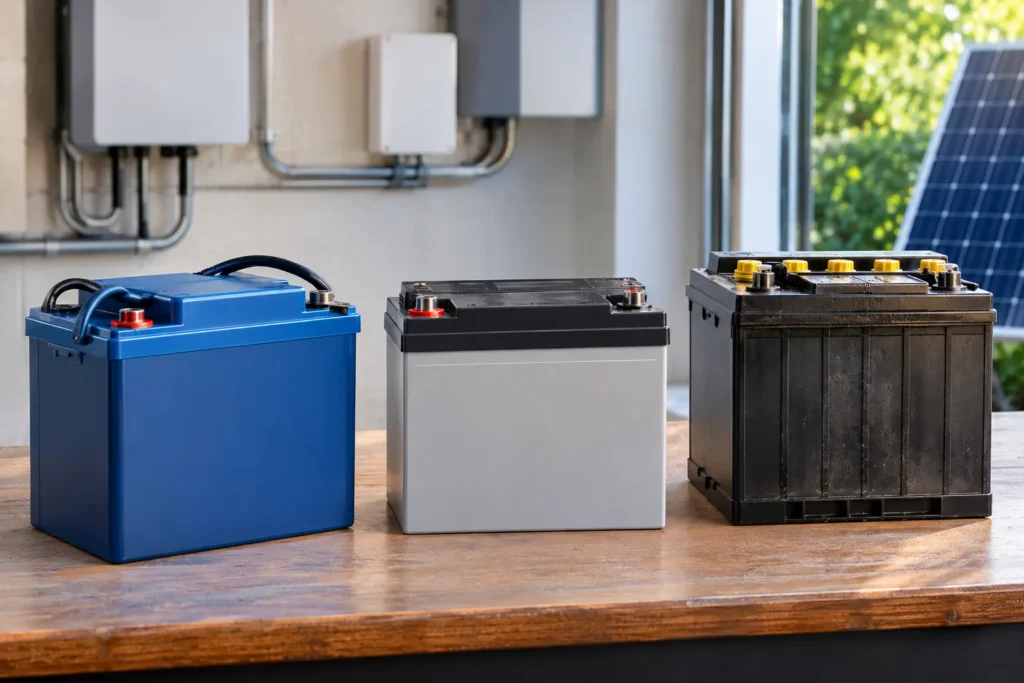
Lead-acid batteries have traditionally been used in off-grid solar systems, recreational vehicles, and backup power installations.
They are often less expensive upfront than lithium-ion alternatives, but typically require replacement sooner.
Two common categories are:
Flooded lead-acid batteries: These may require electrolyte checks, appropriate ventilation, and periodic maintenance according to manufacturer instructions.
Sealed lead-acid batteries: AGM and gel designs generally require less routine maintenance, but still need correct charging and temperature management.
Lead-acid batteries can experience substantial capacity loss when repeatedly discharged deeply.
For this reason, their practical usable capacity may be considerably lower than their nameplate capacity.
4. Flow Batteries
Flow batteries store energy using liquid electrolytes and are primarily associated with larger or specialized energy storage systems.
They can be designed for frequent cycling, but their economics, maintenance needs, and system complexity differ from typical residential lithium-ion products.
They are not the standard choice for most rooftop solar homes.
What Factors Affect Solar Battery Lifespan?
Even batteries with the same rated capacity can age differently.
The most important factors are battery chemistry, cycling frequency, depth of discharge, temperature, and charging conditions.
Battery Charge and Discharge Cycles
A battery cycle represents energy discharged and subsequently replenished, commonly measured as an equivalent full cycle.
For example, two discharges of 50% of rated capacity can represent approximately one equivalent full discharge cycle, although actual cycle accounting varies by manufacturer.
Daily cycling generally causes more cumulative wear than occasional backup use, all else being equal.
However, calendar aging also occurs when a battery is rarely used.
According to the National Renewable Energy Laboratory’s (NREL) System Advisor Model discussion, solar battery capacity declines through two main processes: cycle degradation, caused by repeated charging and discharging, and calendar degradation, which occurs naturally as the battery ages, even when it is not frequently used.
Depth of Discharge (DoD)
Depth of discharge describes how much of a battery’s capacity has been used.
For example:
A 10 kWh battery discharged by 20% has delivered approximately 2 kWh.
The same battery discharged by 80% has delivered approximately 8 kWh.
Repeated deep discharging can increase wear, depending on battery chemistry and system design.
Modern battery management systems often reserve some capacity internally to protect the cells.
Important: Follow the manufacturer’s operating recommendations rather than imposing an arbitrary discharge limit on every battery.
Temperature and Installation Conditions
Temperature significantly affects battery performance and aging.
Prolonged exposure to high temperatures can accelerate chemical degradation. Extremely cold conditions can also reduce available power and charging performance.
A properly designed battery installation should account for local climate, ventilation, weather protection, and manufacturer-approved operating temperatures.
This is especially important in hot regions of the United States and Australia or areas with harsh winters.
Never assume that an outdoor-rated battery can be installed in any location without additional environmental considerations.
Charging and Battery Management
Incorrect charging settings can damage batteries or accelerate degradation.
Modern residential systems generally use a battery management system (BMS) to monitor conditions such as voltage, temperature, and current.
The BMS helps keep the battery within its permitted operating range.
For safe operation, use compatible inverters, approved charging equipment, and manufacturer-supported configurations.
Daily Electricity Consumption
A household that frequently discharges its battery to support evening electricity use may accumulate more cycles than one that reserves storage mainly for emergencies.
However, daily use does not automatically mean the battery will fail prematurely.
Battery life depends on how the product was engineered and whether the actual operating pattern falls within its design and warranty limits.
How Long Does a Solar Battery Last on One Charge?
This is a different question from how many years a battery will last.
Battery lifespan measures useful operating years.
Battery backup runtime measures how many hours the stored electricity can power your appliances.
A large battery supplying a small load can last much longer than the same battery supplying an air conditioner, electric heater, or several major appliances simultaneously.
Solar Battery Backup Runtime Formula
A simplified calculation is:
Backup runtime (hours) = Battery capacity (kWh) × Usable fraction × Discharge efficiency ÷ Average load (kW)
Here:
Battery capacity is the rated stored energy.
Usable fraction is the portion of capacity available for discharge.
Discharge efficiency accounts for energy lost while supplying power.
Average load is the average electricity demand of the appliances being powered.
If a manufacturer already specifies usable AC-delivered capacity, do not subtract the same losses twice.
Example: How Long Will a 10 kWh Solar Battery Last?
Suppose a household has:
Rated battery capacity: 10 kWh.
Usable fraction: 90%.
Assumed discharge efficiency: 90%.
Average backup load: 500 watts (0.5 kW).
The estimated delivered energy is:
10 × 0.90 × 0.90 = 8.1 kWh
Estimated runtime:
8.1 ÷ 0.5 = 16.2 hours
Under these simplified assumptions, the battery could supply a steady 500-watt load for approximately 16 hours.
Actual runtime will vary with the battery’s state of charge, age, temperature, inverter performance, and changes in appliance demand.
Battery Backup Runtime Comparison
The following examples use an assumed 90% usable fraction and 90% discharge efficiency, with no solar recharging during the outage.
| Rated Battery Capacity | 500W Average Load | 1,000W Average Load | 2,000W Average Load |
|---|---|---|---|
| 5 kWh | 8.1 hours | 4.1 hours | 2.0 hours |
| 10 kWh | 16.2 hours | 8.1 hours | 4.1 hours |
| 15 kWh | 24.3 hours | 12.2 hours | 6.1 hours |
| 20 kWh | 32.4 hours | 16.2 hours | 8.1 hours |
All figures are illustrative estimates, rounded to one decimal place. They are not manufacturer performance guarantees.
The table shows why understanding your household’s actual electrical load is essential.
For a more personalized estimate, use our Solar Battery Calculator to plan storage capacity around your needs.
Can Solar Panels Recharge a Battery During a Power Outage?
Yes, but only if the solar and battery system is designed and configured to operate during a grid outage.
A standard grid-tied solar installation without suitable backup equipment normally shuts down when the utility grid fails.
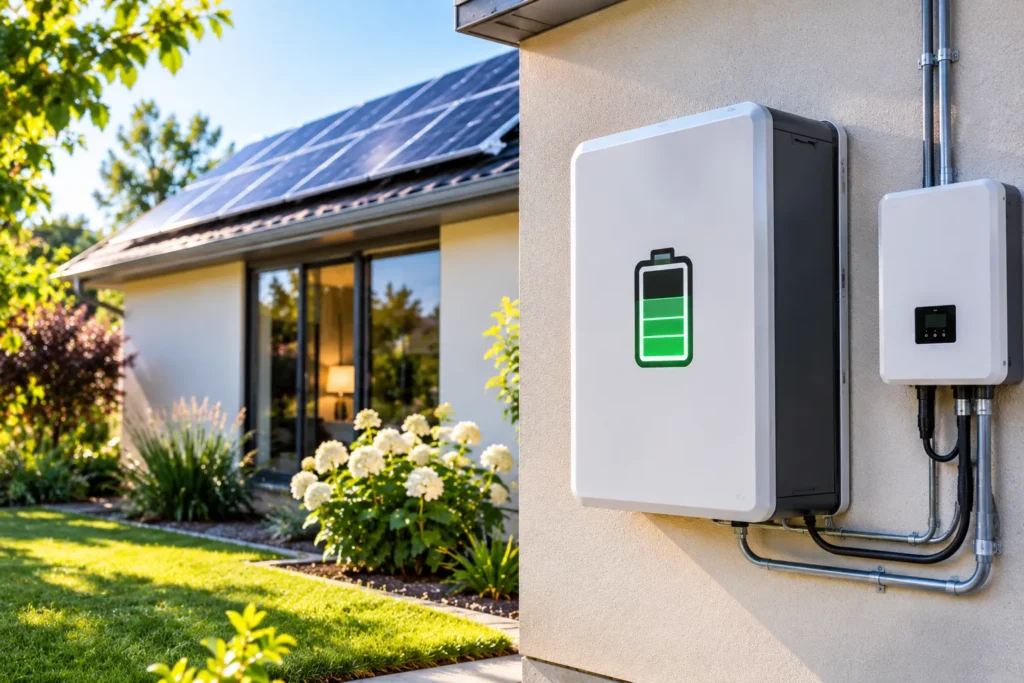
A properly configured backup-capable system can isolate itself from the grid and use available solar generation to support household loads and recharge the battery.
That can extend backup duration beyond what one full battery charge would provide.
However, continued operation depends on:
Available sunlight and weather conditions.
Solar panel generation.
Household electricity demand.
Battery charging capacity.
Inverter and backup-system limitations.
A battery cannot recharge from solar panels at night, and cloudy weather may significantly reduce charging.
Use our Solar Production Calculator to estimate potential solar generation under different system assumptions.
For homes designed to operate independently of the utility grid, our Off-Grid Solar Calculator can help with preliminary system planning.
Solar Battery Warranty vs Actual Lifespan
A battery warranty is not the same as a promise that the battery will stop working at the end of the coverage period.
Many residential battery manufacturers provide warranties of approximately 10 years, although specific terms differ.
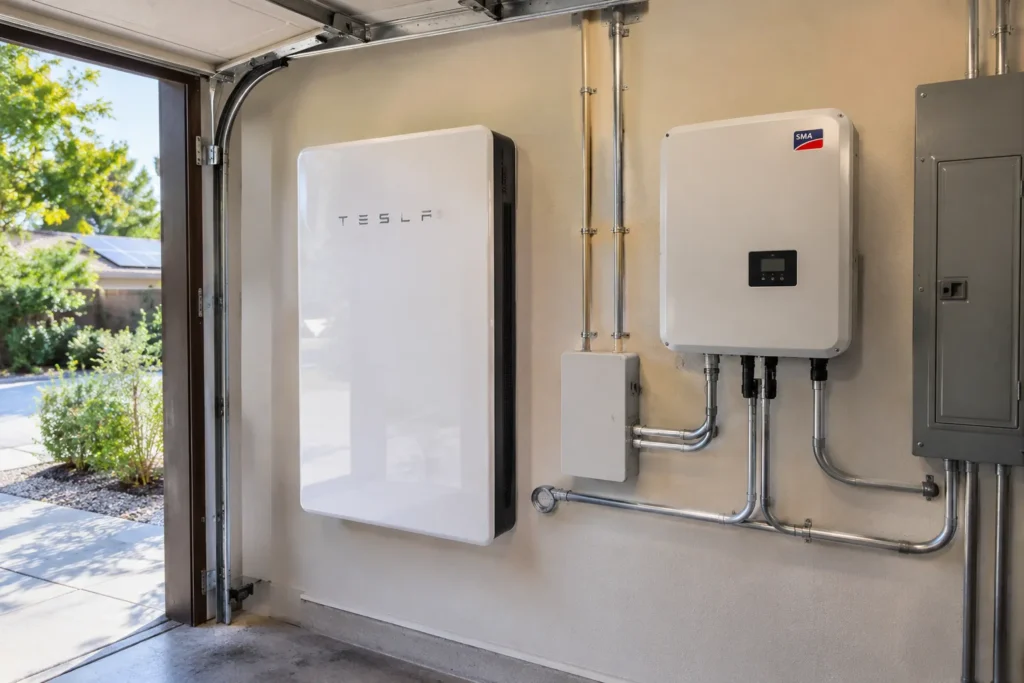
For example, Tesla lists a 10-year warranty for Powerwall 3. Coverage conditions and requirements must be checked in the applicable regional warranty documentation.
Battery warranties may specify several different protections.
Warranty Duration
This describes how long the manufacturer provides coverage under the applicable terms.
Capacity Retention
A performance warranty may promise that the battery retains a minimum percentage of its original capacity after a stated period.
For example, a hypothetical battery originally storing 10 kWh that retains 70% of its capacity would store approximately 7 kWh under comparable measurement conditions.
That does not necessarily mean the battery has failed. It means its energy storage capacity has declined.
Cycle or Energy Throughput Limits
Some warranties include limits on cumulative charging and discharging.
Energy throughput is the total amount of energy processed over time, often measured in megawatt-hours (MWh).
A warranty with a throughput restriction may provide different practical coverage from one without such a limit.
Before purchasing a solar battery, compare the full warranty document rather than relying only on the advertised warranty length.
How to Make Solar Batteries Last Longer
Proper system design and operation can help protect your investment.
1. Choose a Battery Designed for Your Usage
Select a battery with sufficient usable capacity for your normal electricity demand and intended backup loads.
An undersized system may experience more demanding cycling than expected.
Our Solar Battery Size Calculator can support the initial sizing process.
2. Follow Manufacturer Charging Limits
Use the manufacturer’s recommended charging settings and compatible equipment.
Do not bypass battery management protections.
3. Avoid Excessive Heat
Install the battery in an approved location with suitable environmental protection and ventilation where required.
Temperature limits vary by model.
4. Monitor Battery Performance
Check the manufacturer’s monitoring app or control system for changes in available capacity, charging behavior, and error messages.
Unexpected performance changes may indicate a maintenance issue.
5. Keep Software Updated
Where supported, firmware updates may improve system operation, monitoring, or compatibility.
Follow the manufacturer’s update guidance.
6. Schedule Professional Inspections When Needed
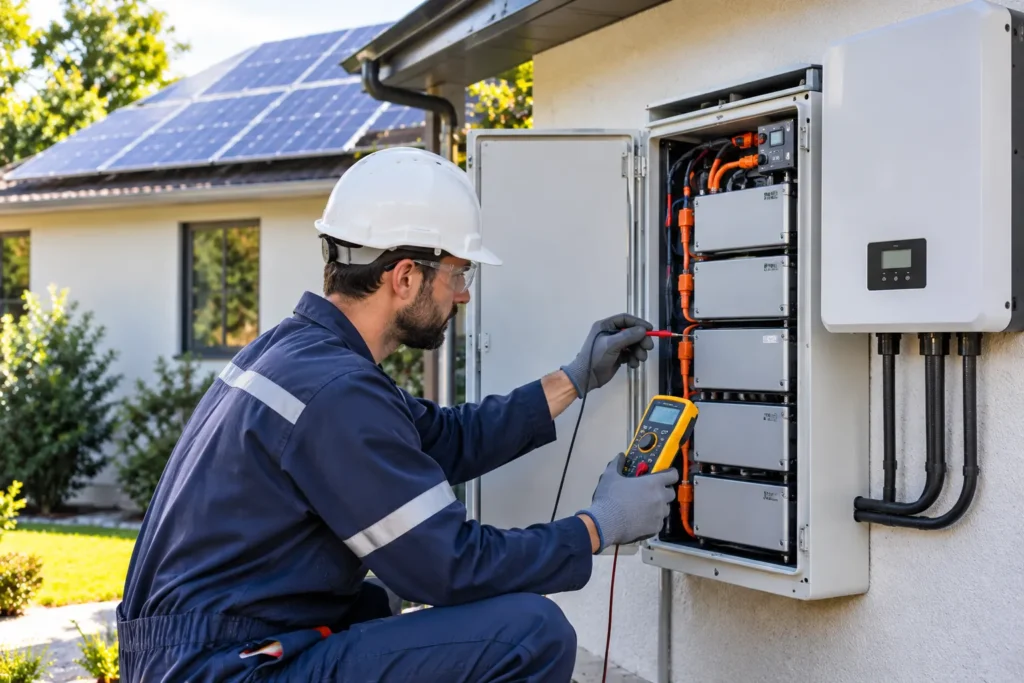
Have a qualified professional assess damaged wiring, unusual battery behavior, persistent faults, or suspected installation problems.
Never open a sealed battery enclosure or attempt to repair damaged battery cells yourself.
How Much Does Solar Battery Replacement Cost?
Solar battery replacement costs vary substantially by country, battery capacity, chemistry, manufacturer, and installation requirements.
The total expense may include:
Replacement battery equipment.
Installation labor.
Electrical modifications.
Inverter or system compatibility upgrades.
Removal and approved recycling of the old battery.
Permits or inspection fees where applicable.
A battery replacement may cost less than a completely new storage installation if existing components remain compatible, but that should never be assumed without an installer assessment.
When comparing options, consider the battery’s usable capacity, expected service life, warranty coverage, and total installed cost.
A cheaper battery that needs replacing more frequently may not provide better lifetime value.
For a broader view of your solar investment, explore our Solar ROI Calculator.
Solar Battery Lifespan vs Solar Panel Lifespan
Solar panels and batteries are both important parts of a solar energy system, but their expected lifespans differ.
| Component | Typical Planning Lifespan | Main Aging Concern |
|---|---|---|
| Solar panels | Approximately 25–30 years or longer | Gradual decline in electricity output |
| Modern lithium-ion solar batteries | Approximately 10–15 years | Decline in energy storage capacity |
| Lead-acid solar batteries | Approximately 2–7 years | Capacity loss and cycling-related wear |
Solar panels can continue producing electricity after their typical planning lifespan, while batteries may need replacing sooner.
This means a homeowner could replace a solar battery one or more times during the operating life of a rooftop solar array.
For a detailed comparison, read our guide on How Long Solar Panels Last on a Roof.
Are Long-Lasting Solar Batteries Worth It?
A longer battery lifespan can improve the economics of solar storage, but it is not the only factor that matters.
A suitable battery may provide value by:
Supplying electricity during qualifying grid outages.
Increasing the use of solar electricity generated at home.
Reducing grid purchases during expensive electricity periods, where applicable.
Supporting selected critical appliances.
Improving energy flexibility.
Whether a battery is financially worthwhile depends on local electricity tariffs, compensation for exported solar energy, installation cost, battery performance, and household consumption patterns.
For some households, backup reliability may be the primary benefit rather than financial savings.
It is important to calculate realistic costs and benefits instead of assuming every solar battery will pay for itself.
Frequently Asked Questions
How long do solar panel batteries last?
Modern lithium-ion solar panel batteries commonly have useful lifespans of around 10 to 15 years. Lead-acid models often last fewer years. Actual results depend on battery design, usage, temperature, and maintenance.
Can a solar battery last 20 years?
Some batteries may continue operating for 20 years under favorable conditions, but that should not be assumed for a typical residential installation. A battery can also remain operational while delivering substantially less capacity than when new.
How long does a solar battery last at night?
It depends on stored energy and electricity demand. For example, a 10 kWh battery with 8.1 kWh of estimated delivered energy could support a steady 1 kW load for approximately 8.1 hours, assuming no recharging.
How many years does a lithium solar battery last?
Many modern lithium-ion home batteries are expected to remain useful for roughly 10 to 15 years. Battery chemistry, warranty terms, and operating conditions determine the practical lifespan.
Do solar batteries lose capacity over time?
Yes. Rechargeable batteries experience calendar aging and cycling-related degradation. As capacity decreases, the battery may power the same appliances for fewer hours.
Do solar batteries need maintenance?
Most modern sealed lithium-ion home batteries require relatively little routine maintenance, but they still need appropriate installation, monitoring, and occasional professional attention. Flooded lead-acid batteries may have additional maintenance requirements.
How often do solar batteries need replacing?
Many homeowners using modern lithium-ion storage may plan for replacement after approximately 10 to 15 years. Replacement timing should be based on actual performance, condition, and economics rather than age alone.
What is the difference between battery lifespan and battery cycle life?
Battery lifespan refers to how many years the system remains useful. Cycle life refers to the number of equivalent charge-discharge cycles a battery can complete before reaching a specified capacity threshold under defined test conditions.
A high cycle-life rating does not eliminate calendar aging.
Final Thoughts
How long do solar batteries last? For most modern residential lithium-ion systems, 10 to 15 years is a useful planning estimate. Lead-acid batteries generally have shorter lifespans, while actual results vary with battery chemistry, temperature, charging habits, and daily use.
Remember that battery lifespan and backup runtime are two different measurements. A battery might last for more than a decade but supply electricity for only several hours on a single charge.
Before buying or replacing a solar battery, compare usable capacity, warranty terms, expected cycling, installation requirements, and long-term cost.
To estimate the storage capacity that suits your home, start with our Solar Battery Calculator.
References and Further Reading
Disclaimer: Lifespan ranges and backup calculations are educational estimates, not guarantees of product performance. Always consult the manufacturer’s specifications, warranty, and a qualified solar-storage installer for system-specific guidance.