- Solar Guides
How Many Solar Panels Do I Need? Calculate Panels for Your Home (2026)
How many solar panels do I need? For many U.S. homes, a starting estimate is approximately 16–23 modern solar panels, although the actual number depends on electricity consumption, available sunlight, panel wattage, and roof conditions.
A household using 900 kWh of electricity per month, for example, would need approximately 19 panels rated at 450 watts each under an illustrative assumption of four peak sun hours per day and 80% overall energy delivery.
But your home might need significantly fewer—or more—panels.
Two houses with identical floor areas can have completely different electricity needs. One may use efficient appliances and gas heating, while the other relies on electric heating, air conditioning, and an electric vehicle.
This guide explains how to calculate the number of solar panels needed to power a house, with practical formulas, electricity-bill examples, panel wattage comparisons, and roof-space considerations.
For a personalized starting estimate, try the Solar System Size Calculator.
How Many Solar Panels Do You Need to Power a House?
The number of solar panels required for a home depends primarily on three factors:
Electricity consumption: How many kilowatt-hours (kWh) your household uses.
Solar energy availability: How much usable sunlight reaches your panels.
Panel capacity: How much power each solar panel is rated to produce.
As a broad market reference, EnergySage’s 2026 residential solar guide estimates that many U.S. homes need around 16–23 panels to offset annual electricity consumption.
However, this is not a universal requirement. A smaller household may need fewer than 10 panels, while a high-consumption property may require 30 or more.
Quick Solar Panel Requirements by Monthly Electricity Usage
The following table estimates panel requirements using:
450W solar panels
Four average daily peak sun hours
An illustrative 80% overall energy-delivery factor
A 30-day month
A target of generating energy equivalent to 100% of monthly consumption
| Monthly electricity use | Estimated solar system size | 450W panels needed |
|---|---|---|
| 300 kWh | 3.13 kW | 7 |
| 500 kWh | 5.21 kW | 12 |
| 750 kWh | 7.81 kW | 18 |
| 900 kWh | 9.38 kW | 21 |
| 1,000 kWh | 10.42 kW | 24 |
| 1,200 kWh | 12.50 kW | 28 |
| 1,500 kWh | 15.63 kW | 35 |
All panel counts are rounded up to whole modules. The installed array capacity may therefore exceed the calculated minimum. These are illustrative planning estimates, not site-specific production forecasts.
The actual panel count can change considerably depending on location and system design.
How to Calculate How Many Solar Panels You Need
You can estimate your solar panel requirements using your electricity bill, local peak sun hours, and the wattage of the panels you intend to install.
Step 1: Find Your Monthly Electricity Consumption
Check your electricity bill for the number of kilowatt-hours consumed during the billing period.
For example, suppose your home uses:
900 kWh per month
Assuming a 30-day month:
900 ÷ 30 = 30 kWh per day
Your solar installation would need to generate an average of approximately 30 kWh daily to match that consumption over the assumed period.
For a better estimate, add up the last 12 months of electricity bills and divide by 365 to find your average daily consumption.
Annual data is especially useful when electricity usage changes significantly between summer and winter.
The U.S. Department of Energy recommends reviewing previous electricity bills when assessing residential solar requirements.
Step 2: Determine Your Peak Sun Hours
Peak sun hours represent the equivalent number of hours when solar irradiance averages 1,000 watts per square meter.
They are not the same as total daylight hours.
A location can experience 12 hours of daylight but receive considerably fewer equivalent peak sun hours because sunlight intensity changes throughout the day.
For example, consider a site with an assumed average of four peak sun hours daily.
This is a useful illustration, but actual values vary by location, season, weather, shading, and panel orientation.
For U.S. locations, the NREL PVWatts Calculator can provide a more realistic estimate of electricity production based on local solar-resource data.
Step 3: Account for Solar System Losses
Solar panels do not deliver their rated power continuously under real-world conditions.
Energy production can be reduced by factors such as:
High module temperatures
Shading from trees or nearby structures
Dust and dirt accumulation
Inverter conversion losses
Wiring and electrical losses
Panel orientation and tilt
Equipment aging
For a simplified example, we will assume that 80% of ideal calculated energy is delivered.
This is a planning assumption, not a universal efficiency rating.
Step 4: Calculate the Required Solar System Size
Use this formula:
Solar System Size (kW) = Daily Electricity Usage (kWh) ÷ (Peak Sun Hours × Energy Delivery Factor)
For a household consuming 30 kWh daily:
30 ÷ (4 × 0.80) = 9.375 kW
The household would need approximately 9.38 kW of rated solar capacity under these assumptions.
Step 5: Calculate the Number of Panels
Use:
Number of Solar Panels = Required System Capacity (W) ÷ Panel Wattage (W)
For 450W panels:
9,375 ÷ 450 = 20.83 panels
Round up to the next whole panel.
Final estimate: 21 solar panels
Twenty-one 450W panels provide a total rated DC capacity of 9.45 kW.
This example illustrates how the calculation works. Your final system design should use local solar production estimates and the selected equipment’s specifications.

Solar Panel Calculator: Get an Estimate Without Manual Calculations
Manual calculations help you understand how solar sizing works, but they can become complicated when comparing different panel wattages, electricity consumption levels, and solar conditions.
Our free Solar System Size Calculator helps you estimate an appropriate solar installation based on your energy requirements.
You can also use the Solar Production Calculator to explore expected energy generation.
A calculator is useful for initial planning, but final installation decisions should consider roof suitability, local electrical requirements, utility policies, and professional system design.
How Many Solar Panels Do I Need for 500, 750, or 1,000 kWh per Month?
Electricity consumption is usually a better starting point than home size when calculating solar panel requirements.
The following examples assume four daily peak sun hours and 80% overall energy delivery.
Home Using 500 kWh per Month
Daily consumption:
500 ÷ 30 = 16.67 kWh
Required system capacity:
16.67 ÷ (4 × 0.80) ≈ 5.21 kW
With 450W panels:
5,208 ÷ 450 ≈ 11.57
Estimated requirement: 12 solar panels
Twelve 450W panels provide 5.4 kW of rated capacity.
Home Using 750 kWh per Month
Daily consumption:
750 ÷ 30 = 25 kWh
Required solar capacity:
25 ÷ 3.2 = 7.81 kW
With 450W panels:
7,812.5 ÷ 450 ≈ 17.36
Estimated requirement: 18 solar panels
Home Using 1,000 kWh per Month
Daily consumption:
1,000 ÷ 30 = 33.33 kWh
Required system capacity:
33.33 ÷ 3.2 ≈ 10.42 kW
With 450W panels:
10,416.7 ÷ 450 ≈ 23.15
Estimated requirement: 24 solar panels
These examples assume the same solar conditions for every household. Actual installations in different climates can require substantially different array capacities.
How Does Solar Panel Wattage Affect the Number of Panels?
Higher-wattage solar panels can reduce the number of modules needed to achieve a particular system capacity.
However, higher wattage does not automatically mean a panel is more efficient. Larger modules can have higher power ratings simply because they contain more solar cells.
Solar Panel Count by System Size
| Solar system size | 350W panels | 400W panels | 450W panels | 500W panels |
|---|---|---|---|---|
| 3 kW | 9 | 8 | 7 | 6 |
| 5 kW | 15 | 13 | 12 | 10 |
| 6 kW | 18 | 15 | 14 | 12 |
| 8 kW | 23 | 20 | 18 | 16 |
| 10 kW | 29 | 25 | 23 | 20 |
| 12 kW | 35 | 30 | 27 | 24 |
Panel counts are rounded up. For some combinations, the resulting installed DC array capacity exceeds the nominal system size.
For example, a 5kW array can be built with ten 500W panels, while thirteen 400W panels provide 5.2kW.
Panel selection should also consider module dimensions, warranties, manufacturer specifications, roof layout, and inverter compatibility.
The U.S. Department of Energy’s photovoltaic system design guide explains how solar modules work alongside mounting structures and other system components.
How Many Solar Panels Do I Need Based on House Size?
Homeowners often ask how many solar panels are required for a 1,000-, 1,500-, 2,000-, or 3,000-square-foot house.
However, square footage alone cannot determine the correct solar panel count.
A 2,000-square-foot home with efficient appliances and limited cooling needs may consume less electricity than a 1,000-square-foot home with electric heating and an EV charger.
Instead of assigning a fixed panel count to each house size, use your actual electricity consumption.
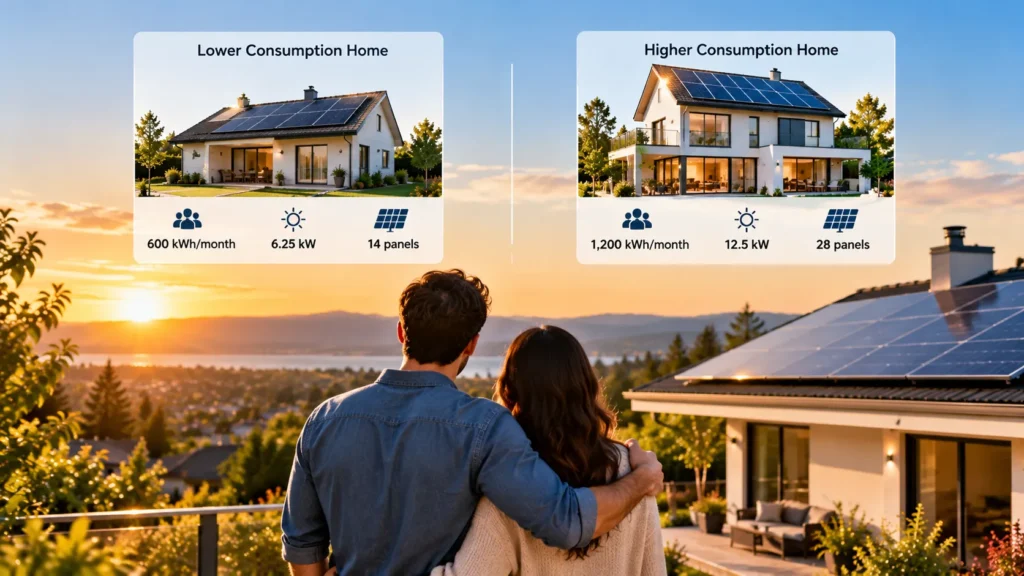
Why Two Similar Houses May Need Different Solar Systems
Consider two hypothetical 2,000-square-foot homes:
| Factor | Home A | Home B |
|---|---|---|
| Monthly electricity consumption | 600 kWh | 1,200 kWh |
| Main electrical loads | Lighting, appliances, limited cooling | Electric heating, cooling, EV charging |
| Estimated system size | 6.25 kW | 12.5 kW |
| Estimated 450W panels | 14 | 28 |
Calculations assume four daily peak sun hours, 80% energy delivery, and a 30-day month.
Despite having the same floor area, Home B requires approximately twice as much solar capacity under these assumptions.
If you are estimating a smaller property, our Solar Panels for a 1,000 Sq Ft Home Guide explores the relationship between floor area and energy consumption in more detail.
How Much Roof Space Do Solar Panels Need?
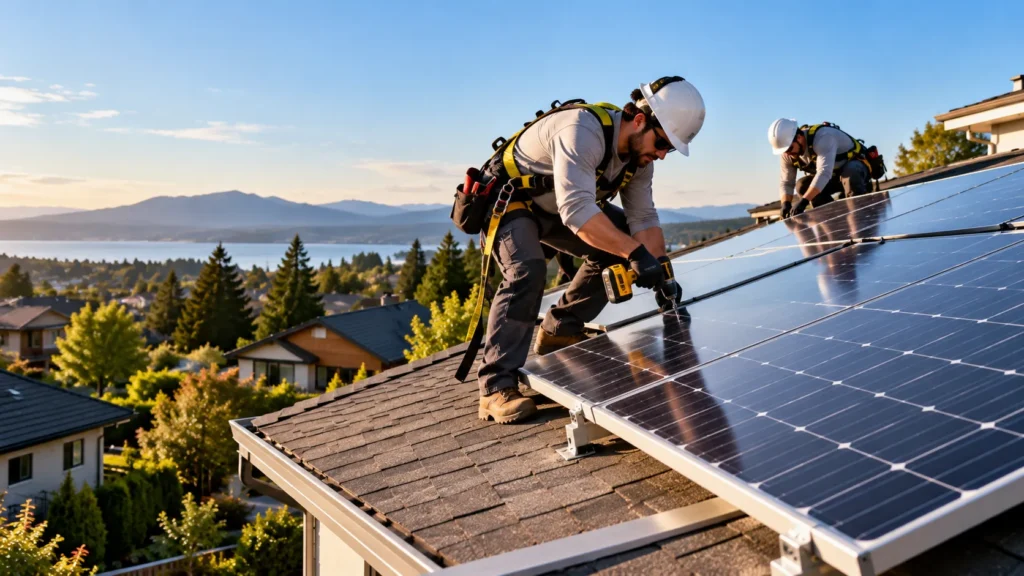
The roof area required depends on the physical dimensions and number of panels.
For illustration, suppose each solar panel occupies approximately 21 square feet.
A system containing 20 panels would cover:
20 × 21 = 420 square feet of panel surface
However, the actual installation footprint may be larger because installers must account for roof edges, fire access pathways, chimneys, vents, obstructions, and local regulations.
Estimated Solar Panel Surface Area
| Number of panels | Approximate panel surface area |
|---|---|
| 8 | 168 sq ft |
| 12 | 252 sq ft |
| 16 | 336 sq ft |
| 20 | 420 sq ft |
| 24 | 504 sq ft |
| 30 | 630 sq ft |
Illustrative values assume 21 square feet per panel. Actual module dimensions vary, and these figures exclude required clearances.
Roof condition matters just as much as available space.
According to the U.S. Department of Energy’s residential solar guidance, roof suitability, structural condition, shading, and solar exposure should be assessed before installation.
A roof inspection can also identify whether repairs or replacement should be completed before installing solar panels.
For more information about long-term roof considerations, see our guide on How Long Solar Panels Last on a Roof.
How Location Changes the Number of Solar Panels You Need
Solar electricity production varies geographically.
A solar panel installation in a sunny region may produce more annual electricity than an identical installation in a cloudier region.
That means two households with the same electricity consumption can require different solar system sizes.
Example: The Same Household in Different Solar Conditions
Assume a household uses 900 kWh per month and installs 450W panels.
| Average daily peak sun hours | Required solar capacity | Estimated panel count |
|---|---|---|
| 3 hours | 12.50 kW | 28 |
| 3.5 hours | 10.71 kW | 24 |
| 4 hours | 9.38 kW | 21 |
| 4.5 hours | 8.33 kW | 19 |
| 5 hours | 7.50 kW | 17 |
| 5.5 hours | 6.82 kW | 16 |
Assumes 80% overall energy delivery and a 30-day month.
These values demonstrate how solar availability affects the calculation. They are not assigned to specific cities or countries.
Solar Panel Sizing in the USA, UK, Canada, and Australia
United States: Solar production varies considerably between states and even between properties in the same region. Use local solar-resource data rather than a single national peak-sun-hours figure.
United Kingdom: Seasonal daylight and solar irradiance patterns matter. A system designed around annual production may generate considerably less electricity during winter months.
Canada: Winter conditions, snow coverage, and seasonal solar availability can affect output. Cold temperatures alone do not mean solar panels cannot generate electricity.
Australia: Strong solar resources in many regions can support substantial electricity production, but roof orientation, temperature, shading, and local weather remain important.
In every country, accurate sizing requires location-specific solar data and a realistic understanding of annual electricity consumption.
How Many Solar Panels Do You Need to Run Common Appliances?
If you want to power particular appliances, start by calculating their electricity consumption.
Use:
Energy Consumption (kWh) = Power (W) × Hours Used ÷ 1,000
For example, a 100W television used for five hours consumes:
100 × 5 ÷ 1,000 = 0.5 kWh
A 1,500W electric heater operating for four hours consumes:
1,500 × 4 ÷ 1,000 = 6 kWh
The heater consumes 12 times as much energy in this example.
Example Household Appliance Usage
| Appliance | Example power or daily energy | Usage | Daily consumption |
|---|---|---|---|
| 5 LED lights | 50W total | 5 hours | 0.25 kWh |
| Television | 100W | 5 hours | 0.50 kWh |
| Laptop | 60W | 6 hours | 0.36 kWh |
| Ceiling fan | 60W | 8 hours | 0.48 kWh |
| Refrigerator | 1.2 kWh/day | Full day | 1.20 kWh |
| Electric heater | 1,500W | 4 hours | 6.00 kWh |
| Wi-Fi router | 12W | 24 hours | 0.288 kWh |
These are illustrative ratings and usage patterns. Actual appliance consumption depends on the model, settings, duty cycle, and operating conditions.
The refrigerator is expressed as daily energy consumption because its compressor does not normally operate continuously.
Use our Appliance Wattage Chart to estimate the electrical loads in your home.
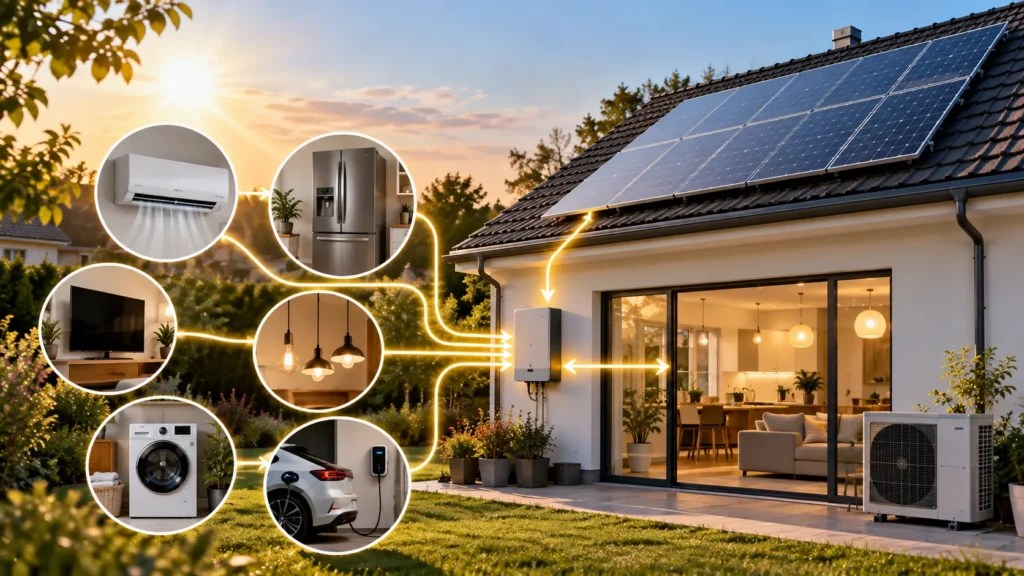
Can Solar Panels Power a House at Night?
Solar panels do not produce meaningful electricity without sunlight.
At night, a grid-connected household typically uses utility electricity unless it has a compatible battery system or another power source.
An off-grid household generally needs battery storage and appropriately sized backup arrangements.
A solar array that generates enough electricity over a month is not automatically capable of supplying all household loads at every moment.
Grid-Tied vs Off-Grid Solar: Does the Panel Count Change?
The required number of solar panels depends partly on how the system will operate.
Grid-Tied Solar System
A grid-tied solar system operates alongside the utility network.
When solar generation is insufficient, electricity can come from the grid. Depending on local policies, excess production may be exported.
A grid-tied system can often be sized around annual electricity consumption and financial goals rather than worst-case daily energy requirements.
However, conventional grid-tied systems generally shut down during outages unless specifically designed for backup operation.
Off-Grid Solar System
An off-grid installation must supply electricity without relying on the utility network.
Its design needs to account for:
Daily energy consumption
Winter or low-sunlight production
Battery autonomy
Inverter continuous power and surge capacity
Battery charging requirements
Backup generation, if necessary
Off-grid systems may require more panels than a simple annual-energy calculation suggests, particularly when reliable electricity is needed during periods of poor weather.
Try the Off-Grid Solar Calculator to explore these requirements.
Do You Need a Battery for Your Solar Panels?
A battery is not mandatory for a conventional grid-tied solar system.
However, storage can be useful when homeowners want to use solar electricity after sunset or maintain selected loads during an outage.
Battery sizing should be based on energy needs, desired backup duration, usable battery capacity, and conversion losses.
For example, a household requiring 10 kWh of usable backup energy with a battery designed around 90% usable depth of discharge would need:
10 ÷ 0.90 = 11.11 kWh nominal battery capacity
This simplified calculation does not include additional reserve requirements, conversion losses, or aging.
The battery must also be capable of delivering enough instantaneous power to operate the connected appliances.
Use our Solar Battery Calculator to estimate storage needs separately from solar panel capacity.
How Much Does It Cost to Install the Solar Panels You Need?
The cost of a residential solar system depends on installed capacity, equipment specifications, location, labor, roof conditions, permitting, and battery requirements.
The number of panels alone does not determine the full installation price.
For example, a 10kW installation using 400W panels needs 25 modules, while a 10kW installation using 500W panels needs 20 modules.
Both arrays have the same rated capacity, but their module dimensions, mounting requirements, and equipment costs may differ.
Simple Installation Cost Formula
Estimated Installed Cost = System Capacity (W) × Installed Price per Watt
For a hypothetical 8kW system priced at $2.50 per watt:
8,000 × $2.50 = $20,000
This is a mathematical example, not a verified 2026 market quotation.
Actual pricing varies by location and installation details.
Before purchasing, compare itemized quotes covering panels, inverters, mounting, electrical equipment, labor, permits, warranties, and utility connection requirements.
Use the Solar Installation Cost Calculator to explore installation costs.
You can also use our Solar ROI Calculator to estimate how installation cost, electricity value, and system production may affect financial returns.
Common Mistakes When Calculating Solar Panel Requirements
Even a simple solar calculation can produce misleading results when important assumptions are overlooked.
1. Using House Size Instead of Electricity Consumption
Floor area does not tell you how much electricity your appliances consume.
Use your utility bills whenever possible.
2. Confusing Watts With Kilowatt-Hours
Watts measure power, while kilowatt-hours measure energy.
A 450W panel does not automatically produce 450 kWh of electricity over any fixed period.
Its energy generation depends on sunlight and system conditions.
3. Ignoring Solar System Losses
Rated panel capacity is measured under standardized test conditions.
Actual electricity production changes with temperature, shading, inverter performance, and other factors.
4. Using Daylight Hours Instead of Peak Sun Hours
A location with 12 hours of daylight does not necessarily receive 12 peak sun hours.
Use appropriate solar-resource data.
5. Assuming Every Roof Is Suitable
A roof may have enough total area but insufficient usable space because of shading, orientation, vents, structural limitations, or required access pathways.
6. Forgetting Future Electricity Needs
Installing an EV charger, heat pump, electric water heater, or additional air conditioner can significantly increase household electricity consumption.
Consider planned changes before finalizing the system size.
7. Assuming 100% Energy Offset Means a Zero Electricity Bill
Even when solar generation equals annual household consumption, utility bills may include fixed charges, different import and export rates, and other fees.
Solar savings should be evaluated using local utility rules rather than energy production alone.
How to Choose the Right Number of Solar Panels for Your Home
A practical solar sizing process begins with real electricity consumption and ends with a site-specific installation assessment.
Follow these steps:
Review your last 12 months of electricity bills.
Calculate average daily electricity consumption.
Estimate your location’s solar production potential.
Choose an appropriate solar panel wattage.
Account for expected system losses.
Calculate the required solar capacity and panel count.
Check roof space, shading, orientation, and structural condition.
Determine whether batteries or backup power are needed.
Compare installation quotes and equipment specifications.
Have a qualified professional verify the final design.
The U.S. Department of Energy’s Homeowner’s Guide to Solar offers additional guidance on evaluating rooftop solar installations.
Frequently Asked Questions
How many solar panels do I need for a 2,000-square-foot house?
There is no fixed number based on floor area alone. For example, a 2,000-square-foot home consuming 900 kWh per month would need approximately 21 panels rated at 450W each under the illustrative assumptions used in this guide. Actual requirements depend on electricity consumption and local solar production.
How many solar panels are needed to power a house completely?
The number depends on annual electricity consumption, solar production, and whether you mean annual energy offset or independent operation without the grid. Under favorable conditions, some homes need fewer than 15 panels, while others require 25 or more.
How many solar panels do I need for 1,000 kWh per month?
Using 450W panels, four peak sun hours daily, 80% energy delivery, and a 30-day month, approximately 24 panels would be needed to generate energy equivalent to 1,000 kWh per month.
Is 10 solar panels enough to power a house?
Ten 450W panels provide 4.5kW of rated DC capacity. Under four peak sun hours and 80% energy delivery, the array would generate approximately 14.4 kWh daily, or 432 kWh over 30 days. That may be sufficient for some low-consumption households but not others.
How many solar panels does a 5kW system need?
A 5kW solar array can be built using ten 500W panels. Thirteen 400W panels provide 5.2kW, slightly exceeding the nominal 5kW target.
Can 20 solar panels power an entire house?
Twenty 450W panels provide 9kW of rated DC capacity. Under the example assumptions, they would generate approximately 28.8 kWh daily, or 864 kWh over 30 days. Whether that meets household needs depends on consumption, location, and electricity usage patterns.
How many solar panels do I need for an off-grid home?
Off-grid requirements depend on daily consumption, low-sunlight conditions, battery storage, inverter capability, and backup power needs. A simple annual energy-offset calculation is not sufficient for reliable off-grid system design.
Do higher-wattage solar panels mean I need fewer panels?
Usually, yes, for the same target DC capacity. However, panel dimensions, efficiency, electrical compatibility, and roof layout should also be considered.
Can I add more solar panels later?
Often, but expansion depends on inverter capacity, available roof space, electrical infrastructure, utility approvals, and the existing system’s design. Planning future electricity needs during the initial installation can reduce complications.
Final Thoughts: How Many Solar Panels Do You Really Need?
The answer to “how many solar panels do I need?” starts with your electricity consumption—not the square footage of your house.
A home using 500 kWh per month may need approximately 12 panels rated at 450W, while a home using 1,000 kWh may need around 24 under the same illustrative solar conditions.
The actual number depends on your location, solar resource, panel wattage, system losses, roof conditions, and energy goals.
For the most useful starting estimate, review your electricity bills, calculate your daily energy needs, and model realistic solar production.
Ready to estimate your solar requirements? Use the free Solar System Size Calculator to plan your installation, then consult a qualified solar professional before purchasing equipment.
Editorial note: The calculations in this guide are illustrative planning examples. They are not guaranteed production forecasts, installation quotations, or substitutes for site-specific engineering and electrical design.