- Solar Guides
3kW Solar System Guide 2026: Cost, Daily Output, Panels & What It Can Run
A 3kW solar system is a compact residential solar setup with 3,000 watts of rated photovoltaic (PV) panel capacity. Under an illustrative assumption of four peak sun hours per day and 80% overall energy delivery, it can generate approximately 9.6 kWh of electricity daily, or 288 kWh over a 30-day month.
That makes a 3kW system worth considering for smaller homes, households with modest electricity consumption, and homeowners looking to offset part of their utility bills.
But how much does a 3kW solar system cost, how many panels will you need, and what appliances can it actually run?
This guide explains the calculations, equipment, installation options, and important limitations to help you plan a system that matches your electricity needs.
What Is a 3kW Solar System?
A 3kW solar system consists of photovoltaic panels with a combined rated capacity of approximately 3,000 watts under standard test conditions.
For example, six 500-watt solar panels provide:
6 panels × 500 W = 3,000 W (3kW)
Solar panels generate direct-current (DC) electricity. An inverter converts that electricity into alternating current (AC) for household appliances or grid connection.
According to the U.S. Department of Energy’s explanation of photovoltaic technology, solar cells convert sunlight into electrical energy, while other system components make that energy usable.
A complete installation may include solar panels, an inverter, mounting equipment, wiring, disconnects, monitoring equipment, and optional battery storage.
A 3kW system is not necessarily capable of delivering 3kW of usable AC electricity continuously. Actual output depends on sunlight, temperature, shading, inverter specifications, and other system losses.
3kW Solar System at a Glance
| Specification | Typical or illustrative value |
|---|---|
| Rated solar panel capacity | 3,000 W DC |
| Number of 400W panels | 8 panels (3.2kW total) |
| Number of 500W panels | 6 panels (3.0kW total) |
| Daily electricity production | 7.2–12 kWh under the assumptions below |
| Monthly electricity production | 216–360 kWh over 30 days |
| Annual electricity production | 2,628–4,380 kWh under the same daily-average assumptions |
| Battery storage | Optional for grid-tied systems |
| Suitable applications | Smaller homes, partial bill offset, selected essential loads |
Production figures assume 3–5 daily peak sun hours and a simplified 80% overall energy-delivery factor. They are planning examples, not site-specific forecasts.
Use our Solar System Size Calculator to estimate the solar capacity needed for your monthly electricity consumption.
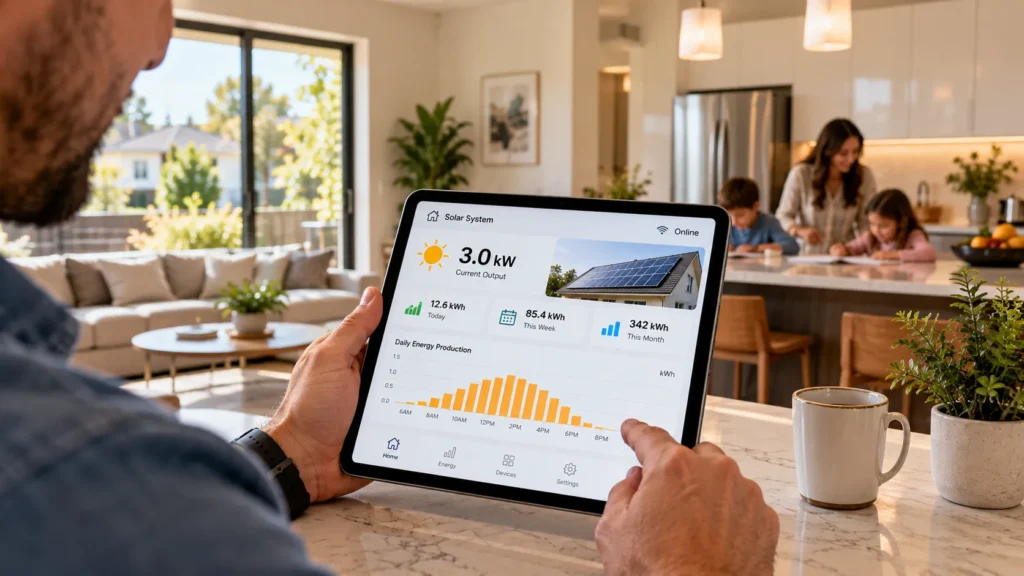
How Much Electricity Does a 3kW Solar System Produce Per Day?
A 3kW solar system can produce approximately 7.2–12 kWh per day when a location receives an average of 3–5 peak sun hours and the system delivers 80% of the ideal calculated energy.
Solar energy production depends heavily on geographic location, solar irradiance, panel orientation, shading, weather, and seasonal conditions.
3kW Solar System Output Calculation
For a simplified estimate, use:
Daily Energy (kWh) = System Size (kW) × Peak Sun Hours × Energy Delivery Factor
For a 3kW system receiving four peak sun hours:
3 × 4 × 0.80 = 9.6 kWh per day
Estimated monthly output:
9.6 × 30 = 288 kWh
Estimated annual output using the same average daily assumptions:
9.6 × 365 = 3,504 kWh
The 80% factor is an illustrative allowance for combined performance effects. It should not be confused with a universal solar panel efficiency rating or the default loss input of a particular modeling tool.
Estimated Solar Electricity Production
| Average peak sun hours | Daily output | 30-day output |
|---|---|---|
| 3 hours | 7.2 kWh | 216 kWh |
| 3.5 hours | 8.4 kWh | 252 kWh |
| 4 hours | 9.6 kWh | 288 kWh |
| 4.5 hours | 10.8 kWh | 324 kWh |
| 5 hours | 12 kWh | 360 kWh |
Calculated with a 3kW DC array and 0.80 energy-delivery factor.
These figures are estimates rather than guaranteed production. Real installations experience changes in solar radiation, module temperature, equipment performance, and weather.
For a location-specific forecast, use the NREL PVWatts Calculator, which models solar electricity generation using system characteristics and local weather data.
You can also estimate daily and monthly output using our Solar Production Calculator.
How Many Solar Panels Are Needed for a 3kW Solar System?
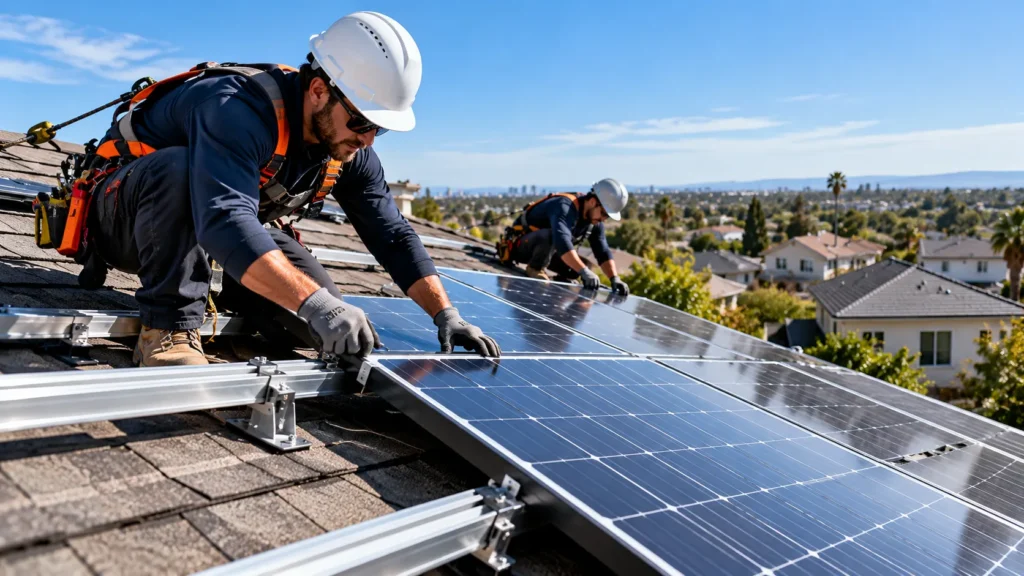
A 3kW solar system generally requires 6–8 modern residential panels, depending on their rated wattage.
The calculation is straightforward:
Number of Panels = 3,000 W ÷ Individual Panel Wattage
Because you cannot install a fraction of a panel, round up to the next whole number.
| Panel wattage | Panels needed | Actual array capacity |
|---|---|---|
| 350 W | 9 | 3,150 W |
| 375 W | 8 | 3,000 W |
| 400 W | 8 | 3,200 W |
| 450 W | 7 | 3,150 W |
| 500 W | 6 | 3,000 W |
| 550 W | 6 | 3,300 W |
Notice that some combinations exceed 3kW slightly. That is normal when designing an array using whole solar panels.
Panel compatibility, string voltage, inverter limits, and local electrical requirements must also be considered.
How Much Roof Space Does a 3kW Solar System Need?
Roof area depends on the physical dimensions and arrangement of the selected modules.
For example, if six panels each occupy approximately 2.2 square meters:
6 × 2.2 = 13.2 square meters of panel surface
That is approximately 142 square feet of module area.
The actual installation footprint will be larger or differently shaped depending on spacing, roof obstructions, mounting design, access requirements, and local fire-safety rules.
A qualified installer should assess roof condition, structural capacity, orientation, and shading before installation.
What Can a 3kW Solar System Run?
A 3kW solar system can help power refrigerators, lights, fans, televisions, laptops, internet equipment, and selected kitchen appliances.
However, the amount of electricity produced over a day is different from the amount of power available at one moment.
A solar array may produce 9.6 kWh over an illustrative day without ever providing a constant 3,000 watts of usable AC power.
Common Household Appliance Electricity Usage
| Appliance | Example operating power | Usage time | Energy consumed |
|---|---|---|---|
| LED lights (5 × 10W) | 50 W | 5 hours | 0.25 kWh |
| Television | 100 W | 4 hours | 0.40 kWh |
| Laptop | 60 W | 5 hours | 0.30 kWh |
| Ceiling fan | 60 W | 8 hours | 0.48 kWh |
| Wi-Fi router | 12 W | 24 hours | 0.288 kWh |
| Refrigerator | 1.2 kWh/day | Daily | 1.20 kWh |
| Microwave | 1,200 W | 15 minutes | 0.30 kWh |
These are illustrative appliance ratings and usage patterns, not measured averages. Refrigerator energy is expressed as a daily total because its compressor cycles on and off.
For these example loads, total daily consumption is approximately 3.22 kWh.
This is less than the illustrative 9.6 kWh daily production of a 3kW solar system. However, that comparison alone does not guarantee that every appliance can run whenever needed.
Can a 3kW Solar System Run an Air Conditioner?
Possibly, depending on the air conditioner’s operating wattage, starting requirements, available solar output, and inverter capacity.
An air conditioner consuming 1,200 watts for five hours uses:
1.2 kW × 5 hours = 6 kWh
That is a substantial portion of the example 9.6 kWh daily solar production.
Larger air conditioners, electric water heaters, electric ovens, and multiple simultaneous high-power appliances can quickly exceed the available output.
For an off-grid system, the inverter must also handle motor startup surges and continuous load demand.
Before choosing appliances, consult our Appliance Wattage Chart and calculate your expected daily energy consumption.
How Much Does a 3kW Solar System Cost in 2026?
The 3kW solar system cost depends on your country, installation type, equipment selection, labor charges, roof conditions, and whether battery storage is included.
A rooftop installation generally involves more than purchasing solar panels. A complete project may include inverter equipment, mounting hardware, electrical protection, permits, inspection, labor, and utility interconnection.
How to Calculate a 3kW Solar System Price
A useful comparison metric is the installed price per watt.
Installed System Cost = System Capacity (W) × Installed Price per Watt
For example:
| Hypothetical installed price | Calculated 3kW system cost |
|---|---|
| $2.00/W | $6,000 |
| $2.50/W | $7,500 |
| $3.00/W | $9,000 |
| $3.50/W | $10,500 |
Important: These are mathematical pricing scenarios, not verified October 2026 market quotations or a claim about average U.S. installation prices.
What Affects the Installed Cost of a 3kW Solar System?
Two 3kW solar installations can have different prices even when their rated panel capacity is identical. The final quotation depends on roof complexity, equipment selection, local labor rates, permitting, electrical upgrades, and installation conditions.
When comparing quotes, check whether the stated price includes:
Solar panels, inverter, and mounting hardware
Electrical wiring, safety equipment, and installation labor
Permits, inspections, and utility interconnection
Monitoring equipment and applicable warranties
Any required roof or electrical-panel upgrades
A lower upfront price does not necessarily represent better value if important installation services or equipment warranties are excluded.
For a consistent comparison, divide the total installed price before incentives by the system’s rated DC capacity in watts. For example, an $8,400 installation with 3,000 watts of panels costs $2.80 per watt.
This example is illustrative, not a verified market quotation.
Actual offers may fall outside these examples. A small installation can also have a higher price per watt because some project expenses do not decrease proportionally with system size.
For a more realistic budget, compare multiple itemized local quotes covering equipment, installation, warranties, permitting, and grid connection.
Our Solar Cost Calculator and Solar Installation Cost Calculator can help you organize cost estimates.
For U.S. homeowners, the Department of Energy’s consumer solar resources provide guidance on evaluating residential solar installations.
Local rebates, electricity export compensation, and tax treatment must be checked under the rules in effect when you install your system. Do not assume that an incentive advertised in a previous year remains available in 2026.
How Much Can a 3kW Solar System Save on Electricity Bills?
Solar savings depend on how much electricity your system generates, how much you use directly, your utility’s electricity rates, and the compensation available for exported solar energy.
Consider a simplified example of a 3kW solar system producing an average of 9.6 kWh per day.
Example assumptions:
Average daily solar generation: 9.6 kWh
Estimated generation over 30 days: 288 kWh
Estimated annual generation over 365 days: 3,504 kWh
Electricity value: $0.20 per kWh
Assumption: Every generated kWh offsets electricity worth $0.20
Estimated Monthly Electricity Value
For an illustrative 30-day month:
288 kWh × $0.20 = $57.60
Estimated Annual Electricity Value
Using a full 365-day year:
3,504 kWh × $0.20 = $700.80
These figures represent the estimated gross electricity value of solar generation, not guaranteed savings on your utility bill.
Actual savings may be lower when exported electricity receives less compensation than imported electricity costs. Fixed utility charges, seasonal production, battery losses where applicable, and changes in household consumption can also affect financial results.
Simple Payback Example
Suppose a 3kW solar system has an installed cost of $7,500 and provides an estimated annual electricity value of $700.80.
Simple Payback = Installed Cost ÷ Annual Electricity Value
$7,500 ÷ $700.80 ≈ 10.7 years
This illustrative calculation assumes the full annual electricity value translates into savings and excludes maintenance, equipment replacement, financing costs, future electricity-rate changes, panel degradation, and incentives.
Actual payback may be longer or shorter depending on installation costs, utility policies, electricity consumption, and available incentives.
For a more detailed financial estimate, use our Solar ROI Calculator to explore different installation costs, electricity savings, and payback scenarios.
Grid-Tied vs Off-Grid 3kW Solar Systems
A 3kW system can be designed for grid connection or off-grid electricity supply, but the equipment and operating requirements are different.
Grid-Tied 3kW Solar System
A grid-tied system operates alongside the utility electricity network.
When solar generation is lower than household demand, electricity can be supplied by the grid. Depending on local rules and system configuration, excess solar energy may be exported.
Grid-tied systems generally do not require batteries.
However, a conventional grid-tied solar installation normally shuts down during a grid outage unless it includes equipment specifically designed to provide backup power.
The U.S. Department of Energy explains solar and outage resilience, including why conventional solar installations cannot automatically supply electricity during blackouts.
Off-Grid 3kW Solar System
An off-grid system operates without relying on a utility connection.
It typically requires battery storage, an appropriate inverter, charge-control equipment, and sufficient energy reserves for nighttime consumption and low-sunlight periods.
A 3kW solar array alone does not establish whether an off-grid installation is sufficient.
Daily electricity consumption, worst-month solar production, battery autonomy, and inverter surge capability must all be considered.
Use our Off-Grid Solar Calculator to estimate system requirements.
What Size Battery Do You Need for a 3kW Solar System?
Battery sizing depends primarily on how much electricity you want to store and use, not simply the wattage of the solar panels.
For example, suppose you need 5 kWh of usable stored energy.
If your battery has an assumed usable depth of discharge of 90%:
Nominal Battery Capacity = Required Usable Energy ÷ Depth of Discharge
5 ÷ 0.90 = 5.56 kWh
This is a simplified minimum nominal capacity calculation before accounting for additional conversion losses, reserve requirements, aging, or other system-specific limitations.
A battery with approximately 6 kWh nominal capacity might meet this illustrative energy target, subject to its actual specifications.
However, battery capacity in kWh and battery power output in kW are different specifications.
A battery may store enough energy for several hours while still being unable to supply the instantaneous power required by a large appliance.
The Department of Energy’s solar and storage overview explains the distinction between storage energy capacity and power capacity.
For a more detailed estimate, use our Solar Battery Calculator.
What Size Inverter Is Needed for a 3kW Solar System?
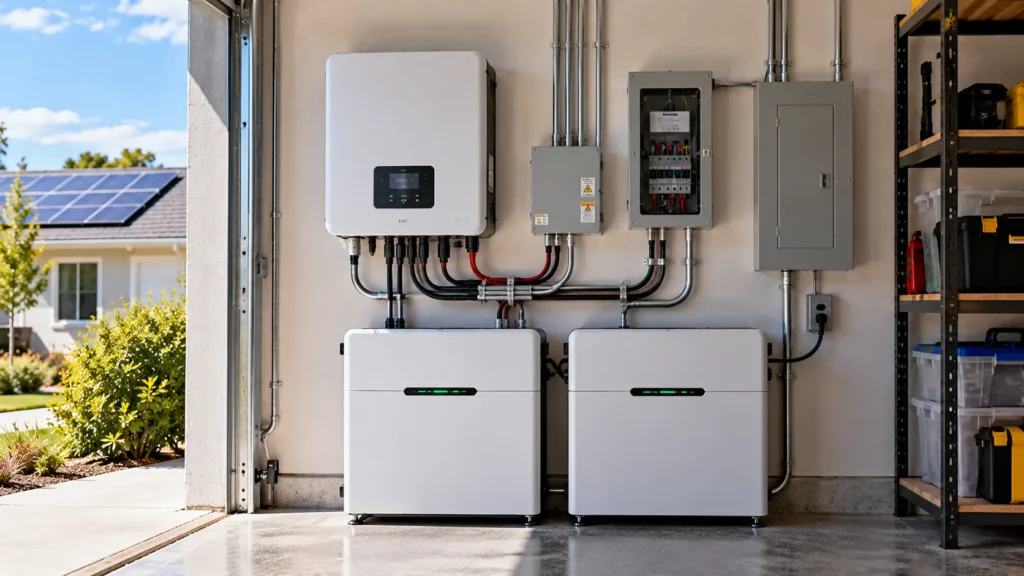
Inverter sizing depends on whether the installation is grid-tied, hybrid, or off-grid.
For a grid-tied 3kW DC array, a compatible inverter with an AC rating around the same order of magnitude may be considered, but the final selection depends on the design’s DC-to-AC ratio, local climate, module characteristics, and manufacturer limits.
An inverter rated below the array’s maximum DC output may occasionally limit peak AC production, a phenomenon called inverter clipping.
For an off-grid or backup system, inverter selection must also account for maximum simultaneous appliance demand and startup surges.
For example, appliances with a combined running load of 2,400 watts may require an inverter capable of supplying at least that continuous load, with additional surge capability where necessary.
The inverter’s DC voltage range, battery compatibility, protection systems, and applicable electrical standards also matter.
The U.S. Department of Energy’s inverter guide explains the differences between string inverters, microinverters, and related equipment.
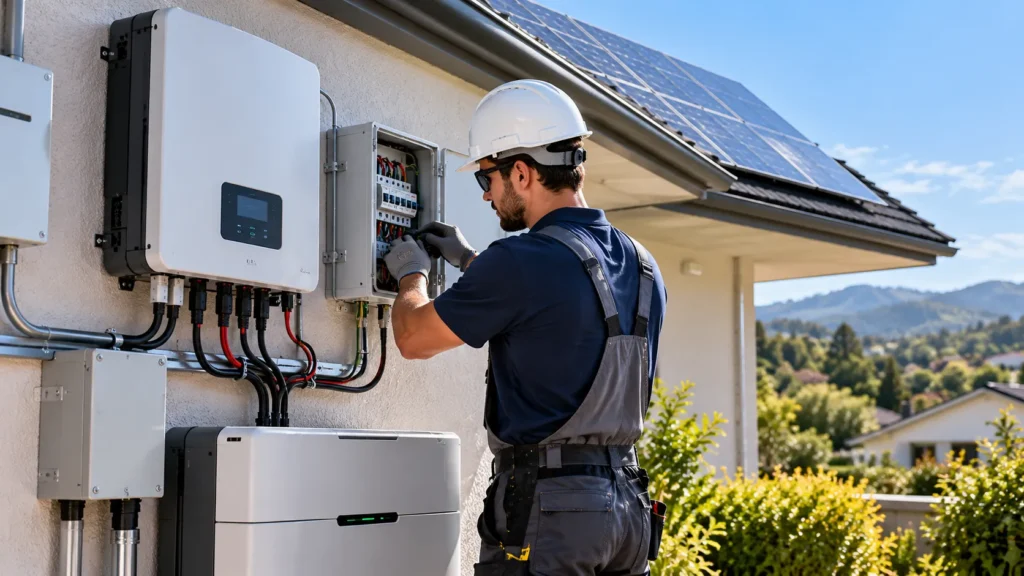
A qualified solar installer or electrical professional should finalize inverter and protection-device specifications.
Is a 3kW Solar System Enough for a House?
A 3kW solar system may cover a substantial share of electricity demand for a small, energy-efficient household.
However, a household with electric space heating, central air conditioning, electric vehicle charging, or other major electrical loads may need a larger array.
Consider a home using 300 kWh per month.
Under the illustrative production assumptions used earlier, a 3kW array generates about 288 kWh over 30 days.
That is equivalent to approximately 96% of the home’s monthly electricity consumption.
But 96% of monthly energy consumption does not necessarily mean a 96% electricity bill reduction.
The timing of electricity consumption, export compensation, fixed charges, and seasonal production determine the actual financial outcome.
If your electricity usage is substantially higher, you may need to compare a 3kW installation with a larger system.
Read our 5kW Solar System Guide to understand how additional capacity changes potential energy generation.
Advantages and Limitations of a 3kW Solar System
A smaller solar installation can be attractive when electricity demand and available installation space are limited.
Potential Advantages
Lower total equipment requirement than larger solar arrays
Suitable for partial household electricity offset
Fewer solar panels to accommodate on the roof
Compatible with appropriately designed grid-tied or hybrid installations
Potential to reduce purchased electricity and associated emissions
Important Limitations
May not cover electricity demand in high-consumption homes
Production varies by weather, season, shading, and location
Requires additional equipment for nighttime backup
May not support multiple high-power loads independently
Savings depend on local electricity pricing and export rules
The best system is not necessarily the largest one. It is the system that matches your energy requirements, site conditions, and financial goals.
How to Plan a 3kW Solar System
Before purchasing equipment, review your electricity bills and estimate your average monthly consumption.
Then evaluate your available roof area, shading conditions, panel wattage, inverter compatibility, and potential battery requirements.
A practical planning sequence is:
Calculate monthly and daily electricity usage.
Estimate available peak sun hours for your location.
Model expected production with realistic system losses.
Select a suitable solar panel configuration.
Determine inverter and battery requirements.
Compare itemized installation quotations.
Verify local permits, electrical requirements, and utility interconnection rules.
For U.S. residential projects, the Department of Energy’s step-by-step solar installation guide explains important consumer considerations.
Frequently Asked Questions About 3kW Solar Systems
How many units does a 3kW solar system produce per day?
Under an illustrative assumption of 3–5 peak sun hours and 80% overall energy delivery, a 3kW system generates approximately 7.2–12 kWh per day. In electricity billing terminology, one unit commonly refers to one kWh.
Can a 3kW solar system run a refrigerator?
Yes, a properly designed 3kW solar installation can support a refrigerator, provided the inverter and available electricity supply meet its operating and startup requirements. Nighttime operation requires grid electricity or suitable battery storage.
Can a 3kW solar system run an entire house?
It depends on household electricity consumption. A 3kW system may offset much of the usage of a small, efficient home, but it may be insufficient for homes with large heating, cooling, or vehicle-charging loads.
How many solar panels are required for 3kW?
Six 500W panels provide exactly 3kW of rated DC capacity. Eight 400W panels provide 3.2kW. The exact configuration depends on panel specifications and electrical design.
Does a 3kW solar system need a battery?
Not necessarily. Conventional grid-tied installations can operate without batteries. Off-grid systems and installations requiring backup power generally need appropriately sized storage and compatible control equipment.
How much roof space is needed for a 3kW solar system?
Panel area depends on module dimensions. Six panels occupying 2.2 square meters each require approximately 13.2 square meters of panel surface, excluding additional installation clearances and roof-layout constraints.
Is a 3kW solar system worth it in 2026?
It may be worthwhile if your electricity consumption, installation cost, solar resource, and utility tariff support favorable savings. Compare local installation quotes and model expected production before making a purchase decision.
Final Thoughts: Should You Install a 3kW Solar System?
A 3kW solar system can be a practical option for households seeking to reduce electricity purchases without installing a large rooftop array.
With suitable sunlight and realistic performance assumptions, it may generate approximately 7.2–12 kWh per day. However, actual production, usable power, battery requirements, and savings depend on the complete system design.
Start with your electricity consumption rather than selecting solar capacity based only on panel wattage.
Use the Solar System Size Calculator to estimate your requirements, then compare local installation quotations and review your options with a qualified solar professional.
Editorial note: All illustrative calculations are based on stated assumptions. This guide provides general educational information and does not replace site-specific electrical design, engineering review, or professional installation advice.