Results are estimates only. Always consult a certified solar installer before purchasing. Data sources: NREL, IRENA, Global Solar Atlas, BloombergNEF, US Department of Energy, EnergySage.
- Inverters & Batteries
Types of Solar Inverters: Complete Guide 2026
String, micro, hybrid or off-grid — which solar inverter is right for you? 2026 guide covering how each works, costs, pros and cons.
If you are planning a solar installation, the inverter is the one component you cannot afford to get wrong. Every solar panel produces direct current electricity — DC power — that your home cannot use directly. The inverter converts that DC power into alternating current — AC power — that runs every appliance in your home. Without the right type of solar inverter, even the most expensive solar panels deliver nothing useful.
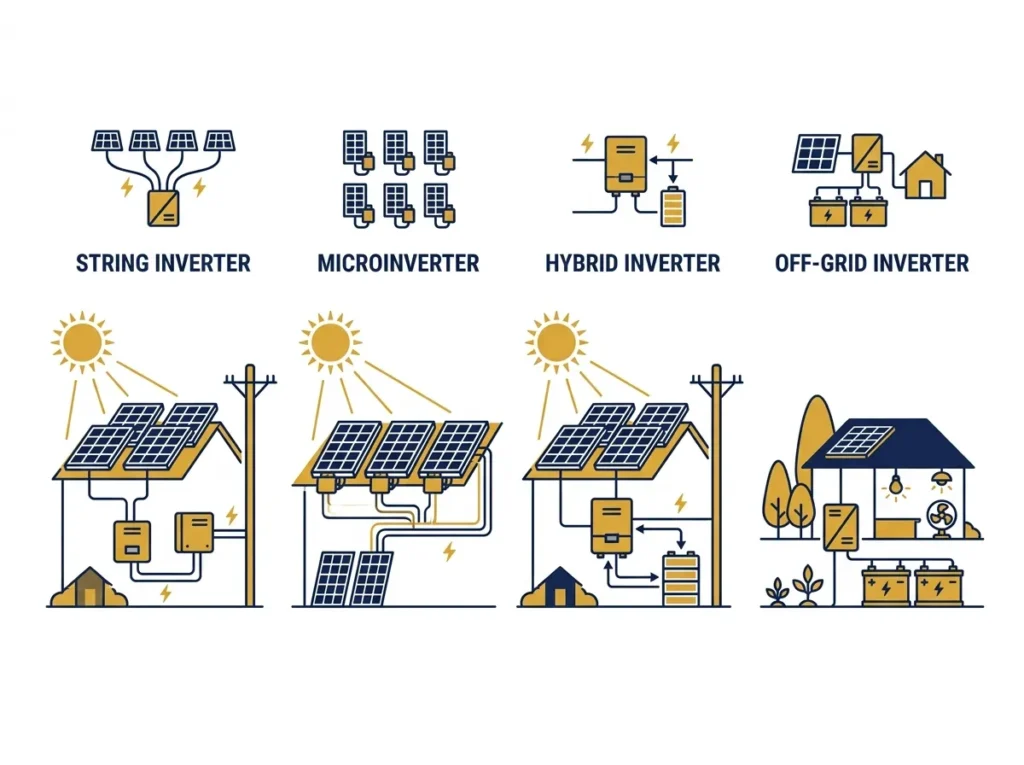
In 2026, there are four main types of solar inverters available for homes and businesses: string inverters, microinverters, hybrid inverters, and off-grid inverters. Each works differently, costs differently, and suits different situations. Choosing the wrong type can cost you thousands of dollars and years of underperformance. This guide explains every inverter type clearly — no engineering background required.
Once you know which type suits your situation, use our free solar system size calculator to find the exact inverter size you need in under 60 seconds.
What does a solar inverter do?
Before comparing the different types of solar inverters, it helps to understand what every inverter does regardless of type. Solar panels generate DC electricity whenever sunlight hits them. Your home, however, runs on AC electricity — which alternates direction 50 or 60 times per second depending on your country. Everything plugged into your wall requires AC power.
The solar inverter sits between your solar panels and your home’s electrical system. It converts raw DC power from the panels into grid-compatible AC power and feeds it into your home. Any electricity your panels produce beyond what your home needs in that moment either goes to the grid, gets stored in a battery, or is wasted if you have neither.
A quality inverter also performs Maximum Power Point Tracking — continuously optimising voltage and current from your panels to extract maximum possible power under real-world conditions of heat, cloud cover, and partial shading. According to NREL research, the difference between a quality inverter and a poor one in daily energy harvest can reach 5 to 15 percent — which adds up to thousands of dollars over a 25-year system life. Understanding the types of solar inverters is therefore not a technical exercise — it is a financial one.
The four main types of solar inverters
1. String inverters
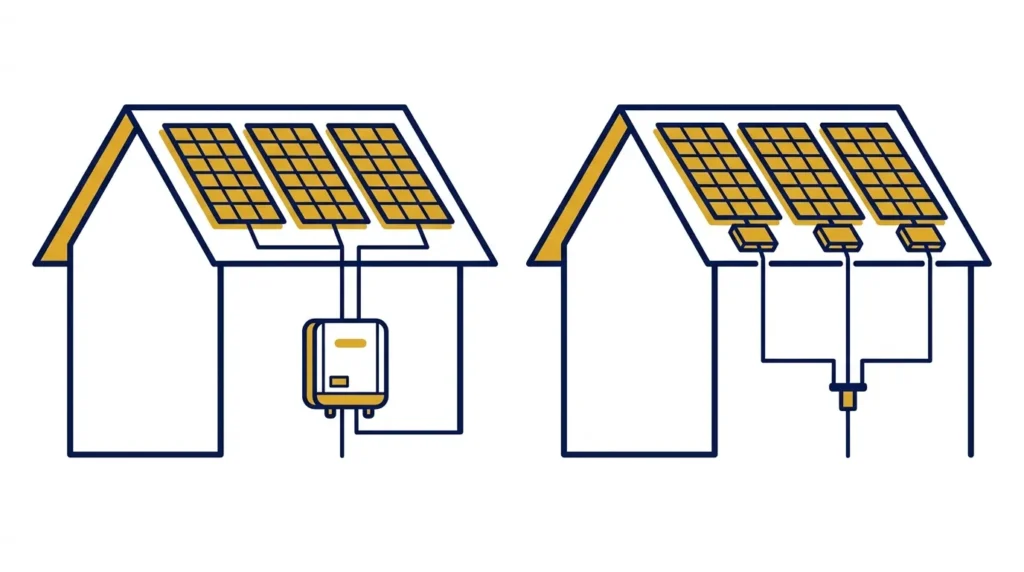
A string inverter is the most common and most affordable of all types of solar inverters. It works by connecting all your solar panels together in a series — called a string — and feeding the combined DC output into a single centralised unit, which converts it all to AC at once. String inverters have been the industry standard for decades. They are straightforward, well-understood by installers worldwide, easy to maintain, and the cheapest option per watt of solar capacity.
A typical residential string inverter costs between $1,000 and $2,500 depending on size and brand. Because there is only one unit — typically wall-mounted near your electrical panel — maintenance and replacement are simple and affordable. Brands such as Huawei, SMA, Fronius, and Sungrow dominate this segment globally in 2026, with efficiency ratings consistently above 97 percent.
The main limitation of string inverters is shading sensitivity. Because all panels in a string are electrically linked, if one panel underperforms — due to shade from a tree, chimney, or dirt buildup — the output of the entire string drops to match that weakest panel. This is the well-known weak-link problem, and it is the primary reason string inverters are not ideal for roofs with significant shading during peak hours. For most homes in Pakistan, India, the Middle East, and Australia — where rooftops are typically flat or simply angled and shading is minimal — string inverters deliver excellent performance at the lowest possible cost.
2. Microinverters
Microinverters are small inverter units mounted on the back of each individual solar panel. Instead of sending DC power to a central inverter, each panel converts its own output to AC power independently, right at the panel itself. Among all types of solar inverters, microinverters solve the shading problem most completely. Because each panel operates independently, shading on one panel has zero effect on the output of any other. A shaded panel simply produces less — the rest of the array continues at full performance.
Microinverters also provide panel-level monitoring through a smartphone app, allowing you to see exactly how much power each individual panel produces in real time. If one panel or its microinverter fails, the rest of the system keeps running at full capacity. Enphase dominates this segment globally, holding the majority of residential microinverter installations worldwide in 2026.
The downside is cost. Microinverter systems typically cost 20 to 30 percent more than equivalent string inverter systems. They are also physically harder to access if a unit fails, since they sit under a panel on the roof. For roofs with no shading, the additional cost of microinverters rarely pays off in extra energy production. For complex or shaded roofs, however, the extra production they enable often justifies the cost within a few years. According to External the US Department of Energy, panel-level electronics like microinverters improve system output by 5 to 25 percent in shaded conditions compared to standard string inverters.
3. Hybrid solar inverters
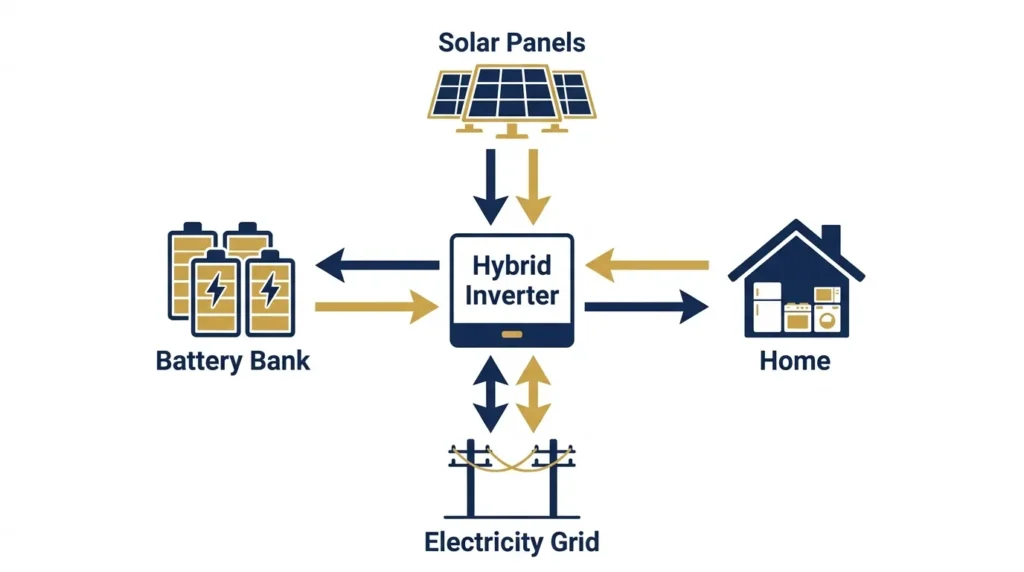
A hybrid solar inverter — also called a battery-ready inverter or multi-mode inverter — is the most versatile of all types of solar inverters. It combines the functions of a standard solar inverter with a battery charge controller, managing power flow between solar panels, a battery bank, the utility grid, and your home — all in a single unit.
When the sun is shining, the hybrid inverter powers your home from solar panels and simultaneously charges your battery. When your battery is full and panels are still producing, excess power is exported to the grid. When the sun goes down, the inverter draws from your battery first. When the battery is depleted, it switches to the grid seamlessly with no interruption to your home. During a power outage, the hybrid inverter disconnects from the grid and runs your home entirely from solar plus battery — providing backup power automatically.
This capability makes hybrid inverters the most popular choice in 2026 for homes that experience load-shedding or frequent outages — which includes the vast majority of homeowners in Pakistan, India, Bangladesh, Nigeria, and much of the Middle East. The ability to store solar energy and use it during outages transforms a solar installation from a bill-reducer into a true energy independence solution. Hybrid inverters typically cost $1,500 to $4,000 for the unit itself — more than a standard string inverter — but they eliminate the need for a separate battery charge controller, reducing component and installation costs significantly.
Our free solar system size calculator handles hybrid system sizing automatically — enter your daily usage and backup hours to get a full component recommendation including the correct hybrid inverter size.
4. Off-grid inverters
Off-grid inverters are designed for solar systems with no connection to the utility grid at all. They work with a battery bank as the primary power source, with solar panels continuously recharging the batteries during daylight, and the inverter drawing from the batteries to power the home around the clock. Because off-grid inverters cannot rely on the grid to balance supply and demand, they must be more robust, typically including built-in battery management systems and the ability to handle large surge loads from motors and air conditioners.
Off-grid inverters are the right choice for remote properties with no grid access, agricultural installations far from the utility, and any situation where connecting to the grid is either impossible or prohibitively expensive. Among the four main types of solar inverters, off-grid systems require the most careful sizing — an undersized battery bank or inverter in a grid-free environment has no fallback. For a complete guide to designing an off-grid system, read our off-grid solar system complete guide.
String inverter vs microinverter vs hybrid — how to choose
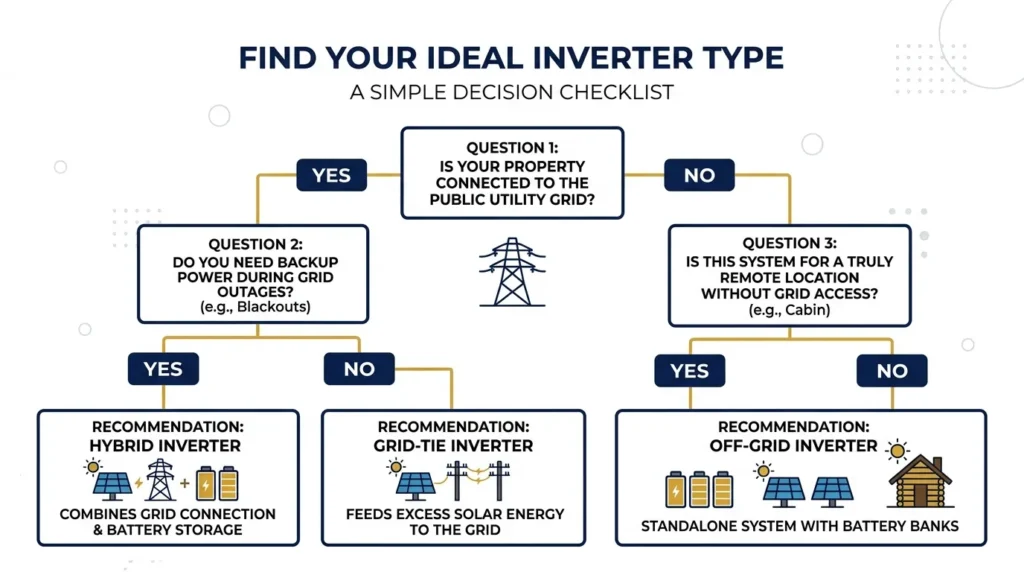
Choosing between the types of solar inverters comes down to three questions about your specific situation, your roof, and your energy goals.
The first question is whether your roof has shading. If any part of your roof is shaded by trees, chimneys, neighbouring buildings, or other obstructions during peak sunlight hours, microinverters or power optimisers deserve serious consideration. If your roof is shade-free throughout the day, a string or hybrid inverter delivers better value in almost every case.
The second question is whether you want battery storage now or in the future. If you want to store solar energy for outage protection or nighttime use, you need either a hybrid inverter or a separate battery inverter. A standard string or microinverter system cannot directly charge a battery without additional equipment. If load-shedding is a concern in your area — and for most homeowners in South Asia and Africa it is — a hybrid inverter is almost always the right decision.
The third question is your budget. String inverters offer the lowest upfront cost and are ideal for simple, unshaded roofs. Microinverters add 20 to 30 percent to system cost but pay off on shaded or complex rooftops. Hybrid inverters offer the best long-term flexibility for anyone planning to add batteries now or in the coming years. Off-grid inverters are a specialist product for specific remote-site situations.
For most homeowners in South Asia, the Middle East, and Africa in 2026: a hybrid inverter paired with a solar array and a LiFePO4 battery bank is the optimal combination — delivering grid-backup capability, excellent efficiency, and the most compelling total cost of ownership for the functionality delivered.
What size solar inverter do you need?
Once you have chosen the right solar inverter type, sizing it correctly is the next critical step. An undersized inverter limits the output of your entire solar array. An oversized one costs money unnecessarily and runs inefficiently at low load for most of the day.
The general rule used by solar professionals worldwide is that your inverter’s kilowatt rating should be 75 to 90 percent of your solar array’s peak kilowatt-peak rating. A 5 kWp solar array therefore typically pairs with a 4 to 4.5 kW inverter. This allows the inverter to operate in its most efficient zone for most of the day, rather than sitting idle during the low-output morning and evening hours.
For hybrid inverters, sizing also needs to account for the battery charging load. A hybrid inverter simultaneously managing solar panels and charging a battery bank requires more rated capacity than an equivalent on-grid string inverter of the same panel array size. According to Global Solar Atlas, your location’s peak sun hours also directly affect the optimal inverter-to-panel ratio — regions with 6 to 7 daily sun hours like Pakistan and the Middle East can run slightly higher panel-to-inverter ratios without clipping losses.
Our free solar system size calculator calculates the recommended inverter size for your specific situation — accounting for your daily usage, system type, and location — in under 60 seconds. No technical knowledge needed.
Solar inverter costs in 2026
Inverter prices vary significantly by type, brand, size, and country. Here is what you can expect in 2026 based on current market data from IRENA and regional solar industry sources.
String inverters for a typical residential system of 3 to 6 kW cost $800 to $2,500 in the USA and Europe. In Pakistan and India, the same size string inverter from regional brands costs PKR 35,000 to PKR 120,000 or ₹25,000 to ₹90,000 respectively, making them accessible for most homeowners considering solar for the first time.
Microinverter systems cost 20 to 30 percent more than equivalent string setups — a 5 kW microinverter installation that would cost $12,000 with a string inverter typically runs $14,500 to $15,500 with microinverters installed. This premium is worth paying on shaded or complex rooftops but rarely justified on clean, south-facing roofs.
Hybrid inverters in the 3 to 6 kW range cost $1,200 to $3,500 for the unit itself in international markets in 2026. Popular brands include Growatt, Deye, SolaX, and Sungrow — all widely available across South Asia, Africa, and the Middle East at competitive prices. The additional cost over a standard string inverter is typically recovered within two to three years through the energy savings enabled by battery storage.
Understanding the cost differences between types of solar inverters helps you compare quotes from installers accurately. An installer quoting a string inverter system is not directly comparable to one quoting a hybrid system — the capabilities are fundamentally different. Always confirm the inverter type when comparing solar quotes. For a full breakdown of how inverter type affects your total system cost and payback period, read our solar panel payback period guide.
Frequently asked questions about types of solar inverters
What are the main types of solar inverters?
The four main types of solar inverters are string inverters, microinverters, hybrid inverters, and off-grid inverters. String inverters are the most affordable and most widely installed. Microinverters offer the best performance on shaded rooftops. Hybrid inverters are the most versatile, managing solar, battery, and grid simultaneously. Off-grid inverters are designed for installations with no utility grid connection.
Which type of solar inverter is best for home use?
For most homeowners in 2026, especially those in regions with frequent power outages or load-shedding, a hybrid solar inverter is the best choice. It provides all the benefits of a standard solar system while also enabling battery storage for backup power. For homes in areas with reliable grid power and no shading issues, a standard string inverter offers excellent performance at the lowest cost.
How long do solar inverters last?
String and hybrid inverters typically last 10 to 15 years before requiring replacement, with most manufacturers offering 5 to 12-year warranties. Microinverters often come with longer warranties — Enphase offers a 25-year warranty on its latest generation — because they are designed to match the lifespan of the solar panels they are attached to. Budget for at least one inverter replacement over the 25-year life of your solar array.
Can I add a battery to a string inverter system?
Yes, but it requires additional equipment — specifically a battery inverter or AC-coupled battery system — which adds cost and complexity. If you plan to add battery storage in the future, it is almost always more cost-effective to install a hybrid inverter from the start rather than retrofitting a battery to an existing string inverter system later. The difference in upfront cost is typically $500 to $1,000, while the retrofit cost later is usually $1,500 to $3,000 more than a new installation would have been.
What is the difference between a hybrid inverter and an off-grid inverter?
A hybrid inverter is connected to both the utility grid and a battery bank. It can draw from and export to the grid, and uses the grid as a backup when battery is depleted. An off-grid inverter has no grid connection whatsoever — it operates entirely from solar panels and battery storage. Hybrid systems are ideal for areas with an existing but unreliable grid. Off-grid systems are for areas with no grid access at all. Among the types of solar inverters, hybrid is more flexible; off-grid demands more careful sizing and larger battery banks.