Results are estimates only. Always consult a certified solar installer before purchasing. Data sources: NREL, IRENA, Global Solar Atlas, BloombergNEF.
- Solar System Sizing
Off-Grid Solar System: Complete Beginner’s Guide 2026
What is an off-grid solar system and how does it work? Complete 2026 guide covering components, sizing, cost, and how to calculate exactly what you need.
An off-grid solar system is one of the most powerful decisions you can make for long-term energy independence. Whether you live in a remote area with no reliable grid access, deal with daily load-shedding, or simply want to stop paying electricity bills permanently, understanding how an off-grid solar system works — and how to size one correctly — is where everything starts.
In 2026, going off-grid with solar is more accessible than it has ever been. Battery technology has improved dramatically, panel prices remain competitive, and thousands of homeowners across Pakistan, India, Africa, and the Middle East are already living proof that it works. This complete guide explains everything — from how an off-grid solar system works, to the components you need, how to calculate your exact system size, and what it realistically costs in your country.
Use our free solar system size calculator to get your off-grid system size in under 60 seconds — no engineer required.
What is an off-grid solar system?
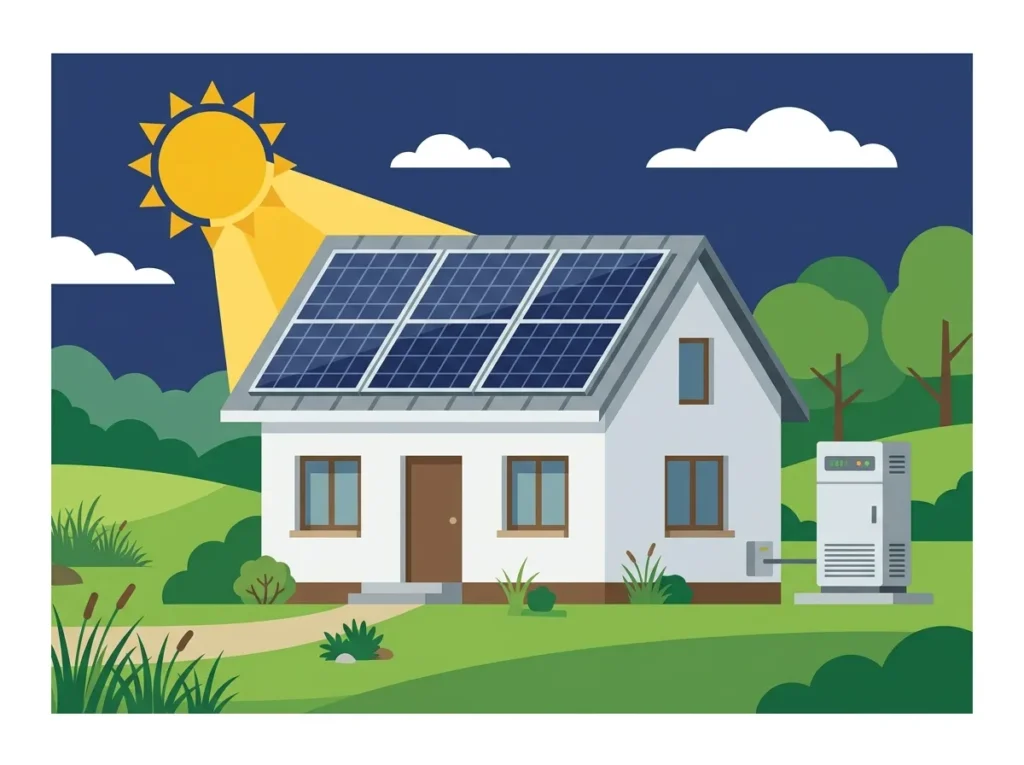
An off-grid solar system is a solar power setup that operates completely independently from the public electricity grid. There is no utility connection. Your solar panels generate electricity during the day, a battery bank stores what you do not use immediately, and an inverter converts that stored energy into usable power for your home or business — day or night, sun or cloud.
This is fundamentally different from an on-grid system, which stays connected to the utility and offsets your bill, and from a hybrid system, which uses the grid as a backup alongside battery storage. An off-grid solar system stands entirely on its own. If you are still deciding between system types, read our guide on how many solar panels you need which covers all three types in detail.
For millions of people in rural Pakistan, Sub-Saharan Africa, rural India, and remote parts of the Middle East who deal with unreliable or absent grid power, an off-grid solar system is not a lifestyle choice — it is the most practical and economical energy solution available. The appeal is obvious: no monthly electricity bills, no outages because of grid failures, and complete control over your own energy supply for the next 25 to 30 years.
How does an off-grid solar system work?
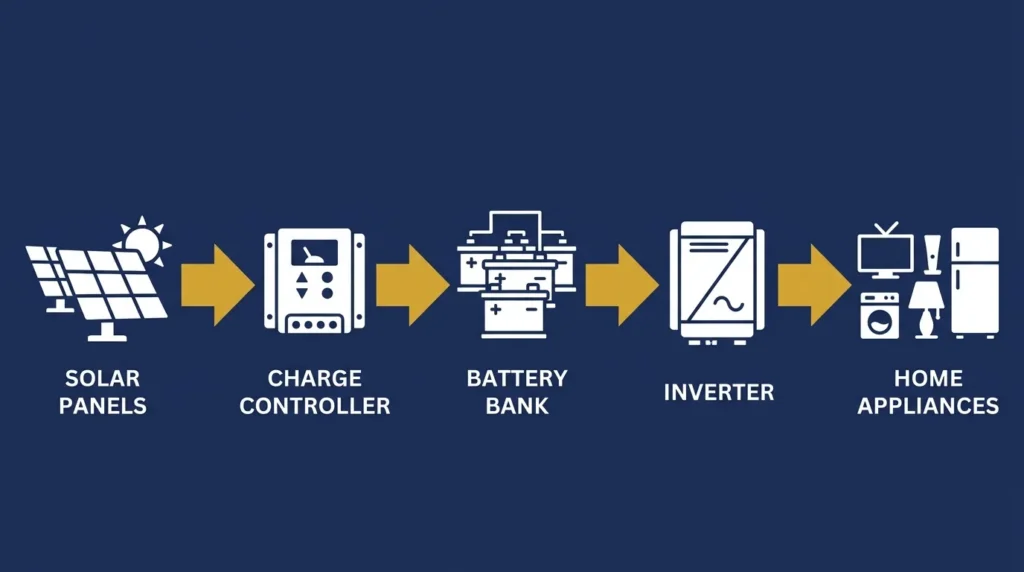
The process follows a simple and reliable flow once you understand it. During daylight hours, your solar panels absorb sunlight and convert it into direct current electricity — DC power. This electricity flows first into a charge controller, which regulates the voltage and current to protect your batteries from overcharging. From the charge controller, electricity enters your battery bank, where it is stored as chemical energy for use later.
When you switch on a light, run a fan, or power your refrigerator, stored energy flows from the batteries into an inverter. The inverter’s job is to convert the DC electricity in your batteries into alternating current — AC power — which is exactly what your home appliances are built to use. From the inverter, electricity reaches your home the same way it would from a regular grid connection.
At night, or during overcast days, your system runs entirely on the energy stored in the batteries from the previous period of sunlight. This is why battery sizing is the most important calculation in any off-grid solar system — get it wrong and you run out of power. Get it right and your home runs smoothly around the clock, completely independent of any utility.
The four core components of an off-grid solar system
Every off-grid solar system, whether powering a small cabin or a full family home, is built from the same four fundamental components. Understanding each one helps you make informed decisions when buying or commissioning your system.
Solar panels
Solar panels are the energy source of your off-grid solar system. They capture sunlight and convert it into DC electricity through the photovoltaic effect. In 2026, monocrystalline panels are the most widely recommended for off-grid applications because of their higher efficiency — typically 20 to 23 percent — meaning they generate more power from the same surface area. The number of panels your system needs depends directly on your daily electricity consumption and the peak sun hours your location receives. According to Global Solar Atlas data, Pakistan, most of India, Saudi Arabia, and much of Sub-Saharan Africa sit in the world’s highest solar irradiance zones — making off-grid solar particularly productive in these regions.
Charge controller
The charge controller is the brain of your off-grid solar system. It sits between the solar panels and the battery bank and regulates the flow of electricity into the batteries. Without a charge controller, your panels would push unregulated current directly into the batteries, causing overcharging, heat buildup, and permanent damage within weeks. There are two types: PWM (Pulse Width Modulation) and MPPT (Maximum Power Point Tracking). MPPT controllers are 15 to 30 percent more efficient and are the right choice for any serious off-grid solar installation in 2026.
Battery bank
The battery bank is the heart of any off-grid solar system. It stores the electricity your panels generate during daylight hours so you can use it at night or during overcast days. The size of your battery bank determines your system’s autonomy — how many days you can run without direct sunlight before running low on power.
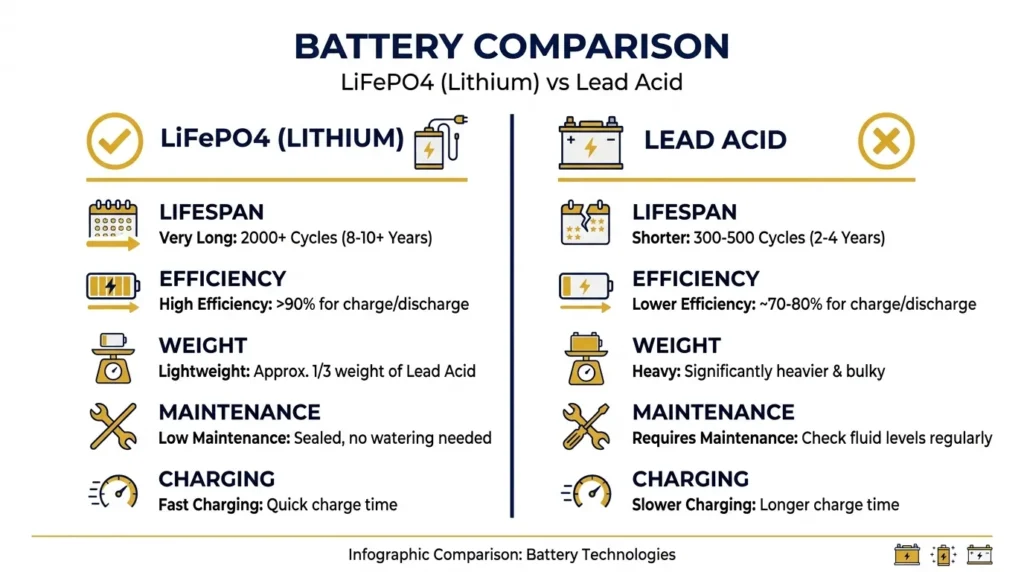
In 2026, Lithium Iron Phosphate batteries — commonly called LiFePO4 — have become the clear standard for off-grid solar applications. They offer a usable depth of discharge of 80 to 100 percent, compared to just 50 percent for lead-acid batteries, which means you get nearly double the usable storage from the same rated capacity. They also last three to five times longer — typically 3,000 to 5,000 charge cycles versus 500 to 1,000 for lead-acid — and require zero maintenance. The higher upfront cost of LiFePO4 batteries is consistently offset by their dramatically longer lifespan. For any permanent off-grid solar installation powering a home, LiFePO4 is the only battery technology worth serious consideration.
Inverter
The inverter converts the DC electricity stored in your batteries into the AC electricity your home appliances require. For an off-grid solar system, a pure sine wave inverter is essential. Pure sine wave inverters produce clean, stable power that is safe for all electronics — computers, televisions, medical equipment, and sensitive appliances. Modified sine wave inverters cost less but can damage sensitive electronics over time and are not recommended for any permanent residential off-grid installation. Your inverter must be sized to handle the peak combined load of all appliances that might run simultaneously in your home.
How to size an off-grid solar system correctly
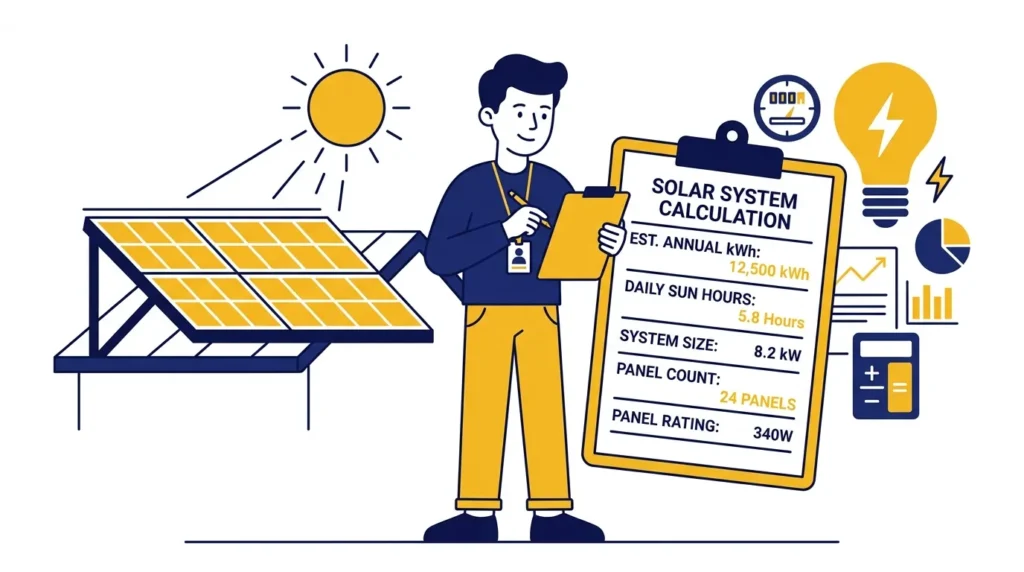
Getting the size right is the most important step in designing your off-grid solar system. An undersized system leaves you without power when you need it. An oversized system wastes money you did not need to spend. The process follows four straightforward steps that any homeowner can work through — or you can let our calculator handle it instantly.
Step 1 — calculate your daily energy consumption
List every appliance in your home that will run on your off-grid solar system. For each one, note its wattage and the average number of hours per day you use it. Multiply watts by hours to get watt-hours per day for that appliance, then add them all together. Divide the total by 1,000 to convert to kilowatt-hours — this is your daily energy demand. As a reference point, a 150W refrigerator running 24 hours uses 3.6 kWh, two ceiling fans running 12 hours use 1.8 kWh, and a television running 4 hours uses around 0.32 kWh. A typical Pakistani household with basic appliances and no air conditioning falls between 5 and 10 kWh per day. Our free solar system size calculator lets you add individual appliances one by one and calculates your total automatically.
Step 2 — account for system losses
No off-grid solar system converts every watt of sunlight into usable electricity at the appliance. Real-world losses from wiring resistance, battery charging inefficiency, inverter conversion, and temperature effects typically reduce system output by 20 to 25 percent. Divide your daily energy demand by 0.80 to get your actual daily solar generation target. According to NREL research, this derating factor is the most commonly underestimated element in off-grid solar sizing, and undersizing is the leading cause of off-grid system failures.
Step 3 — calculate your solar array size
Divide your daily generation target by the average peak sun hours in your location. This gives you the solar array size in kilowatts your off-grid solar system needs. For a home needing 7.15 kWh per day in a location with 5 peak sun hours, the calculation is 7.15 ÷ 5 = 1.43 kW of solar panels — roughly four 400W panels. In Pakistan and the Middle East where peak sun hours average 6 to 7, the same daily demand requires fewer panels, which is one of the key reasons off-grid solar delivers such strong value in these regions.
Step 4 — size your battery bank
Your battery bank needs to store enough energy to power your home overnight and through any cloudy days. A safe starting point is 1.5 to 2 days of autonomy. For a home needing 7.15 kWh per day, with a 48V system using LiFePO4 batteries at 90 percent depth of discharge and 2 days autonomy, the calculation gives approximately 330 Ah of battery capacity — practically four 100Ah lithium batteries in a 48V configuration. These four steps look complex on paper but take under a minute using our free solar system size calculator, which handles all calculations automatically for on-grid, hybrid, and off-grid solar systems alike.
What does an off-grid solar system cost in 2026?
Off-grid solar system costs vary significantly by country, system size, and component quality. Based on current market data from IRENA and regional solar industry sources, here is what you can realistically expect in 2026.
In Pakistan, a properly sized off-grid solar system for a medium household consuming 10 to 15 kWh per day — covering fans, lighting, a refrigerator, and occasional air conditioning — typically costs between PKR 700,000 and PKR 1,400,000, depending on battery type and panel brand. Systems using LiFePO4 batteries cost more upfront but deliver significantly better long-term value. In India, equivalent systems range from ₹3.5 lakh to ₹7 lakh. In the USA, off-grid solar is substantially more expensive due to higher labour costs — a comparable system runs $20,000 to $40,000 for a full home setup.
The most expensive component in any off-grid solar system is always the battery bank, which typically accounts for 40 to 50 percent of total system cost. This is why correct battery sizing matters so much financially — oversizing your battery bank wastes money, while undersizing it means unreliable power. The solar panel payback period for an off-grid system is typically longer than for on-grid systems due to the higher battery cost, but when compared to diesel generators or expensive grid extension, off-grid solar almost always wins. Read our full breakdown of solar panel payback periods by country to see how the numbers compare.
Is an off-grid solar system right for you?
An off-grid solar system is the right choice in specific situations. If your property has no grid connection and connecting to the grid would cost more than a solar installation, off-grid solar is almost certainly the better financial decision. If you live in an area where the grid exists but load-shedding makes it unreliable for more than 6 to 8 hours per day, an off-grid solar system delivers reliable power that even a hybrid system cannot fully match during extended outages. And if complete energy independence is your goal — paying nothing to a utility company for the next 25 years — an off-grid solar system is the only way to achieve it completely.
It is not the right choice for everyone. If your grid is reliable and your electricity bill is your primary concern, a hybrid or on-grid system typically offers a faster payback at lower upfront cost. The right choice depends entirely on your location, usage, and priorities. Our free solar system size calculator compares all three system types — on-grid, hybrid, and off-grid — with personalised cost and savings estimates based on your actual usage. It takes under 60 seconds and requires no technical knowledge.
Frequently asked questions
How many solar panels does an off-grid solar system need?
The number depends on your daily electricity consumption and the peak sun hours in your location. A small home using 5 kWh per day in a region with 5 peak sun hours needs a 1.25 kW system — roughly three to four 400W panels. A larger home using 15 kWh per day needs 3.75 kW or more — around ten to twelve panels. Our free calculator gives you a precise number in under 60 seconds.
What is the best battery for an off-grid solar system in 2026?
Lithium Iron Phosphate batteries — LiFePO4 — are the clear best choice for any permanent off-grid solar system in 2026. They last 10 to 15 years under normal use, provide 80 to 100 percent usable capacity, require zero maintenance, and perform reliably in high-temperature environments across South Asia and the Middle East. Lead-acid batteries cost less upfront but need replacement every 3 to 5 years, making them more expensive over the full lifetime of the system.
Can an off-grid solar system power an air conditioner?
Yes, but air conditioners are among the highest-consuming appliances in any home. A 1-ton AC unit running 8 hours per day adds approximately 8 kWh to your daily demand — roughly the equivalent of all other appliances in an average household combined. Powering an AC with an off-grid solar system is absolutely achievable but requires a significantly larger panel array and battery bank. Correct sizing before purchasing is essential.
How long does an off-grid solar system last?
A properly designed and maintained off-grid solar system lasts 20 to 30 years. Solar panels typically carry 25-year performance warranties. LiFePO4 batteries last 10 to 15 years before needing replacement. Charge controllers and inverters generally last 10 to 15 years. This long lifespan is one of the most compelling reasons off-grid solar delivers such strong long-term financial return.
Do I need a backup generator with an off-grid solar system?
Many off-grid solar system owners keep a small backup generator for extended cloudy periods or unexpectedly high consumption events. It is not mandatory, but for critical applications — medical equipment, refrigeration, or business operations — a generator as emergency backup provides peace of mind. Most systems sized with 1.5 to 2 days of battery autonomy handle normal cloudy weather without any generator use at all.