- Solar Savings & ROI
Solar Panel Payback Period in 2026: Real Numbers by Country
The solar panel payback period is the single most important number before going solar — and in 2026, it varies dramatically depending on where you live, how much electricity you use, and what system you choose.
You have decided to go solar. The system looks great on paper — lower electricity bills, cleaner energy, and long-term savings. But one question always comes next: how long will it actually take for your solar panels to pay for themselves?
Understanding your solar panel payback period before signing any contract is the smartest financial move you can make. This guide answers the most searched questions — how long do solar panels take to pay off, what is a realistic solar ROI, and is solar worth it in 2026 — all with real numbers, a step-by-step formula, and country-by-country data.
Use our free solar system size calculator to estimate your payback period instantly
What Is the Solar Panel Payback Period?
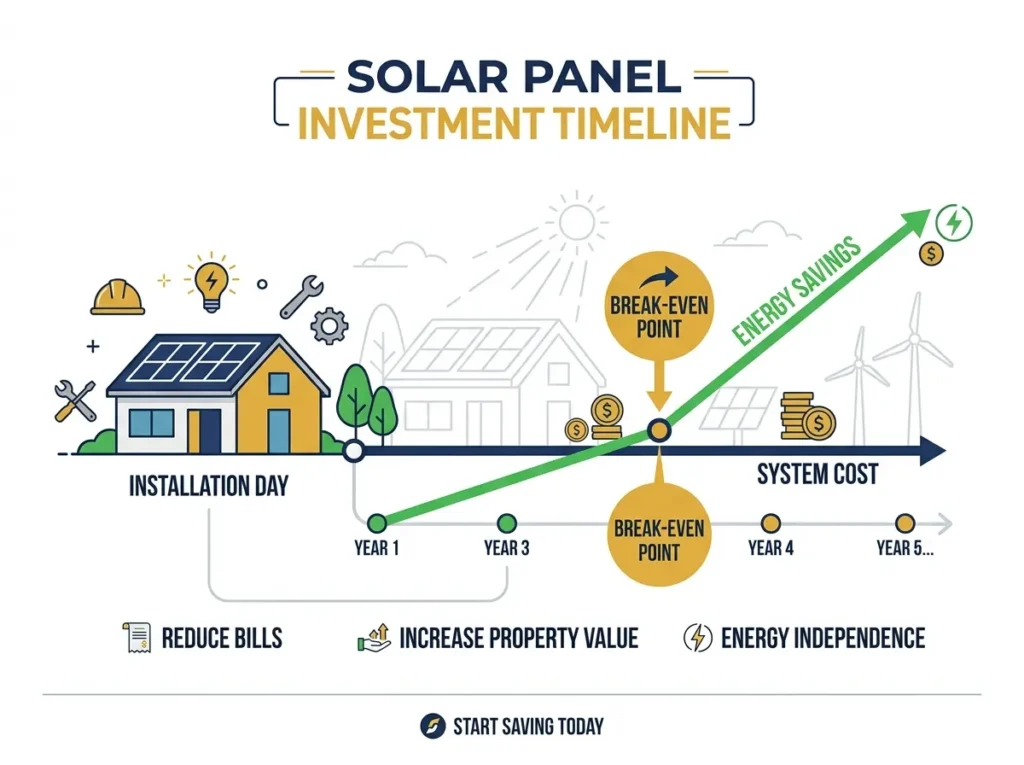
The solar panel payback period is the number of years it takes for the money you save on electricity bills to equal the upfront cost of your solar system.
After that point, every unit of electricity your panels produce is essentially free. Since most solar panels carry a 25-year warranty and last 30 years or more, even a system with a 7-year payback period gives you roughly 18 to 23 years of nearly free electricity.
The formula is straightforward:
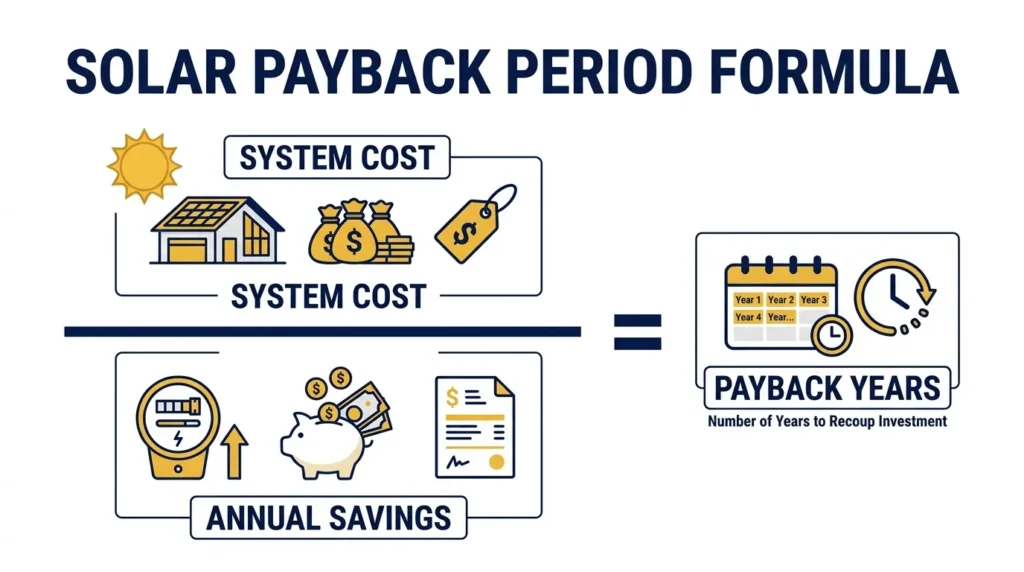
Payback Period = Total System Cost ÷ Annual Electricity Savings
For example: a $10,000 system saving you $1,500 per year in electricity costs has a payback period of 6.7 years.
What Is the Average Solar Panel Payback Period in 2026?
According to data from the National Renewable Energy Laboratory (NREL) and industry tracking platforms, the global average solar panel payback period in 2026 sits between 6 and 10 years for residential installations. However, this average hides enormous variation.
For high-sunshine, high-electricity-cost regions like South Asia and the Middle East, the solar panel payback period can be as short as 3 to 5 years — delivering an outstanding solar investment return. For countries with lower electricity rates or less sunlight, like parts of Northern Europe, the payback period stretches to 10 to 14 years.
Solar investment return varies enormously by country. The solar panel payback period in Pakistan and India is dramatically shorter than in Europe or North America — primarily because of higher electricity tariffs, more daily sunlight, and lower installation costs. Knowing your realistic solar ROI before purchasing helps you avoid oversized systems and overpriced quotes.
The key insight: the average does not matter. Your personal solar panel payback period depends entirely on your specific situation — which is exactly why country-by-country data below matters more than any global average.
Solar Payback Period by Country in 2026
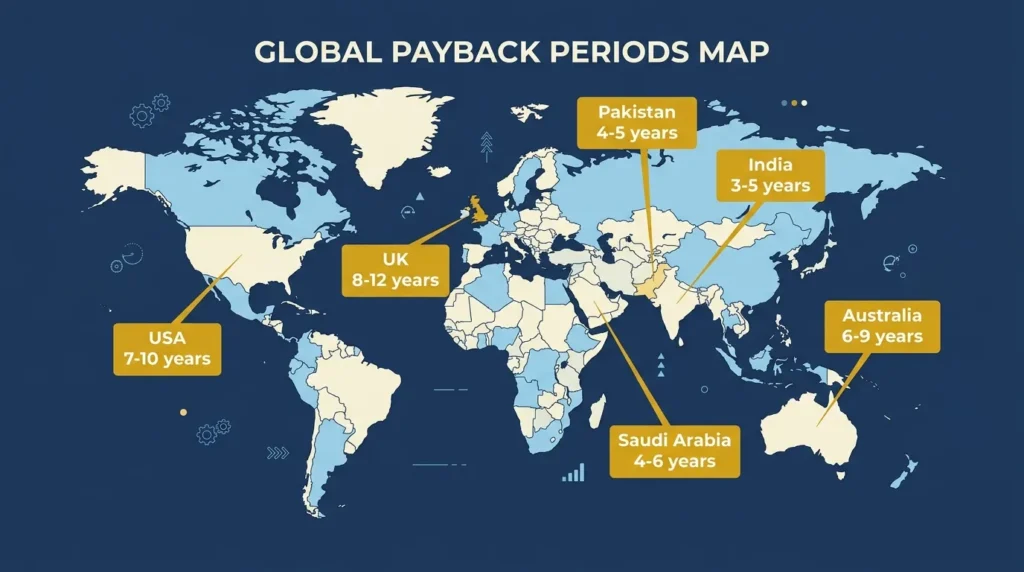
Here is a country-by-country breakdown based on current electricity tariffs, average sun hours, and typical system costs reported by BloombergNEF and regional solar industry data:
Country
Avg. Annual Savings
Avg. System Cost
Payback Period
Pakistan
PKR 700,000–1,200,000
PKR180,000–280,000
4–6 years
India
₹2.5–4.5 lakh
₹60,000–1.2 lakh
3–5 years
Saudi Arabia
SAR 25,000–50,000
SAR 5,000–10,000
4–6 years
UAE
AED 30,000–55,000
AED 6,000–11,000
5–7 years
Australia
AUD 8,000–14,000
AUD 1,200–2,000
6–9 years
USA
$15,000–28,000
$1,500–3,000
7–10 years
Germany
€10,000–18,000
€1,200–2,000
8–11 years
UK
£8,000–14,000
£900–1,400
8–12 years
The solar panel payback period data above shows a clear pattern — countries with higher electricity rates and more sunlight consistently deliver better solar investment return. If your country is not listed, use our free calculator to estimate your personal solar panel payback period based on your actual usage and location.
Why do Pakistan and India have such short payback periods?
Three reasons:
First, both countries have excellent solar irradiation — Pakistan averages 5 to 6 peak sun hours daily and India averages 5 to 5.5 hours, meaning panels produce more electricity per day.
Second, electricity tariffs have been rising sharply in both countries, so every unit your solar system produces saves more money.
Third, installed system costs are significantly lower than in the US or Europe due to local labour costs and competitive panel markets.
How to Calculate Your Personal Solar Payback Period
Here is the step-by-step method solar professionals actually use:
Step 1: Get Your Total System Cost
In 2026, global solar module prices range from $0.18 to $0.25 per watt according to BloombergNEF. However, the full installed system cost — including inverter, mounting, wiring, and labour — is higher.
- Pakistan/India/Middle East: approximately $0.50–$0.80 per watt installed
- USA: approximately $2.50–$3.50 per watt installed (NREL 2026 benchmark data)
- Europe: approximately $1.50–$2.50 per watt installed
A 5 kW system in Pakistan therefore costs roughly $2,500–$4,000. The same system in the USA costs $12,500–$17,500.
Step 2: Subtract Any Incentives or Subsidies
Many governments reduce your net cost substantially:
- India’s PM Surya Ghar scheme covers up to 60% of the cost for systems up to 2 kW
- Gulf states increasingly offer net metering programmes
- European countries offer various rebates and green energy grants
Always check your local incentives at IRENA’s renewable energy database before calculating.
Step 3: Calculate Your Annual Savings
Your annual savings = (Annual kWh your system produces) × (Your electricity rate per kWh)
To find your annual production, use this formula:
Annual kWh = System Size (kW) × Peak Sun Hours × 365 × 0.80
The 0.80 accounts for real-world system losses. Our free solar size calculator does this automatically for your location and system type.
Step 4: Divide
Payback Period = Net System Cost ÷ Annual Savings
Example — Karachi homeowner:
- 5 kW system, fully installed: PKR 850,000
- Annual system production: 5 × 6 × 365 × 0.80 = 8,760 kWh
- Electricity rate: PKR 50/unit
- Annual savings: 8,760 × 50 = PKR 438,000
- Payback period: 850,000 ÷ 438,000 = 1.94 years
Note: This is an aggressive best-case example. A more conservative estimate using partial self-consumption and grid-export limitations puts real payback for most Pakistani homeowners at 4–6 years.
Calculating your solar panel payback period manually takes time. If you want an instant answer, our free solar system size calculator does all of this automatically — just enter your monthly usage and location.
5 Factors That Affect Your Solar Payback Period
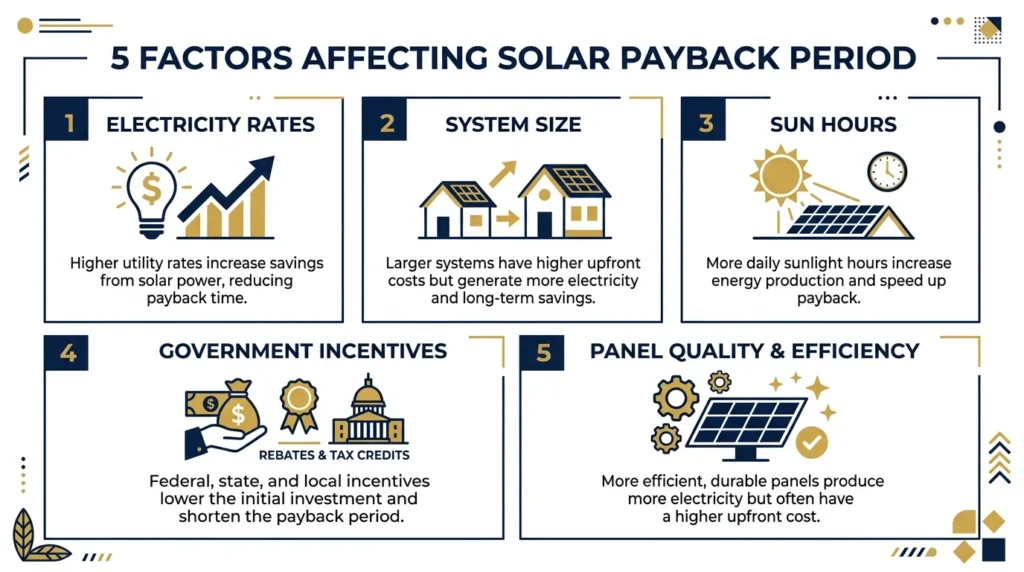
1. Your Electricity Rate
This is the single most powerful variable. If you pay $0.30/kWh (like Massachusetts), your solar savings per unit are three times higher than someone paying $0.10/kWh. High electricity rates dramatically accelerate payback. In New Jersey in 2026, where residential rates average 17–19 cents per kWh — about 35% above the national average — solar payback runs 7 to 9 years, one of the best results in the Northeast.
2. Peak Sun Hours in Your Location
More sunshine means more electricity generated from the same system. Pakistan and the Middle East, with 6 to 7 peak sun hours daily, generate far more power per panel than the UK at 2.5 to 3.5 hours.
3. System Size and Quality
Oversizing your system beyond your actual consumption slows payback — excess electricity you cannot use or export is wasted. Undersizing means you still pay for grid electricity. Getting the size right is critical, which is exactly what our solar system size calculator is designed to help with.
In 2026, higher-efficiency panels may cost more per watt but they reduce balance-of-system costs like mounting and wiring. For homes with limited roof space, efficiency matters more than raw price.
4. Government Incentives and Net Metering Policy
In India, most residential rooftop systems have a payback period of 3 to 5 years, and for commercial installations where electricity tariffs are higher, payback can be as fast as 2.5 to 3 years. This is largely due to government subsidies that cover a significant portion of upfront costs.
In the USA, the federal 30% Investment Tax Credit expired at the end of 2025, which has meaningfully extended payback periods for new installations in 2026.
5. Financing Method
A cash purchase gives you the cleanest payback calculation. A solar loan adds interest costs that extend your effective payback. Leasing or PPA arrangements eliminate upfront cost but typically offer smaller long-term savings since you do not own the system.
Each of these five factors directly shapes your solar panel payback period. The good news is that most of them are within your control — right-sizing your system, choosing the correct financing, and claiming all available incentives can cut years off your solar investment return timeline.
On-Grid vs Hybrid vs Off-Grid: How System Type Affects Payback
The type of solar system you choose significantly impacts your payback period:
On-Grid systems have the shortest payback because they are the cheapest to install — no battery required. However, you depend on the grid for backup.
Hybrid systems cost more upfront due to battery storage but protect you from outages. In areas with frequent load-shedding like Pakistan and India, the value of uninterrupted power supply makes the additional cost justified for most homeowners. Payback is typically 1 to 2 years longer than on-grid.
Off-Grid systems carry the highest upfront cost due to larger battery banks, but for areas with no reliable grid access, they replace the need for expensive diesel generators — often resulting in surprisingly good ROI.
Our solar system size calculator handles all three system types and adjusts the cost and payback estimate accordingly.
Is Solar Still Worth It in 2026?
For most regions, yes — and in many cases more than ever.
The short answer to “is solar worth it in 2026” — yes, for the vast majority of homeowners and businesses worldwide. The solar panel payback period has never been more predictable, panel efficiency has never been higher, and electricity tariffs continue rising globally, which means your solar ROI improves every year you own your system. How long do solar panels take to pay off? In the best markets, under 5 years. Even in slower markets like the UK or Germany, 8 to 11 years on a 25-year panel is still an outstanding solar investment return.
While solar panel costs are experiencing some upward pressure in 2026 due to policy shifts and rising material costs, investing in solar still delivers compelling long-term financial benefits. According to current solar cost calculators, homeowners may save tens of thousands of dollars in electricity expenses over a 25-year system lifetime.
Here is a simple way to think about it: a system with a 6-year payback period on a 25-year panel with a 30-year lifespan gives you 19 to 24 years of electricity at zero marginal cost. The internal rate of return on that investment is typically 10% to 20% per year — better than most savings accounts or bonds.
For Pakistan, India, the Middle East, and Sub-Saharan Africa, the case is even stronger. Rising grid tariffs, excellent sunlight, and falling hardware costs combine to make solar one of the best financial decisions a homeowner or business can make in 2026.
How to Check If Your Solar System Is on Track
Once your system is installed, monitor it monthly. A well-performing system should generate within 10% of the production estimate your installer provided. Tools like the Global Solar Atlas can help you verify expected output for your specific location.
Signs your system may be underperforming:
- Output consistently 20% or more below estimate
- No change after cleaning dusty panels
- Inverter error codes
Underperformance extends your payback period, so catching it early matters.
Calculate Your Exact Payback Period For Free
Every household and business is different. The country averages above give you a useful range, but your actual payback depends on your specific electricity usage, your roof, your location, and your system type.
Our free solar system size calculator at SolarSizeCalc.com gives you a personalised estimate in under 60 seconds — including panels needed, system size, estimated cost, monthly savings, and payback period. No signup, no engineer required.
Frequently Asked Questions
How long does it take for solar panels to pay for themselves? Globally, most residential solar systems pay for themselves in 4 to 12 years depending on location, electricity rates, and system cost. High-sunshine regions like Pakistan and India typically see payback in 4 to 6 years, while the USA and Europe range from 7 to 12 years.
What is a good solar payback period? Under 7 years is generally considered an excellent solar panel payback period. 7 to 10 years delivers strong solar ROI over a 25-year panel life. Over 12 years warrants evaluation — but even then, solar investment return beats most savings accounts when electricity rates keep rising.
Does solar increase home value? Yes. Studies consistently show solar installations add 3% to 5% to property values. A well-sized system in a high-electricity-cost market can add more than its installation cost to resale value.
What happens after the payback period? Your system continues producing electricity for free for the remaining panel life — typically 18 to 25 more years. This is the period where solar delivers its highest financial return.
Can I speed up my payback period? Yes. Use more electricity during daylight hours (run heavy appliances like dishwashers and washing machines during the day), ensure your system is properly sized, clean your panels regularly, and claim every available government incentive.
Is solar worth it in 2026 with rising panel prices? Yes. While some upward price pressure exists in 2026, the solar panel payback period is still shorter than it was five years ago in most markets. Rising electricity rates offset any increase in system costs — meaning your solar investment return remains compelling. How long do solar panels take to pay off in 2026? Between 4 and 12 years depending on your location, with sunny regions seeing the fastest solar ROI.
The solar panel payback period is not just a number — it is your roadmap to energy independence. Whether your solar ROI arrives in 4 years or 10, the electricity you generate after that point is essentially free for the remaining life of your panels.
Results are estimates only. Always consult a certified solar installer before purchasing. Data sources: BloombergNEF, NREL, IEA, IRENA, EnergySage.